
Others
Begineer Friendly
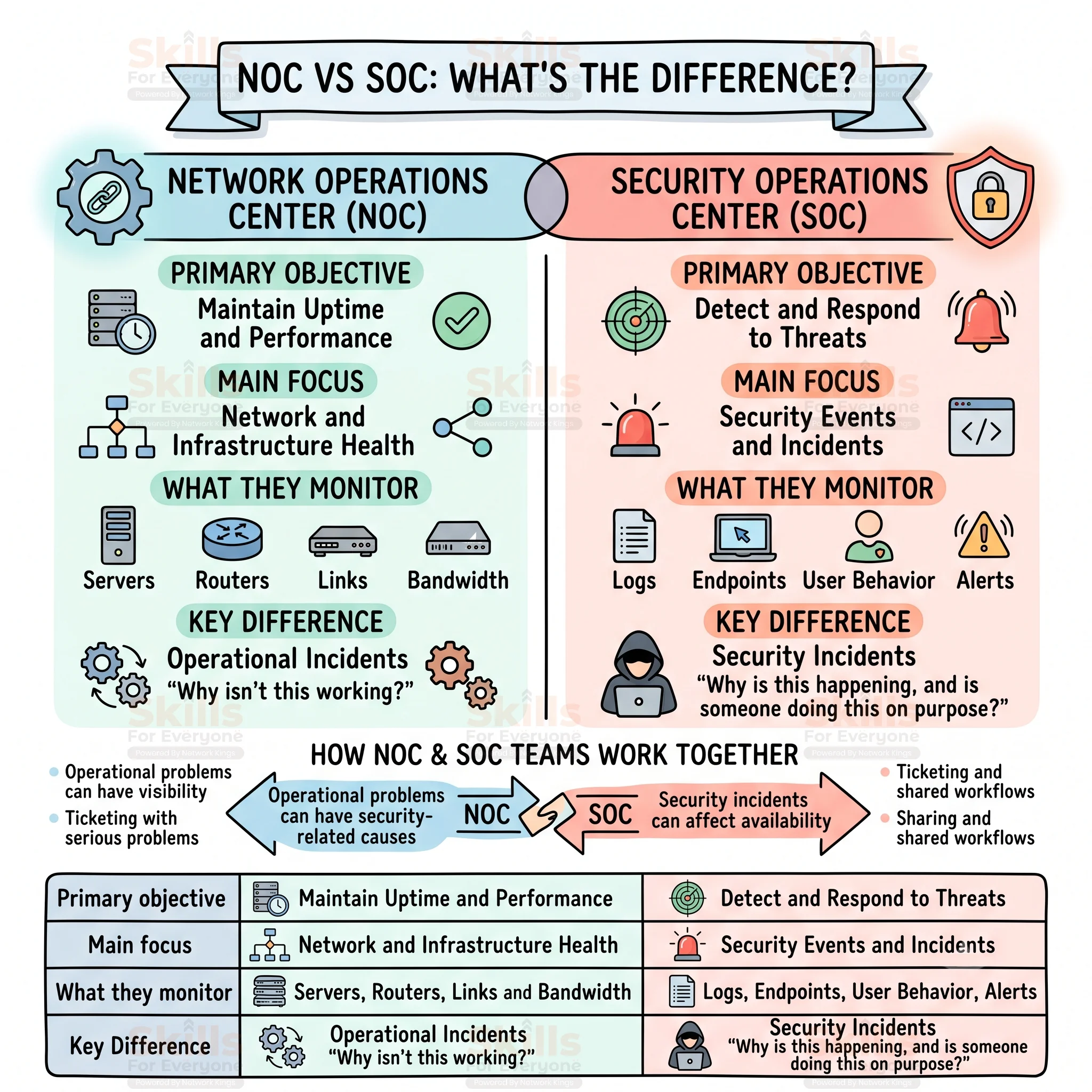
NOC vs SOC comes down to a simple distinction: a NOC keeps IT services running, while a SOC keeps IT environments secure. A Network Operations Center (NOC) focuses on network availability, infrastructure health, performance, and operational troubleshooting. A Security Operations Center (SOC) focuses on security monitoring, threat detection, investigation, and incident response.
The two teams may monitor some of the same systems, but they approach them from different perspectives. A NOC engineer might investigate why a network link is down or why users are experiencing high latency. A SOC analyst might investigate whether unusual traffic, a suspicious login, or malware activity indicates a security incident. In larger organizations, NOC and SOC teams often work together because a security incident can affect availability, and an operational problem can sometimes have a security-related cause.
What is a NOC
A Network Operations Center is a centralized team responsible for monitoring and maintaining an organization's IT infrastructure. This includes servers, routers, switches, firewalls, cloud environments, and network links. The NOC's job is operational continuity. When a server goes down, a link becomes saturated, or an application starts responding slowly, the NOC is typically the first to notice and the first to respond.
NOC engineers rely heavily on network monitoring platforms, SNMP polling, syslog data, and dashboards that track uptime, bandwidth, latency, and device health. Their world revolves around performance and availability rather than intent. If a router interface flaps or a data center link drops, that's a NOC problem, not necessarily a security one.
What is a SOC
A Security Operations Center exists to detect, investigate, and respond to security threats. Where a NOC watches for things breaking, a SOC watches for things being attacked or misused. SOC analysts monitor for suspicious logins, malware activity, unusual outbound connections, and policy violations that could indicate a breach in progress.
The core tool here is typically a SIEM platform, which aggregates logs from firewalls, endpoints, servers, and applications so analysts can correlate events and spot patterns that a single log source would never reveal on its own. SOC teams also lean on endpoint detection and response (EDR) tools, intrusion detection and prevention systems (IDS/IPS), and vulnerability management platforms to understand where an organization is exposed before an attacker finds it.
So is NOC part of cybersecurity? Not directly. A NOC focuses on availability and performance, not threat detection, though the two functions frequently intersect around shared infrastructure.
Key Difference Between NOC and SOC
The clearest way to separate the two is by intent. A NOC deals with operational incidents, things like outages, degraded performance, and hardware failures. A SOC deals with security incidents, things like intrusions, data exfiltration attempts, and malware infections.
Put another way, NOC engineers ask "why isn't this working," while SOC analysts ask "why is this happening, and is someone doing this on purpose." A slow application might be a NOC issue caused by a misconfigured router, or it could be a SOC issue caused by a denial of service attack. Sorting out which one it is often takes both teams working together.
NOC vs SOC Comparison Table
Dimension | NOC | SOC |
Primary objective | Maintain uptime and performance | Detect and respond to threats |
Main focus | Network and infrastructure health | Security events and incidents |
What they monitor | Servers, routers, links, bandwidth | Logs, endpoints, user behavior, alerts |
Typical incidents | Outages, latency, hardware failure | Intrusions, malware, unauthorized access |
Key responsibilities | Troubleshooting, maintenance, capacity planning | Threat detection, investigation, incident response |
Common technologies | SNMP, network monitoring tools, syslog | SIEM, EDR, IDS/IPS, vulnerability management |
Common job roles | NOC engineer, network technician | SOC analyst, threat hunter |
Main success metrics | Uptime, mean time to repair | Mean time to detect, mean time to respond |
Escalation approach | Escalates to network or systems engineering | Escalates to incident response or security leadership |
What Does a NOC Monitor
NOC monitoring is primarily concerned with availability, performance, and operational health.
A NOC might monitor whether a router is reachable, whether an interface is overloaded, whether a server is responding, or whether latency has increased between two locations.
Network monitoring platforms can collect information through technologies such as SNMP, syslog, flow data, telemetry, and infrastructure monitoring systems. The NOC uses these alerts and metrics to determine whether a problem is isolated or affecting a wider service.
Consider a simple example. If users report that an application is slow, the NOC may investigate network latency, packet loss, bandwidth utilization, server availability, or connectivity between application components.
What Does a SOC Monitor
SOC monitoring focuses on security events, suspicious behavior, and potential indicators of compromise.
A SOC may collect data from endpoints, firewalls, identity systems, cloud platforms, applications, and network devices. A SIEM can centralize and correlate security events, while EDR provides visibility into endpoint activity.
For example, imagine a server suddenly begins generating unusually high outbound traffic. The NOC may investigate whether the traffic is affecting network performance or connectivity. The SOC may investigate whether the traffic is associated with malware, command-and-control communication, or potential data exfiltration.
This is where the difference between network troubleshooting and threat detection becomes especially clear.
NOC and SOC Tools
The technologies used by each team reflect their different responsibilities, although some tools are shared.
NOCs commonly use:
Network monitoring and management platforms
SNMP and network telemetry
Syslog
Performance monitoring systems
Ticketing and IT service management platforms
Configuration and network automation tools
SOCs commonly use:
SIEM platforms
EDR and endpoint security tools
IDS and IPS
Firewalls and security gateways
Vulnerability management platforms
Threat intelligence systems
Security orchestration and response tools
A firewall is a good example of overlapping responsibilities. The NOC may monitor its availability and connectivity functions, while the SOC may analyze blocked connections, suspicious traffic patterns, and security events generated by the device.
NOC Engineer vs SOC Analyst
The roles require different technical priorities, although both benefit from strong networking fundamentals.
A NOC engineer typically works with TCP/IP, routing, switching, DNS, DHCP, VPNs, network monitoring, and troubleshooting. Their work often involves identifying the root cause of infrastructure and connectivity problems.
A SOC analyst typically works with SIEM platforms, security events, endpoint activity, authentication, vulnerabilities, network attacks, and incident response. Their job is to investigate alerts and determine whether activity represents a genuine security incident.
There is useful overlap between the roles. Networking knowledge helps SOC analysts understand attacks and suspicious traffic, while security awareness helps NOC engineers recognize activity that may need to be escalated to the SOC.
Is a NOC Part of Cybersecurity
A NOC is not primarily a cybersecurity function. Its main responsibility is maintaining network and infrastructure availability and performance.
However, NOC teams can contribute to security operations. They manage network infrastructure, have visibility into operational events, and may encounter unusual behavior while troubleshooting. If an operational event appears suspicious, the NOC can provide relevant logs or network information and escalate the issue to the SOC.
This makes coordination between the two teams important without making their responsibilities identical.
How NOC and SOC Teams Work Together
In practice, these teams don't operate in isolation. A NOC engineer investigating a spike in traffic might notice patterns that look less like a hardware fault and more like a coordinated attack, and hand it off to the SOC. Similarly, a SOC analyst responding to a compromised server may need the NOC to isolate that device from the network or restore service once the threat is contained.
Ticketing systems and shared escalation workflows are usually what tie the two together. A well-run organization defines clear handoff points, such as when an anomaly stops being a performance issue and becomes a security concern, so incidents don't fall through the cracks between teams.
Roles and Skills Required
A NOC engineer typically needs strong networking fundamentals, familiarity with routing and switching, and comfort working inside monitoring dashboards under time pressure. Troubleshooting skill matters more than deep security knowledge.
A SOC analyst needs a different mindset. They need to understand attacker behavior, read logs critically, and recognize when something that looks normal is actually malicious. Strong SOC analysts are naturally curious and comfortable investigating ambiguous signals rather than clear-cut failures.
When an Organization Needs a NOC, SOC, or Both
Smaller organizations sometimes combine these functions into a single team or outsource them to a managed provider, while larger enterprises usually run them separately with dedicated staff and tooling. There's no single correct structure, and how a company splits these responsibilities often depends on its size, industry, and risk profile.
That said, most organizations with meaningful digital infrastructure eventually need both functions in some form, because keeping systems running and keeping them secure are two different jobs that require different instincts, tools, and priorities.
Conclusion
NOC and SOC teams solve different problems using different tools, but they share the same underlying goal of keeping an organization's technology reliable and trustworthy. Understanding where their responsibilities separate, and where they intentionally overlap, is what allows IT and security operations to function as a coordinated system rather than two disconnected departments.
Frequently Asked Questions (FAQs)
1. Can a NOC and SOC monitor the same network traffic?
Yes. Both teams may have visibility into the same network traffic, but they analyze it for different purposes. A NOC may examine bandwidth utilization, latency, packet loss, and application performance, while a SOC looks for suspicious connections, command-and-control traffic, data exfiltration, or other indicators of compromise.
2. How does a SOC use SIEM data differently from a NOC?
A NOC generally uses monitoring data to identify infrastructure failures and performance issues. A SOC uses SIEM data to correlate events from multiple sources, such as identity systems, endpoints, firewalls, and servers, to identify potentially malicious patterns. For example, several failed logins followed by a successful login from an unusual location may trigger a security investigation.
3. Can a network outage actually be a cybersecurity incident?
Yes. A network outage can have a security-related cause, such as a denial-of-service attack, compromised network device, ransomware activity, or deliberate disruption. The NOC may initially investigate the availability problem, while the SOC examines whether malicious activity caused or contributed to the outage.
4. What happens when a NOC detects suspicious network behavior?
The NOC typically investigates the operational impact first and gathers relevant technical information. If the behavior appears potentially malicious, it can escalate the event to the SOC according to the organization's incident-handling process. The SOC can then investigate logs, endpoint activity, authentication events, and other security telemetry.
5. How do NOC and SOC teams coordinate during a security incident?
Coordination usually happens through ticketing systems, escalation procedures, communication channels, and predefined incident-response playbooks. For example, the SOC may identify a compromised server and request network isolation, while the NOC performs or supports the required connectivity changes and helps restore normal service after containment.
6. Which networking skills are useful for a SOC analyst?
Strong knowledge of TCP/IP, DNS, HTTP/HTTPS, routing, VPNs, firewalls, NAT, and common network protocols can significantly improve security investigations. These skills help analysts understand whether unusual connections or traffic patterns are normal application behavior or potential indicators of compromise.
7. What is the difference between NOC monitoring and SOC threat detection?
NOC monitoring primarily answers whether infrastructure and services are available and performing as expected. SOC threat detection focuses on whether activity could represent a security threat. The same event, such as a sudden increase in outbound traffic, can therefore generate a performance investigation in the NOC and a security investigation in the SOC.
8. Can one team perform both NOC and SOC functions?
Yes. Smaller organizations may combine operational and security monitoring responsibilities within one team or use a managed service provider. However, the workflows, expertise, monitoring objectives, and escalation processes remain different even when the same people perform both functions.