Cloud Security
Begineer Friendly


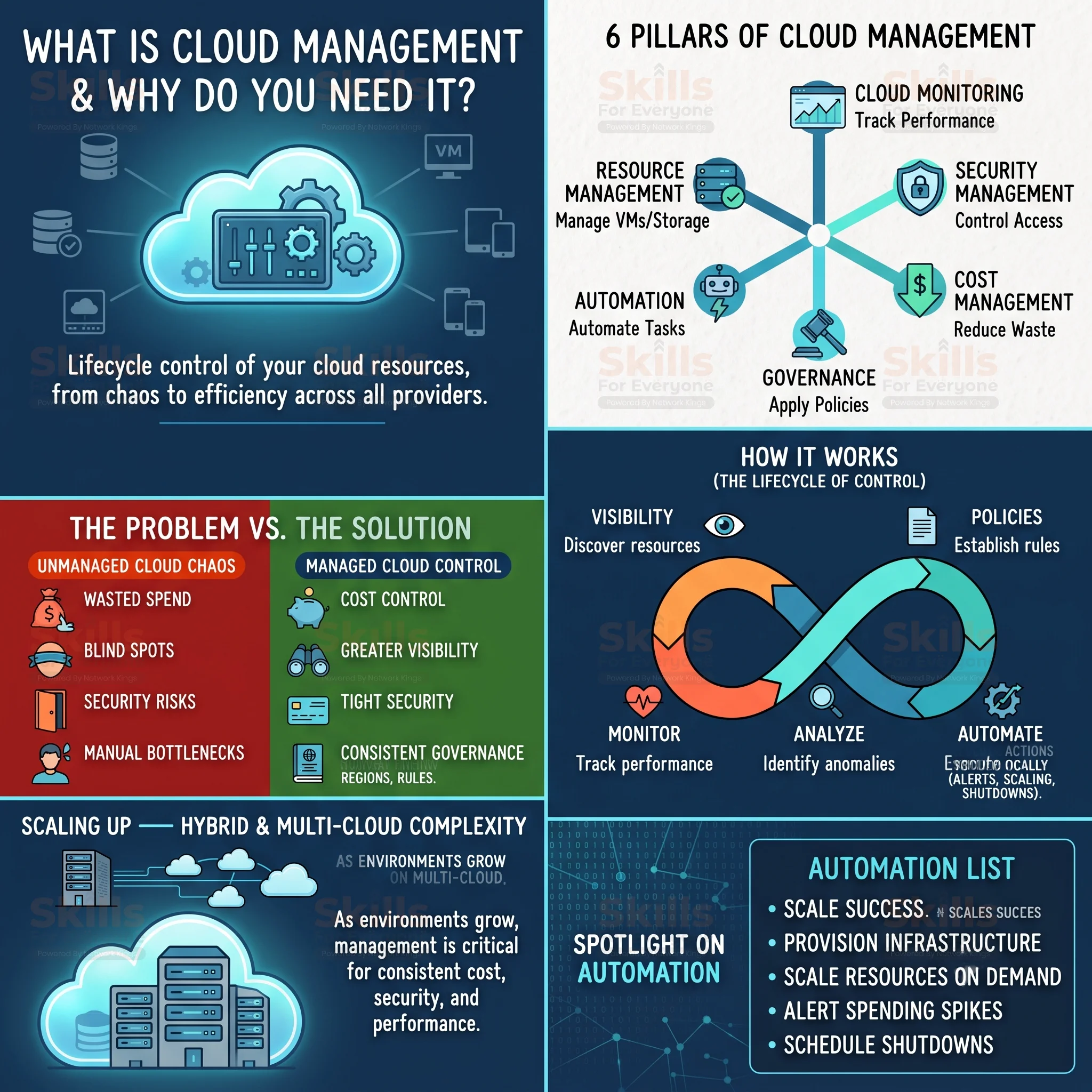
Cloud management is the practice of monitoring, securing, optimizing, and controlling cloud resources, services, and workloads throughout their lifecycle. It brings together processes and tools for managing infrastructure, users, costs, performance, security, and governance across cloud environments.
For businesses, cloud management becomes increasingly important as cloud environments grow. An organization may use services from AWS, Microsoft Azure, or Google Cloud while running virtual machines, databases, containers, storage, and applications across multiple regions. Without proper management, unused resources can increase costs, configuration issues can create security risks, and teams can lose visibility into what is running. Effective cloud management gives IT teams greater control while helping the business use cloud resources efficiently.
What Does Cloud Management Include
Cloud management covers several areas of day-to-day cloud operations. It is broader than simply monitoring whether a server is online.
Common areas include:
Resource management for virtual machines, storage, databases, containers, and other services
Cloud monitoring for availability, performance, capacity, and operational issues
Security management for identities, permissions, configurations, and security policies
Cost management for tracking spending, identifying waste, and improving resource utilization
Governance for applying organizational policies and maintaining compliance requirements
Automation for provisioning, scaling, patching, and repetitive operational tasks
These functions often overlap. For example, automatically shutting down development resources outside working hours can reduce costs while also improving resource governance.
How Cloud Management Works
Cloud management typically starts with visibility. IT teams need to know which resources exist, who owns them, how they are configured, how they are being used, and what they cost.
A cloud management platform or collection of native cloud tools can gather information about infrastructure and workloads. Teams can then establish policies, monitor activity, analyze usage, and automate selected actions.
Consider a company running applications in AWS. Its cloud operations team might monitor compute utilization, review storage growth, identify idle resources, enforce access policies, and create alerts when spending or performance moves outside expected limits.
The same principles apply to environments built with Microsoft Azure or Google Cloud, although the available services and management interfaces differ.
Why Businesses Need Cloud Management
Cloud services make infrastructure easier to provision, but that flexibility can also make environments harder to control as they expand.
Without effective cloud management, businesses may encounter:
Unused or oversized resources that continue generating costs
Limited visibility across accounts, subscriptions, projects, or regions
Inconsistent security configurations
Excessive user permissions
Difficulty tracking resource ownership
Manual operational processes
Performance problems that are discovered too late
Governance and compliance challenges
Cloud management provides a structured way to address these issues. It does not automatically eliminate them, but it gives teams the visibility, policies, and automation needed to manage them.
Key Benefits of Cloud Management
Better cloud cost control
Cloud billing is closely tied to resource consumption. Cloud cost management helps teams understand where money is being spent and identify opportunities for optimization.
For example, a development environment may contain compute resources that are rarely used outside business hours. Reviewing utilization and applying an appropriate shutdown or scheduling policy can prevent unnecessary consumption.
Cost optimization should focus on actual workload requirements rather than simply reducing resources. Removing a resource that an application genuinely needs can create performance or availability problems.
Improved security and access control
Cloud security management helps organizations control identities, permissions, network configurations, and security settings.
A business can use policies to restrict administrative access, review unused permissions, and detect configuration changes. Cloud management therefore supports security, although it should not be treated as a replacement for dedicated cloud security controls.
Greater visibility and performance
Cloud monitoring provides information about resource utilization, application performance, availability, and operational events.
When teams can see how workloads are performing, they can investigate issues earlier and make better capacity decisions. Monitoring also creates useful operational data for troubleshooting and planning.
More consistent governance
Cloud governance establishes rules for how cloud resources should be created, configured, accessed, and managed.
For example, an organization may require specific tags for resource ownership, restrict which regions can be used, or require particular security controls for production workloads.
Governance becomes especially important when multiple teams can independently create and modify cloud resources.
Cloud Management Across Hybrid and Multi-Cloud Environments
Managing one cloud environment can become complicated as infrastructure grows. Hybrid cloud and multi-cloud architectures add another layer of complexity.
A hybrid cloud combines private infrastructure with one or more public cloud environments. A multi-cloud environment uses services from multiple cloud providers.
Management area | Business challenge | Management focus |
Cost | Spending is distributed across services and providers | Track usage, budgets, and resource efficiency |
Security | Policies can vary between environments | Standardize access and security controls |
Performance | Workloads have different monitoring requirements | Establish consistent visibility and alerting |
Governance | Teams may follow different processes | Apply policies, ownership, and compliance rules |
Operations | Multiple tools and platforms increase complexity | Automate repetitive tasks where practical |
A centralized cloud management approach can improve visibility across environments, but organizations should not assume that every workload needs to be managed through one tool. Native cloud services, third-party platforms, and infrastructure-as-code tools can all play different roles.
Cloud Management and Cloud Automation
Automation is an important part of modern cloud operations. Instead of manually performing repetitive tasks, teams can define processes that execute consistently.
Examples include:
Automatically provisioning approved infrastructure
Scaling resources based on workload demand
Applying standardized configurations
Alerting teams about unusual activity
Removing resources that violate defined policies
Scheduling non-production resources
Automation can reduce manual effort and configuration errors, but it needs appropriate controls. Poorly designed automation can scale problems just as quickly as it can solve them.
How to Choose a Cloud Management Approach
The right approach depends on the organization's cloud architecture, operational maturity, security requirements, and business goals.
Before selecting a cloud management platform or strategy, consider:
Which cloud providers and infrastructure types need to be managed?
How much visibility is required across accounts, subscriptions, and projects?
What cost controls and reporting are needed?
Which security and compliance policies must be enforced?
What tasks should be automated?
How will teams monitor and troubleshoot workloads?
Does the organization need centralized management or primarily native cloud tools?
The goal should be practical control rather than adding another layer of technology simply for the sake of centralization.
Bringing Cloud Management Together
Cloud management gives businesses a structured way to control cloud resources, costs, security, performance, governance, and operations. As cloud environments become larger or span multiple providers, visibility and consistent management become increasingly important.
The most effective approach combines appropriate tools with clear policies, ownership, monitoring, automation, and ongoing optimization. Cloud management does not guarantee lower costs or stronger security by itself. Its value comes from how effectively an organization uses these capabilities to operate its cloud environment.
FAQs
What is cloud management in simple terms?
Cloud management is the process of controlling and monitoring cloud resources, workloads, costs, security, performance, and policies so that cloud environments operate efficiently and according to business requirements.
Why is cloud management important for businesses?
It helps businesses maintain visibility over cloud resources, control spending, manage security and access, improve operational efficiency, and apply consistent governance as their cloud environment grows.
What does a cloud management platform do?
A cloud management platform can provide capabilities such as resource visibility, monitoring, cost analysis, policy management, automation, and reporting. The exact features vary between platforms.
Is cloud management the same as cloud security?
No. Cloud security focuses specifically on protecting cloud infrastructure, workloads, identities, data, and configurations. Cloud management is broader and also covers areas such as cost, performance, resource utilization, governance, and operations.
How does cloud management reduce costs?
It can help identify unused or oversized resources, monitor consumption, establish budgets and policies, and automate appropriate resource schedules. Actual savings depend on workload requirements and how effectively those controls are implemented.
What is the difference between hybrid cloud and multi-cloud management?
Hybrid cloud management deals with environments that combine private infrastructure with public cloud services. Multi-cloud management focuses on environments that use multiple cloud providers. An organization can have both at the same time.
Can cloud management be automated?
Yes. Organizations can automate tasks such as resource provisioning, scaling, configuration enforcement, monitoring alerts, and scheduled resource operations. Automation should be tested and governed to prevent unintended changes.
Do businesses need a third-party cloud management platform?
Not necessarily. Cloud providers offer native management, monitoring, security, governance, and cost-management services. A third-party platform may be useful when an organization needs broader visibility or centralized management across multiple environments.