Cyber Security
Begineer Friendly

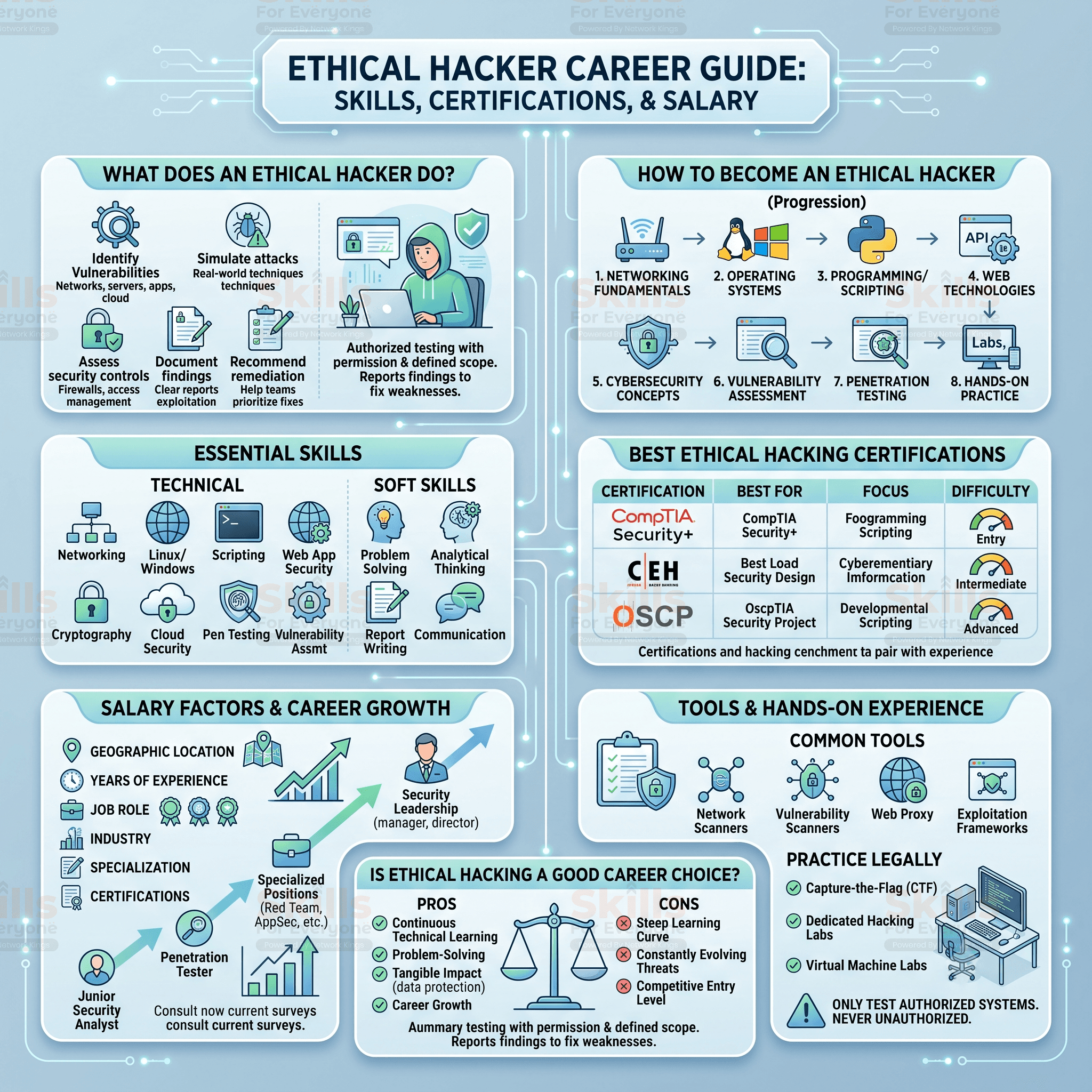
An ethical hacker helps organizations find and fix security weaknesses before attackers can exploit them. Unlike malicious hackers, ethical hackers work with authorization to assess systems, applications, networks, and security controls. For people interested in cybersecurity, this makes ethical hacking a practical career path that combines technical knowledge, problem-solving, and continuous learning.
What Does an Ethical Hacker Do?
An ethical hacker is a cybersecurity professional authorized by an organization to test its systems, networks, and applications for security weaknesses using the same techniques a malicious hacker would use, but with permission and a defined scope.
The distinction between ethical hacking and malicious hacking comes down to authorization, intent, and disclosure. A malicious hacker exploits systems without consent to steal data, cause damage, or gain unauthorized access. An ethical hacker operates under a signed agreement, follows an agreed testing scope, and reports every finding back to the organization so it can be fixed.
Day to day, an ethical hacker's responsibilities typically include:
Identifying vulnerabilities in networks, servers, applications, and cloud environments
Simulating real-world attack techniques to test how systems respond
Assessing existing security controls such as firewalls, access management, and monitoring tools
Documenting findings clearly, including how a vulnerability could be exploited and its potential impact
Recommending remediation steps and helping teams prioritize fixes based on risk
This work directly reduces an organization's exposure to data breaches, financial loss, and reputational damage, which is why the role carries real responsibility rather than just technical curiosity.
How to Become an Ethical Hacker
There is no single required path into ethical hacking, but most professionals build knowledge in a similar order, moving from general IT fundamentals toward specialized offensive security skills.
A realistic progression looks like this:
Networking fundamentals, including TCP/IP, DNS, routing, and how data moves across systems
Operating systems, with particular depth in Linux since most security tools run natively on it
Programming or scripting, especially Python, to automate tasks and understand how exploits work
Web technologies, including how browsers, servers, and APIs communicate
Core cybersecurity concepts such as authentication, encryption, and common attack patterns
Vulnerability assessment, which involves scanning and identifying weaknesses systematically
Penetration testing, where those vulnerabilities are safely exploited to confirm real risk
Hands-on practice through security labs, capture-the-flag challenges, and home lab environments
Certifications can validate this knowledge to employers, but they work best alongside practical experience rather than as a replacement for it. Many hiring managers value candidates who can demonstrate actual lab work or documented projects, not just exam credentials.
Essential Skills for an Ethical Hacker
Rather than trying to learn everything at once, focus on the skills that show up repeatedly in real engagements.
Networking knowledge comes first, since almost every attack path depends on understanding how systems communicate. Comfort with both Linux and Windows environments follows closely, since ethical hackers regularly test both. Scripting ability, particularly in Python or Bash, helps automate repetitive tasks and customize tools when off-the-shelf options fall short.
On the technical testing side, web application security and vulnerability assessment form the foundation of most entry-level work, while penetration testing builds on that foundation with more advanced exploitation techniques. Basic cloud security knowledge is increasingly necessary as organizations move infrastructure to platforms like AWS and Azure, and a working understanding of cryptography helps explain why certain protocols and configurations are considered secure or outdated.
Familiarity with widely used security tools rounds out the technical side, but two often-underrated skills matter just as much. Problem-solving and analytical thinking determine how effectively someone can chain small findings into a meaningful security risk. Report writing and communication determine whether that finding actually gets fixed, since a vulnerability that isn't clearly explained to a non-technical stakeholder rarely gets prioritized.
Best Ethical Hacking Certifications
Certifications serve different purposes depending on where someone is in their career. Foundational certifications validate broad security knowledge, while practical certifications test whether someone can actually perform an attack under exam conditions.
Certification | Best for | Focus | Difficulty |
CompTIA Security+ | Beginners and IT professionals entering cybersecurity | Core security concepts, risk management, network security basics | Entry level |
Certified Ethical Hacker (CEH) | Those wanting structured coverage of hacking methodologies and tools | Attack techniques, tools, and ethical hacking frameworks | Intermediate |
Offensive Security Certified Professional (OSCP) | Aspiring penetration testers seeking hands-on proof of skill | Practical, exam-based exploitation of live systems | Advanced |
No certification guarantees a job or a specific salary outcome. Their real value lies in structuring your learning and signaling a baseline level of competence to employers, particularly when paired with demonstrable hands-on experience.
Ethical Hacker Salary and Career Growth
Ethical hacker compensation varies considerably and depends on several interacting factors rather than a single number that applies broadly across the field.
Key factors that influence salary include:
Geographic location and local cost of living
Years of hands-on experience
Specific job role, since penetration testers, security engineers, and consultants are compensated differently
Industry, with finance and government often differing from smaller private companies
Technical specialization, such as cloud security or application security
Certifications held, particularly practical ones like OSCP
Organization size and security budget
Because compensation data changes over time and varies by region, readers should consult current salary surveys from sources such as government labor statistics or established job platforms rather than relying on fixed figures in an article.
Career growth in this field is fairly well defined. Many professionals start in general IT or a junior security analyst role, move into penetration testing or vulnerability assessment, and progress toward specialized positions such as red team specialist, application security specialist, security engineer, or security consultant. Some eventually move into leadership roles overseeing security programs.
Ethical Hacking Tools and Hands-On Experience
Certifications and coursework build theoretical understanding, but hands-on practice is what turns that knowledge into a usable skill. Employers consistently favor candidates who can point to real lab work, not just exam scores.
Commonly used tools in ethical hacking work include network scanners, vulnerability scanners, web proxy tools for testing applications, and exploitation frameworks used in controlled testing environments. Beginners can build practical experience through legal platforms designed for this purpose, including capture-the-flag competitions, dedicated hacking labs, and personal home lab setups built with virtual machines.
It is worth noting that all testing should occur only against systems you own or are explicitly authorized to test. Practicing on real, unauthorized systems is illegal regardless of intent.
Is Ethical Hacking a Good Career Choice?
Ethical hacking offers genuine opportunities for people who enjoy continuous technical learning and problem-solving under real constraints. The field rewards curiosity and persistence, and the work has tangible impact since findings directly influence how organizations protect their data.
That said, it is not an easy or fast path. The learning curve is steep, tools and attack techniques evolve constantly, and staying current requires ongoing effort well beyond initial certification. Competition for entry-level roles can be significant, and early-career professionals should expect to spend real time building a portfolio of hands-on work rather than expecting certifications alone to open doors.
For those willing to put in consistent practice, ethical hacking offers a career path with room for specialization, a clear progression from analyst to advanced offensive security roles, and long-term relevance as cybersecurity threats continue to evolve.
Conclusion
Becoming a successful ethical hacker depends on building a solid technical foundation in networking, operating systems, and scripting before layering on specialized skills like vulnerability assessment and penetration testing. Certifications such as CompTIA Security+, CEH, and OSCP each serve a different stage of that journey, but none replace the value of hands-on practice in legal lab environments. Salary and career growth depend on multiple factors including location, specialization, and experience rather than any single credential. For those genuinely interested in how systems break and how to fix them responsibly, ethical hacking offers a demanding but rewarding cybersecurity career path.
FAQs
1. What is the difference between vulnerability assessment and penetration testing?
Vulnerability assessment focuses on identifying and prioritizing potential security weaknesses, while penetration testing goes further by safely attempting to exploit those weaknesses to determine whether they can actually lead to unauthorized access or business impact. In practice, penetration testers often use vulnerability scanning as one part of a broader testing methodology.
2. Do ethical hackers need to know programming?
Ethical hackers do not necessarily need to be expert software developers, but programming and scripting skills are highly valuable. Python, Bash, PowerShell, JavaScript, and SQL can help security professionals automate reconnaissance, analyze data, understand application behavior, and modify or create security tools.
3. Is Active Directory knowledge important for penetration testers?
Yes. Active Directory is widely used in enterprise environments, making identity and access security an important part of internal penetration testing. Ethical hackers may need to understand concepts such as Kerberos, NTLM, LDAP, privilege escalation, delegation, Group Policy, and common identity attack paths.
4. What is the difference between a red team and a penetration tester?
A penetration test generally focuses on identifying and validating vulnerabilities within a defined scope. Red team operations are typically broader and more adversary-focused, often attempting to simulate realistic attacks against people, processes, applications, networks, and security controls while measuring the organization's ability to detect and respond.
5. Is cloud security knowledge required for ethical hacking?
Cloud security knowledge is increasingly important because penetration testers may encounter cloud-hosted applications, identities, storage, APIs, containers, and infrastructure. Professionals should understand cloud IAM, network segmentation, storage permissions, logging, secrets management, and common cloud misconfigurations before moving into advanced cloud penetration testing.
6. What should an ethical hacker include in a penetration testing report?
A professional penetration testing report should clearly document the scope, methodology, findings, evidence, affected assets, risk or severity, business impact, and remediation recommendations. A strong report should allow both technical teams and management to understand what was discovered and what actions should be taken.
7. What should you learn after mastering the basics of ethical hacking?
After building strong fundamentals, an ethical hacker can specialize in areas such as web and API security, Active Directory penetration testing, cloud security, mobile security, red teaming, exploit development, or application security. The best specialization depends on the individual's career goals and the type of environments they want to test.