Cyber Security
Begineer Friendly

The demand for cybersecurity professionals has never been higher. Organizations across every industry are investing heavily in security infrastructure, and they're desperate to hire talent that can defend against increasingly sophisticated attacks. If you're looking to break into a lucrative career in IT, understanding how hacking training skills can help you land a high-paying IT job is the key to unlocking opportunities that simply didn't exist a decade ago.
Ethical hacking training isn't just about learning to break into systems. It's about developing a comprehensive skill set that organizations are willing to pay six-figure salaries for. Whether you're an IT graduate exploring career options, a network engineer looking to transition into security, or someone considering a complete career change, the path to a high-paying job in cybersecurity starts with the right foundational training.
Why Cybersecurity Professionals Are in High Demand
Cybercrime continues to evolve, affecting organizations of every size. As companies invest more heavily in digital transformation, cloud computing, and remote work infrastructure, the need for cybersecurity professionals has grown significantly.
Organizations require experts who can:
Identify security weaknesses before attackers find them
Conduct vulnerability assessments and security testing
Secure cloud and on-premises environments
Monitor security operations and respond to incidents
Improve network security and digital security frameworks
This growing demand has created a strong market for ethical hackers, penetration testers, SOC analysts, and cybersecurity engineers. Many employers struggle to fill cybersecurity positions because qualified candidates remain in short supply.
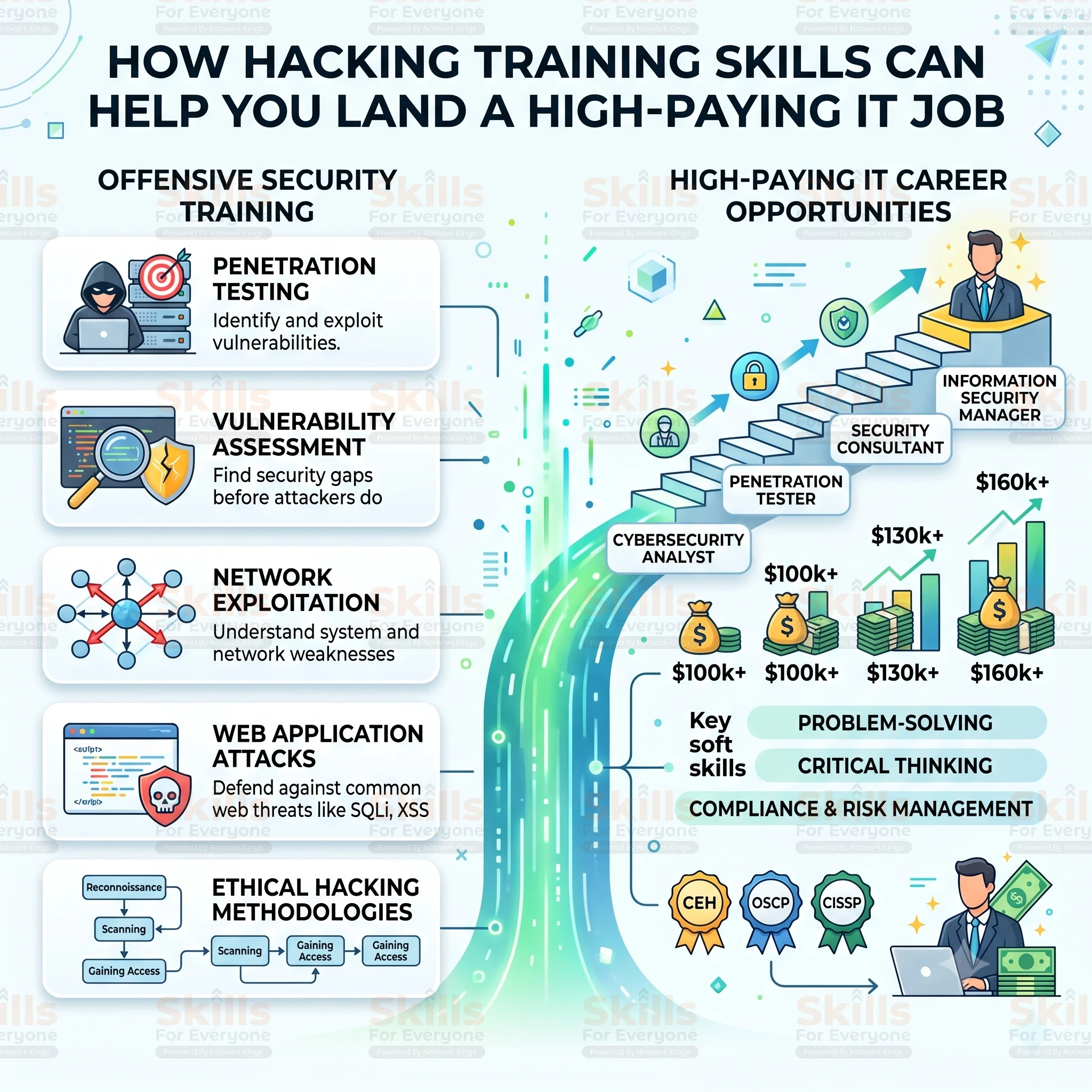
What Skills You Learn in Hacking Training
When you go through proper hacking training, you're building a technical foundation that employers actively seek out.
Core Technical Competencies
Ethical hacking training develops expertise across multiple critical areas:
Penetration testing and authorized security assessments
Network security protocols and architecture analysis
Vulnerability identification and exploitation techniques
Security tools including Metasploit, Burp Suite, and Wireshark
Log analysis and forensic investigation methods
Risk assessment and threat modeling
Policy implementation and compliance evaluation
The Adversarial Mindset
Beyond the technical toolkit, hacking training teaches you to think like an attacker. This adversarial mindset is invaluable. You start seeing systems the way threat actors do, which makes you dramatically more effective at both offensive and defensive security roles.
You'll understand attack chains, reconnaissance methods, and evasion techniques. This knowledge translates directly into better defensive strategies and more thorough security testing.
High-Paying IT Jobs That Value Ethical Hacking Skills
Hacking training opens doors to specific roles where organizations pay premium salaries. These positions actively recruit people with ethical hacking certifications and hands-on penetration testing experience.
Penetration Tester
Penetration testers conduct authorized security tests that simulate real attacks. They identify vulnerabilities before malicious actors do and document findings in ways that executives can understand. This role commands some of the highest salaries in IT security.
Red Team Operator
Red team operators take penetration testing further, conducting comprehensive adversary simulations for organizations that want to test their entire security posture under realistic attack scenarios. These specialized roles often pay $120,000 to $180,000 or more annually.
Security Operations Center (SOC) Analyst
SOC analysts work the defensive side, monitoring networks and responding to threats. Buffer zones exist between entry-level and experienced positions here, but the career ladder is clear and salary progression is strong. Entry-level SOC analysts typically earn $65,000 to $95,000, with senior positions reaching $130,000 and beyond.
Vulnerability Assessment Specialist
These professionals concentrate specifically on finding and documenting security weaknesses, often specializing in particular technologies or industries. Their hacking training directly translates to identifying exploitable flaws that others might miss.
Information Security Engineer
Information security engineers design and implement security solutions, working on both architecture and policy. Organizations need people who understand how security actually works in practice, not just in theory. If you can demonstrate that you've conducted penetration testing and understand how systems can be compromised, you become far more credible in these roles.
Bug Bounty Hunter
Bug bounty hunters operate independently or through platforms like HackerOne and Bugcrowd, getting paid for each vulnerability they responsibly disclose. While not a traditional employment path, top performers earn substantial income through a combination of bounties and consulting work.
Salary Comparison Across Cybersecurity Roles
Job Role | Key Skills Required | Average Salary Range | Experience Level | Career Growth Potential |
Security Analyst | Network monitoring, incident response, log analysis | $65,000-$95,000 | Entry to Mid | High |
Penetration Tester | Exploitation, vulnerability assessment, report writing | $90,000-$140,000 | Mid to Senior | Very High |
Red Team Operator | Advanced exploitation, evasion techniques, adversary simulation | $120,000-$180,000 | Senior | Excellent |
Information Security Engineer | Architecture, policy implementation, security design | $95,000-$145,000 | Mid to Senior | High |
SOC Manager | Team leadership, incident management, compliance | $100,000-$160,000 | Senior | Excellent |
Security Architect | System design, risk management, enterprise security | $130,000-$200,000 | Senior | Excellent |
The salary data reflects current market conditions in the United States. Specialized roles like red team operators and security architects command the highest compensation, but even entry-level security analysts with proper certifications start well above average IT positions.
Certifications That Increase Hiring Potential
Certifications serve as proof that you actually know what you're talking about. They accelerate hiring timelines and directly increase your earning potential. Employers use them as quick validation that you've invested time in structured learning.
Entry-Level Certifications
Certified Ethical Hacker (CEH): The most recognizable entry point covering the breadth of hacking skills
CompTIA Security+: Broader IT security knowledge and required for many government contracts
Security Blue Team Level 1 (SBTL): Focuses on defensive capabilities and complements offensive certifications
Advanced Certifications
Offensive Security Certified Professional (OSCP): Challenging exam requiring live penetration testing in a lab environment
Practical Network Penetration Tester (PNPT): Hands-on credential that proves actual penetration testing ability
Certified Information Systems Security Professional (CISSP): Enterprise standard for senior security roles
For hands-on credibility, the OSCP and PNPT certifications carry enormous weight with employers. These are challenging exams that actually require you to demonstrate penetration testing skills in a live lab environment. If you hold these certifications, employers know you can actually do the work.
How Employers Evaluate Ethical Hacking Skills
Employers don't just want to see a certificate hanging on your wall. They want evidence that you can actually perform in the role.
Technical Assessments
During interviews and hiring processes, employers typically use:
Technical questions testing your understanding of attack methodologies and defense strategies
Walk-throughs of penetration tests you've conducted
Analysis of real-world security scenarios and proposed solutions
Take-home challenges involving pcap analysis, code review, or security design
Hands-on labs where you demonstrate technical competency
Portfolio and Experience
Your portfolio matters significantly. Employers value:
Real penetration tests you've conducted professionally
Contributions to open-source security tools
Bug bounty program participation and disclosed vulnerabilities
Capture the Flag (CTF) competition participation
Published security research or blog posts
Speaking engagements at security conferences
Certifications and Credentials
Prior certifications and hands-on training credentials speak volumes. An OSCP holder has proven they can conduct penetration testing under real exam conditions. A CEH demonstrates breadth of knowledge across hacking domains. These certifications reduce hiring risk because they come with built-in validation.
Steps to Start a Career in Ethical Hacking
If you're ready to pursue this path, the roadmap is straightforward and achievable.
Phase 1: Build Foundational Knowledge
Start with foundational IT knowledge if you don't already have it. You need to understand:
Network protocols and architecture
Operating system fundamentals (Windows, Linux, macOS)
Basic system administration and database concepts
General IT security principles
This phase typically takes three to six months depending on your background.
Phase 2: Enroll in Structured Training
Look for courses that include hands-on labs where you actually practice breaking into systems. Online platforms like TryHackMe, HackTheBox, and professional training providers offer excellent preparation. Dedicate two to four months to intensive study while maintaining realistic expectations about learning pace.
Quality training programs should include:
Video lectures covering core concepts
Hands-on lab environments for practice
Real-world scenario simulations
Exam preparation and practice tests
Access to instructors or community support
Phase 3: Pursue Your First Certification
Pursue your first certification, typically the CEH or CompTIA Security+. These require study and exam fees, but they're investments in your credibility. Plan for two to three months of focused study using practice exams and study guides.
Phase 4: Build Practical Experience
Build practical experience through ethical hacking training labs, bug bounty platforms, or CTF competitions. These hands-on activities are what employers actually care about. Spend time with tools like Burp Suite, Metasploit, and Wireshark until they become second nature.
Consider activities like:
Setting up home labs with virtual machines
Participating in bug bounty programs
Joining capture the flag competitions
Contributing to open-source security projects
Practicing on platforms like HackTheBox
Phase 5: Secure Your First Role
Apply for entry-level positions like security analyst or junior penetration tester roles. Your certifications and lab experience make you competitive even without years of professional experience. Once you're in the industry, career progression happens relatively quickly given the demand.
Future Career Opportunities in Cybersecurity
The cybersecurity field continues to evolve rapidly, creating new opportunities regularly.
Emerging Specializations
New areas of focus are creating specialized, high-paying roles:
Cloud security (AWS, Azure, GCP security)
Application security and secure coding
IoT security and embedded systems
Container and Kubernetes security
Threat intelligence and analysis
Security architecture and strategy
Professionals with hacking training skills are well-positioned to specialize in these areas as technology landscapes shift.
Leadership and Management
Management and leadership paths open up as you gain experience. Security managers, directors, and CISOs command salaries well into the six figures. Many of these roles specifically seek people with hands-on hacking experience because they understand the technical reality of security challenges.
Consulting and Contracting
Consulting and contracting opportunities allow experienced ethical hackers to work independently or with specialized firms, often at rates significantly higher than traditional employment. The flexibility of this path appeals to many security professionals after they've built credibility in the field.
Conclusion
Learning how hacking training skills can help you land a high-paying IT job requires understanding that cybersecurity is no longer optional for any organization. The demand is real, the salaries are substantial, and the career opportunities are expanding. Whether you choose penetration testing, security engineering, or another specialization, starting with structured ethical hacking training sets you on the path to a lucrative, challenging career that matters.
The barrier to entry is lower than ever. You don't need a traditional computer science degree or years of IT experience to break in. What you need is commitment to learning, willingness to practice in lab environments, and the discipline to pursue recognized certifications. For anyone willing to invest the effort, a high-paying IT job in cybersecurity is absolutely achievable.
FAQs
What certifications do I need for a high-paying cybersecurity job?
The CEH and CompTIA Security+ are excellent starting points, while the OSCP and PNPT certifications significantly increase earning potential. Many senior roles require CISSP. Start with entry-level certifications, gain experience, then pursue advanced credentials as your career progresses.
How long does hacking training typically take?
Entry-level ethical hacking training takes three to six months of intensive study including labs and practice. Obtaining your first certification adds another two to three months. Total time from start to first job is typically six to twelve months with full-time dedication.
Can I get a high-paying cybersecurity job without a degree?
Yes. Many cybersecurity positions prioritize hands-on skills and certifications over formal degrees. With proper ethical hacking training, relevant certifications, and demonstrated practical experience, you can secure well-paying roles without a traditional IT degree.
What's the average salary for a penetration tester?
Penetration testers typically earn between $90,000 and $140,000 annually, with senior penetration testers and red team operators earning $120,000 to $180,000 or more depending on experience, location, and specialization.
How do I practice ethical hacking skills without breaking laws?
Use legal platforms like HackTheBox, TryHackMe, and OWASP WebGoat. Set up your own lab environment with virtual machines. Participate in authorized bug bounty programs. Pursue certifications that include controlled lab environments where you can practice without legal risk.