Cyber Security
Begineer Friendly

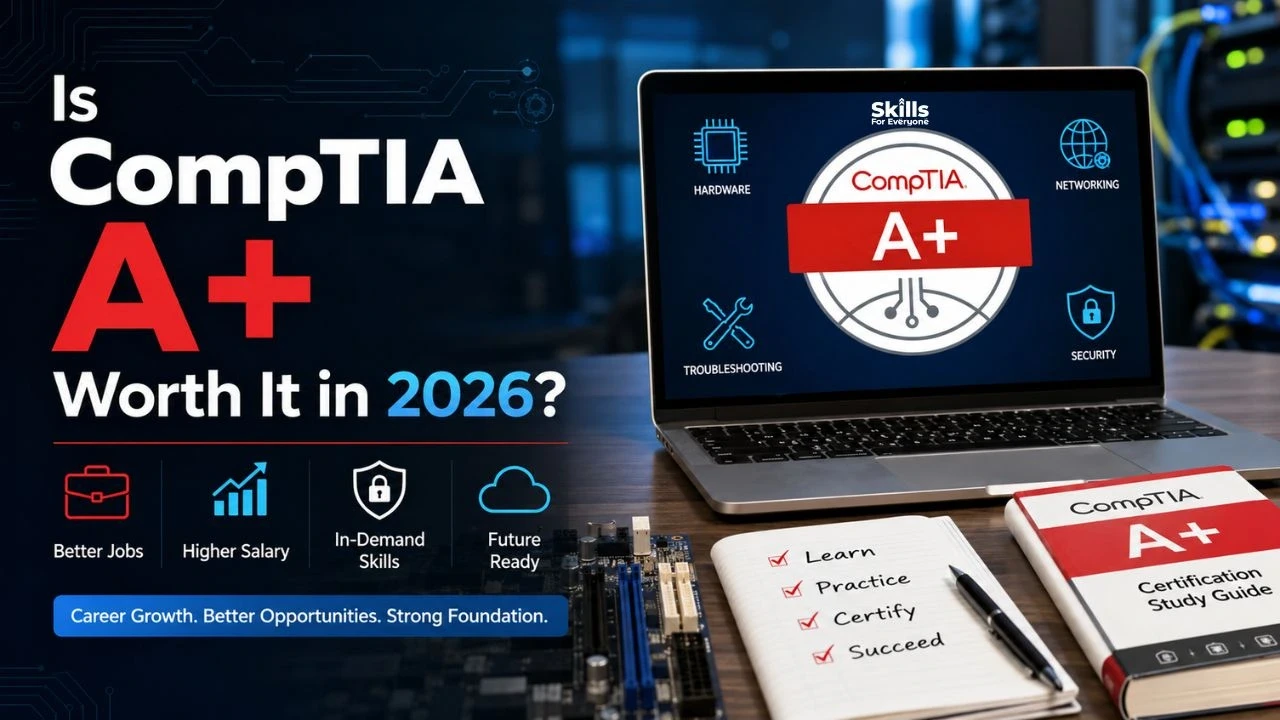
If you have spent any time researching IT careers, you have probably run into the same debate over and over. Some people swear CompTIA A+ opened doors for them. Others say certifications do not matter anymore and only hands-on skills count. So which side is right in 2026?
Here is the short answer. CompTIA A+ is still worth it in 2026 for most people who are new to IT, especially those with no degree, no experience, and no professional network in the industry. It will not make you rich on its own, and it will not replace real skills. But it remains one of the fastest, cheapest, and most recognized ways to prove you understand the basics of computer hardware, software, networking, and troubleshooting.
In this article, we will walk through what CompTIA A+ actually covers, why employers still ask for it, what kind of salary and job opportunities it realistically leads to, and who should consider earning it this year. By the end, you should have a clear, honest picture of whether this entry-level IT certification fits your situation.
What Is CompTIA A+ Certification
CompTIA A+ is an entry-level IT certification created by CompTIA, a nonprofit trade association that has been setting vendor-neutral technology standards for decades. It is often described as the certification that proves you can walk into an IT support role and actually do the job on day one.
The certification covers two exams, Core 1 and Core 2. Core 1 focuses on hardware, networking basics, mobile devices, virtualization, and cloud computing fundamentals. Core 2 covers operating systems, security, software troubleshooting, and operational procedures like documentation and safety practices.
In plain terms, A+ tells an employer you can set up a workstation, diagnose why a printer will not connect, walk a user through a software issue over the phone, and follow basic security protocols without supervision. It is not designed to make you a specialist. It is designed to prove you have a broad, working foundation.
Why CompTIA A+ Remains Relevant in 2026
A common myth is that entry-level IT certifications lost their value once cloud computing and automation took over. In reality, the demand for IT support professionals has not gone anywhere. Every company that uses computers, which is basically every company, still needs people who can fix login issues, manage devices, and keep basic infrastructure running.
Remote work has actually increased the need for help desk technicians, since employees now troubleshoot problems from home offices instead of walking down the hall to IT. Someone still has to support all of that, often remotely.
From an employer's perspective, A+ functions as a screening tool. Hiring managers reviewing dozens of resumes for an entry-level IT support career role do not have time to test every candidate's knowledge. A current certification tells them this person has at least the baseline skills to be productive quickly, without needing months of basic training.
Benefits of Earning CompTIA A+
One of the biggest CompTIA certification benefits is that it helps candidates stand out in a competitive job market. Hiring managers often receive applications from individuals with similar educational backgrounds. Certification can serve as an additional credential that demonstrates commitment and technical competence.
Some key advantages include:
Improved eligibility for entry-level IT jobs
Greater confidence during technical interviews
Recognition from employers worldwide
Strong foundation for advanced certifications
Exposure to real-world troubleshooting scenarios
For many professionals, CompTIA A+ serves as a stepping stone toward certifications such as Network+, Security+, and cloud-related credentials.
CompTIA A+ Salary and Job Opportunities
Salary numbers for A+ certified professionals vary quite a bit depending on the source, the specific job role, location, and experience level. Generally speaking, entry-level roles start in the $40,000 to $55,000 range in the United States, with the national average landing somewhere between roughly $44,000 and $65,000 depending on which roles are included in the data set. Experienced professionals who stack additional certifications can move well beyond that, sometimes into the $75,000 to $100,000 range in tier 2 or tier 3 support and systems administration roles.
Here is a simplified breakdown of common CompTIA A+ jobs and what they typically pay.
Job Role | Typical Salary Range (USD) | Experience Level |
Help Desk Technician | $38,000 to $52,000 | Entry-level |
IT Support Specialist | $42,000 to $58,000 | Entry-level to mid |
Field Service Technician | $40,000 to $60,000 | Entry-level to mid |
Desktop Support Analyst | $45,000 to $62,000 | Mid-level |
Junior Systems Administrator | $55,000 to $85,000 | Mid-level, often with added certs |
Location matters a great deal here. Tech hubs and high cost of living cities tend to pay noticeably more, while smaller markets and government roles tend to sit closer to the lower end of these ranges. Adding certifications like Network+ or Security+ after A+ is one of the most reliable ways to push your salary higher over time.
Pros and Cons of CompTIA A+
No certification is perfect for everyone. Here is a balanced look at where A+ delivers and where it falls short.
Pros | Cons |
Recognized by employers across the US and globally | Will not guarantee a job by itself |
No degree or prior experience required | Entry-level salaries are modest compared to specialized IT roles |
Covers broad, practical skills used daily in support roles | Two exams and fees add up to a real financial investment |
Strong foundation for Network+, Security+, and beyond | Certification expires every three years and requires renewal |
Relatively affordable compared to degree programs | Some experienced hiring managers value real projects over certifications alone |
Who Should Get CompTIA A+ in 2026
CompTIA A+ is not designed for every IT professional. However, it provides exceptional value for specific groups.
Career Changers
Individuals moving from non-technical industries into technology can use the certification to demonstrate foundational knowledge and commitment to their new career path.
Students
Students pursuing IT, computer science, or related fields can strengthen their resumes before graduation and improve internship opportunities.
Beginners Entering IT
For those with no professional experience, CompTIA A+ offers a clear learning roadmap and introduces core concepts used in daily IT operations.
Help Desk and Support Professionals
Professionals already working in entry-level support roles can validate their skills and improve their prospects for promotion.
Is CompTIA A+ Worth the Cost
Cost is where a lot of people hesitate, so let's be direct about the numbers. Each exam currently costs around $219, which means roughly $440 total for both Core 1 and Core 2. Study materials, practice exams, or a bootcamp can add anywhere from nothing, if you use free resources, up to a few hundred dollars more for premium prep tools.
Most people studying part time can prepare in two to four months with consistent effort, often five to ten hours a week. That is a relatively small investment of time and money compared to a college degree or bootcamp program that can cost thousands of dollars and take years to complete.
When you compare a few hundred dollars and a few months of study against the realistic possibility of landing a $40,000 plus entry-level IT job, the return on investment is generally strong, particularly for someone with no other path into the field. The certification will not pay for itself if you never apply for relevant jobs or never build practical skills alongside it. The value comes from combining the credential with real effort, not from the paper alone.
Final Verdict
So, is CompTIA A+ worth it in 2026?
For most beginners, career changers, students, and aspiring IT support professionals, the answer is yes. The certification continues to provide a strong foundation in essential IT skills, remains respected by employers, and helps candidates compete for entry-level positions.
That said, CompTIA A+ is not a shortcut to a high-paying technology career. Its true value comes when combined with hands-on experience, continuous learning, and a clear career development plan.
If you're looking for an entry-level IT certification that builds confidence, validates foundational skills, and opens doors to your first technology role, CompTIA A+ remains a smart investment in 2026.
Frequently Asked Questions
Is CompTIA A+ worth it in 2026 without any experience?
Yes, for most beginners it is. A+ is specifically designed for people with no prior IT experience and remains one of the most accessible entry points into the field.
Can CompTIA A+ get you a job by itself?
It significantly improves your chances for entry-level help desk and IT support roles, but pairing it with a resume that highlights problem-solving, customer service, or any hands-on tech projects will get better results than the certification alone.
How long does it take to study for CompTIA A+?
Most people need two to four months of consistent part time study to prepare for both exams, though prior tech familiarity can shorten that timeline.
Does CompTIA A+ expire?
Yes, it is valid for three years. You can renew it through continuing education credits or by earning a higher level CompTIA certification before it expires.
What should I get after CompTIA A+?
Most people move on to CompTIA Network+ or Security+, both of which build on A+ fundamentals and tend to lead to better-paying, more specialized IT roles.