Cyber Security
Begineer Friendly

Learning penetration testing sounds exciting until you hit the first real obstacle: where do you actually practice? You cannot legally scan a random company's network just because you want to test your skills. One wrong move on the wrong system, and a curious beginner can end up facing serious legal consequences. This is the single biggest hurdle new ethical hackers face, and it is exactly why purpose-built training platforms exist.
The good news is that the cybersecurity industry has matured significantly around this problem. Today, there are dedicated platforms designed specifically to let you break things, exploit vulnerabilities, and sharpen your offensive security skills, all within a fully legal, controlled, and safe environment. This article breaks down what makes a great hacking training platform, compares the top options, and helps you choose the right one for where you are in your career.
Why Ethical Hackers Need Legal, Controlled Practice Environments
Penetration testing is inherently invasive. You are probing systems for weaknesses, attempting exploits, and sometimes gaining unauthorized-style access, all techniques that are illegal to perform against systems you do not own or have explicit written permission to test.
This is where the concept of a controlled security testing environment becomes essential. A proper cyber range or pentesting lab gives you:
A legally sanctioned space to practice real attack techniques
Realistic vulnerabilities modeled after actual systems and CVEs
Immediate feedback without any risk to production infrastructure
A repeatable environment where mistakes cost nothing but time
Professionals preparing for certifications like OSCP, CEH, or CompTIA PenTest+ rely heavily on these labs. So do red team members rehearsing attack chains before an engagement, and blue team analysts trying to understand attacker behavior from the offensive side.
What Makes a Good Hacking Training Platform
Not every practice environment is created equal. The strongest platforms share a few defining characteristics.
Realistic, Diverse Vulnerabilities
The best labs mirror real-world infrastructure, including misconfigured services, outdated software, weak credentials, and chained vulnerabilities that require multi-step exploitation, not just single, isolated flaws.
Structured Learning Paths
Beginners need guidance. Top platforms offer progressive learning tracks that move from fundamentals like networking and Linux basics into more advanced topics such as privilege escalation, Active Directory attacks, and web application exploitation.
Active Community and Write-Ups
A strong community means you are never stuck for long. Forums, official write-ups, and shared methodologies accelerate learning far faster than working in isolation.
Safe, Isolated Infrastructure
Everything happens inside sandboxed virtual machines or containers, so there is zero risk of accidentally impacting real systems, your own network, or anyone else's.
Comparing the Top Hacking Training Platforms
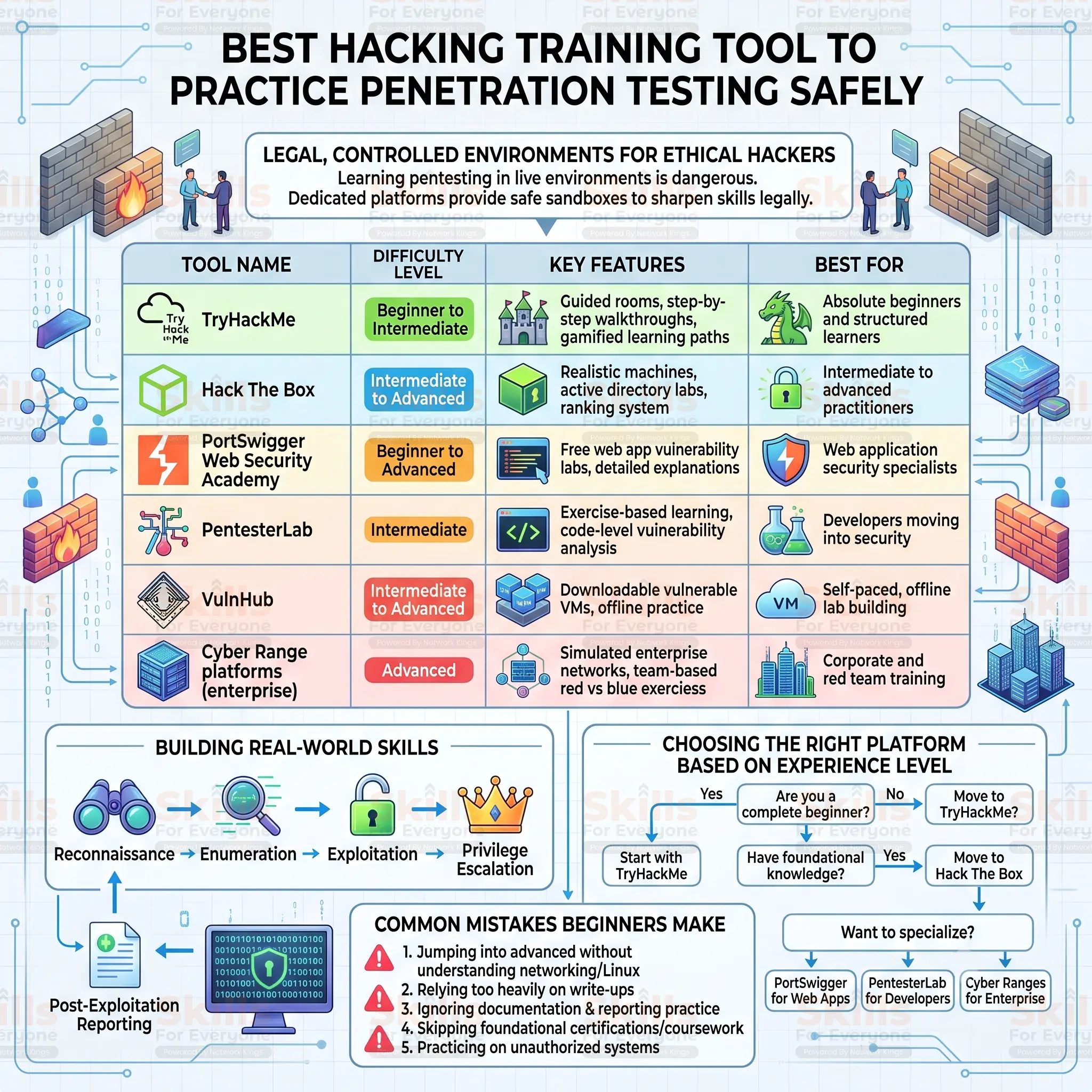
<div class="answer-box"> The best hacking training tool to practice penetration testing safely depends on your skill level, but platforms like Hack The Box and TryHackMe consistently top the list. Both offer isolated, legal virtual labs with guided and unguided challenges, making them ideal for building real penetration testing skills without any legal or technical risk. </div>
Tool Name | Difficulty Level | Key Features | Best For |
TryHackMe | Beginner to Intermediate | Guided rooms, step-by-step walkthroughs, gamified learning paths | Absolute beginners and structured learners |
Hack The Box | Intermediate to Advanced | Realistic machines, active directory labs, ranking system | Intermediate to advanced practitioners |
PortSwigger Web Security Academy | Beginner to Advanced | Free web app vulnerability labs, detailed explanations | Web application security specialists |
PentesterLab | Intermediate | Exercise-based learning, code-level vulnerability analysis | Developers moving into security |
VulnHub | Intermediate to Advanced | Downloadable vulnerable VMs, offline practice | Self-paced, offline lab building |
Cyber Range platforms (enterprise) | Advanced | Simulated enterprise networks, team-based red vs blue exercises | Corporate and red team training |
How These Platforms Build Real-World Cybersecurity Skills
Practicing on a Capture The Flag lab is not just a game. Each challenge simulates a technique attackers actually use, reconnaissance, enumeration, exploitation, privilege escalation, and post-exploitation reporting. Working through these steps repeatedly builds the same methodology professionals follow during real vulnerability assessments and penetration tests.
For example, a beginner working through a TryHackMe room on SQL injection learns not just the exploit itself, but how to identify the vulnerability, understand its impact, and document findings clearly, a skill just as important as the technical exploit.
Professionals also use these platforms to stay sharp. Even experienced penetration testers return to Hack The Box or similar labs to practice new attack techniques before applying them in client engagements, since testing an unfamiliar exploit on a live client network is never acceptable.
Choosing the Right Platform Based on Experience Level
If you are a complete beginner, start with TryHackMe. Its guided rooms explain concepts as you go, which prevents the frustration of getting stuck without direction.
If you have foundational knowledge in networking and Linux, move to Hack The Box. Its less guided format forces you to develop independent problem-solving skills, which mirrors real penetration testing engagements.
If you want to specialize in web applications, PortSwigger Web Security Academy offers some of the most detailed, free content available anywhere, developed by the creators of Burp Suite.
If you are preparing for enterprise or red team roles, look into dedicated cyber range environments that simulate full corporate networks and support team-based offensive and defensive exercises.
Common Mistakes Beginners Make When Learning Penetration Testing
Jumping straight into advanced machines without understanding networking and Linux fundamentals first
Relying too heavily on write-ups instead of struggling through problems independently
Ignoring documentation and reporting practice, which is a core deliverable in real penetration tests
Skipping foundational certifications or coursework in favor of only doing CTF challenges
Practicing on unauthorized systems out of impatience, which carries real legal risk
Avoiding these mistakes early makes the difference between someone who can solve isolated puzzles and someone who can actually perform a professional penetration test.
Conclusion
Learning penetration testing does not have to mean risking legal trouble or damaging real systems. Platforms like TryHackMe, Hack The Box, PortSwigger Web Security Academy, and VulnHub give you a legal, structured, and genuinely effective way to build offensive security skills from the ground up. The key is matching the platform to your current skill level, staying consistent, and avoiding the common mistakes that slow down so many beginners. Structured, hands-on practice, done safely, is still the fastest path to becoming a competent, job-ready penetration tester.
FAQs
Which platform is best for learning ethical hacking?
TryHackMe is generally considered the best starting point due to its structured, beginner-friendly learning paths, while Hack The Box is better suited once you have built foundational skills.
Is Hack The Box suitable for beginners?
Hack The Box can be challenging for complete beginners since it offers less guidance. Many learners start with TryHackMe first, then transition to Hack The Box as their skills grow.
How can I practice penetration testing legally?
Only practice on systems you own or on platforms explicitly designed for this purpose, such as TryHackMe, Hack The Box, VulnHub, or PortSwigger Web Security Academy, all of which provide legal, sanctioned environments.
What are the safest environments for learning cybersecurity?
Isolated virtual labs and cyber ranges are the safest options, since they are sandboxed away from real networks and specifically built for legal offensive security practice.
Which penetration testing lab is best for beginners?
TryHackMe's beginner learning paths, combined with PortSwigger's free web security labs, offer one of the most approachable and legally safe starting points available today.
Do I need a certification alongside lab practice?
Certifications like CompTIA PenTest+ or OSCP validate your skills to employers, but hands-on lab practice is what actually builds the technical ability those certifications test.
Are these platforms free?
Many, including TryHackMe, Hack The Box, VulnHub, and PortSwigger Web Security Academy, offer strong free tiers, with paid subscriptions unlocking additional content and machines.
How long does it take to become proficient using these labs?
Consistent practice over several months, typically combined with structured coursework, is generally needed to build solid, real-world penetration testing proficiency.