DevOps
Begineer Friendly
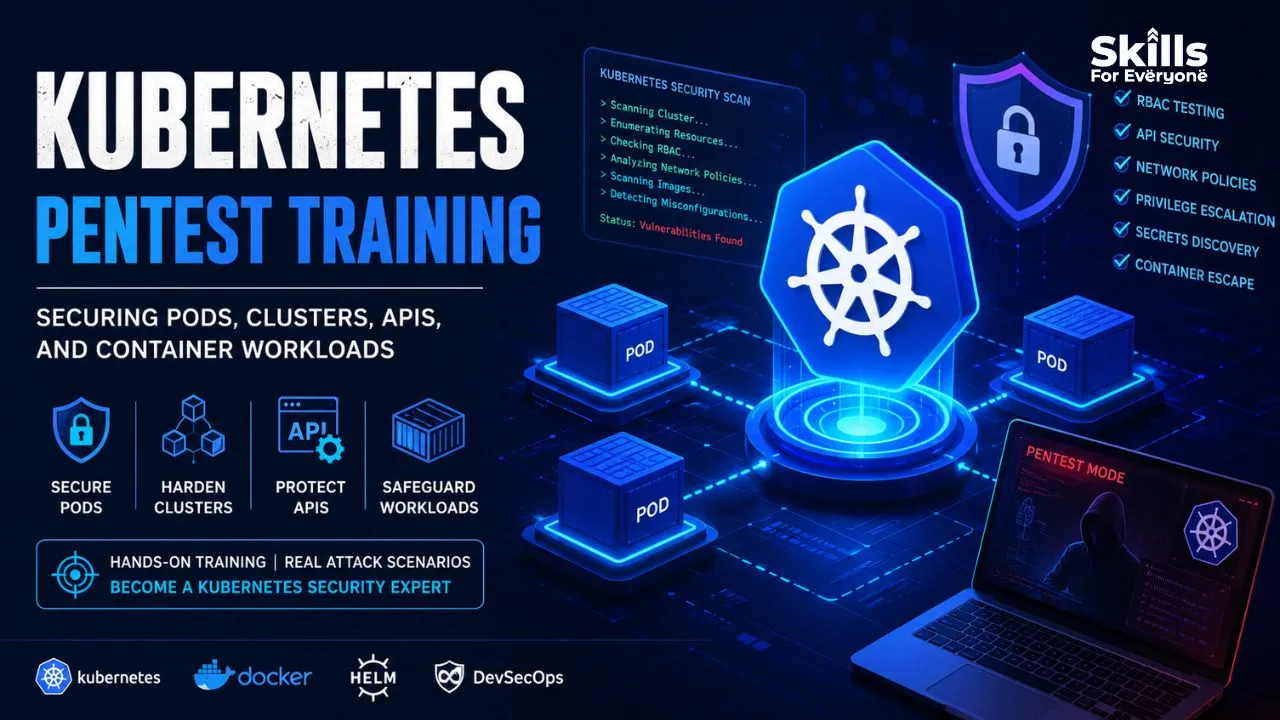
As organizations continue to adopt cloud-native technologies, Kubernetes has become the preferred platform for managing containerized applications at scale. While Kubernetes delivers flexibility, automation, and scalability, it also introduces new security challenges that traditional security teams may not be prepared to handle.
This growing complexity has increased demand for Kubernetes Pentest Training among cybersecurity professionals, DevSecOps teams, cloud engineers, and ethical hackers. Organizations want security experts who understand how attackers target Kubernetes environments and how to identify vulnerabilities before they can be exploited. From misconfigured Kubernetes RBAC permissions to exposed APIs and vulnerable container workloads, the attack surface is much larger than many teams realize.
Understanding Kubernetes penetration testing helps security professionals evaluate real-world risks while building practical skills to defend modern cloud infrastructure.
What Is Kubernetes Pentest Training
Kubernetes Pentest Training teaches security professionals how to assess and secure Kubernetes environments through ethical hacking techniques and real-world attack simulations.
Unlike traditional penetration testing, which focuses primarily on networks, servers, and web applications, Kubernetes pentesting targets cloud-native infrastructure. Students learn how to identify Kubernetes vulnerabilities, evaluate Kubernetes cluster security, test Kubernetes API security, and assess container security controls.
A well-designed training program combines theory with hands-on labs that simulate real attack scenarios. Participants learn both offensive and defensive techniques, allowing them to think like attackers while implementing effective security controls.
Why Kubernetes Security Matters
Kubernetes environments often host critical applications, sensitive data, and cloud infrastructure components. A single security weakness can expose an entire cluster to compromise.
Some of the most common Kubernetes security risks include:
Misconfigured RBAC permissions that grant excessive privileges to users or service accounts.
Exposed Kubernetes API endpoints that allow unauthorized access.
Insecure Secrets management that exposes credentials and tokens.
Privileged Containers capable of accessing host resources.
Weak Network Policies that allow unrestricted communication between workloads.
Container Escape vulnerabilities that enable attackers to break isolation boundaries.
Supply Chain Attacks introduced through compromised container images or dependencies.
Because Kubernetes environments are highly interconnected, a small mistake can quickly lead to privilege escalation, lateral movement, or even full cluster takeover.
Skills You Learn During Kubernetes Pentest Training
Effective Kubernetes penetration testing requires mastery across multiple domains:
Kubernetes Architecture Understanding: Learn how control planes, worker nodes, etcd databases, and container runtimes interact and where vulnerabilities exist
Pod Security Analysis: Identify misconfigurations in pod specifications, security contexts, and resource constraints
RBAC Exploitation: Discover how to test role bindings, service accounts, and permission escalation paths
API Server Assessment: Probe the Kubernetes API for authentication bypasses, authorization flaws, and data exposure
Network Policy Testing: Evaluate network segmentation and identify lateral movement opportunities
Secret Extraction Techniques: Practice retrieving and decoding stored secrets from etcd, environment variables, and mounted volumes
Container Escape Methods: Understand kernel vulnerabilities and runtime weaknesses that enable escape from pod isolation
Cluster Persistence: Learn techniques for maintaining access across cluster restarts and compromise detection evasion
Popular Tools Used During Kubernetes Pentesting
Tool | Purpose | Used For |
kubectl | Kubernetes CLI | API interaction, pod management, resource enumeration |
kube-hunter | Vulnerability scanner | Identifying weaknesses in running clusters |
kube-bench | Configuration auditor | CIS Kubernetes Benchmark compliance assessment |
Kubescape | Risk analysis platform | Runtime scanning and cluster security posture |
Trivy | Container image scanner | Detecting vulnerabilities in container images and registries |
Falco | Runtime security | Monitoring suspicious container and system behavior |
Kubeaudit | Configuration checker | Auditing Kubernetes manifests and deployments |
Nmap | Network scanner | Discovering services and open ports in cluster networks |
Burp Suite | Web proxy | Testing Kubernetes dashboard and API endpoints |
Metasploit | Exploitation framework | Demonstrating real-world attack chains and payloads |
Real-World Attack Scenarios Covered
Effective Kubernetes Pentest Training focuses on practical attack simulations that mirror real-world threats.
Compromising Pods
Attackers often begin by exploiting vulnerable applications running inside pods. Training teaches students how to identify weaknesses and understand the potential impact of pod compromise.
Privilege Escalation
Poorly configured Kubernetes RBAC policies frequently allow attackers to gain elevated permissions. Participants learn how privilege escalation occurs and how to prevent it.
API Server Exploitation
The Kubernetes API server is a critical component of cluster management. Security testing focuses on authentication weaknesses, authorization flaws, and exposed administrative functions.
Secrets Extraction
Many organizations accidentally expose API keys, passwords, and service account tokens. Pentesting exercises demonstrate how attackers locate and abuse these credentials.
Service Account Abuse
Compromised service accounts often provide access to additional resources within the cluster. Students learn how attackers leverage excessive permissions to expand their control.
Lateral Movement
Once inside a cluster, attackers attempt to move between workloads and namespaces. Security testing evaluates whether network policies effectively restrict movement.
Container Escape
Container escape attacks target weaknesses that allow attackers to access the underlying host system. These scenarios highlight the importance of secure container configurations.
Cluster Takeover
Advanced attack chains combine multiple weaknesses to gain administrative access to the entire Kubernetes cluster. Understanding these techniques helps defenders identify critical risks before attackers do.
Who Should Enroll
Kubernetes Pentest Training is valuable for professionals responsible for securing cloud-native environments.
Ideal candidates include:
Ethical Hackers
Penetration Testers
DevSecOps Engineers
Kubernetes Administrators
Security Engineers
Cloud Engineers
Red Team Professionals
Anyone pursuing a career in cloud native security or ethical hacking Kubernetes environments can benefit from this specialized training.
Benefits of Kubernetes Pentest Training
The advantages extend beyond technical knowledge. Professionals with Kubernetes security expertise command significantly higher salaries and attract interest from Fortune 500 companies investing heavily in cloud-native infrastructure. The training accelerates career progression by filling a critical skills gap in the market.
Organizationally, Kubernetes pentest training prevents costly breaches by identifying vulnerabilities before attackers do. It enables teams to understand their actual security posture rather than relying on compliance checklists. The hands-on nature of these programs builds confidence in handling real-world incidents and security incidents involving containerized workloads.
Conclusion
Kubernetes penetration testing is no longer optional for serious cybersecurity professionals. As organizations accelerate their cloud-native adoption, demand for experts who understand Kubernetes security risks has skyrocketed. Kubernetes pentest training provides the practical skills needed to identify vulnerabilities, exploit weaknesses ethically, and implement hardening measures that protect critical infrastructure.
The best way to master these skills is through hands-on practice in dedicated lab environments. Look for programs offering realistic scenarios, comprehensive tool training, and guidance from experienced Kubernetes security practitioners. Your investment in Kubernetes security training today will pay dividends throughout your cybersecurity career.
FAQs
1. What is Kubernetes pentesting?
Kubernetes pentesting is the process of identifying and validating security weaknesses in Kubernetes clusters, pods, APIs, and container workloads through authorized security testing.
2. Why is Kubernetes security important?
Kubernetes often hosts critical applications and sensitive data. Security weaknesses can lead to unauthorized access, data breaches, and cluster compromise.
3. How is Kubernetes penetration testing different from traditional pentesting?
Traditional pentesting focuses on networks and applications, while Kubernetes penetration testing targets cloud-native infrastructure, containers, orchestration platforms, and cluster security controls.
4. What tools are commonly used for Kubernetes pentesting?
Popular tools include kubectl, kube-hunter, kube-bench, Kubescape, Trivy, Falco, Kubeaudit, Nmap, Burp Suite, and Metasploit.
5. Do I need Kubernetes experience before taking training?
Basic Kubernetes knowledge is helpful, but many training programs provide foundational concepts before moving into advanced security topics.
6. What are the most common Kubernetes vulnerabilities?
Common issues include misconfigured RBAC permissions, insecure Secrets, exposed APIs, vulnerable container images, weak network policies, and privilege escalation paths.
7. Who should pursue Kubernetes security training?
Security engineers, penetration testers, DevSecOps professionals, cloud engineers, Kubernetes administrators, and red team members can all benefit.
8. What career opportunities are available after Kubernetes Pentest Training?
Professionals can pursue roles such as Kubernetes Security Engineer, Cloud Security Consultant, DevSecOps Engineer, Penetration Tester, Red Team Operator, or Cloud Security Architect.