Cyber Security
Begineer Friendly
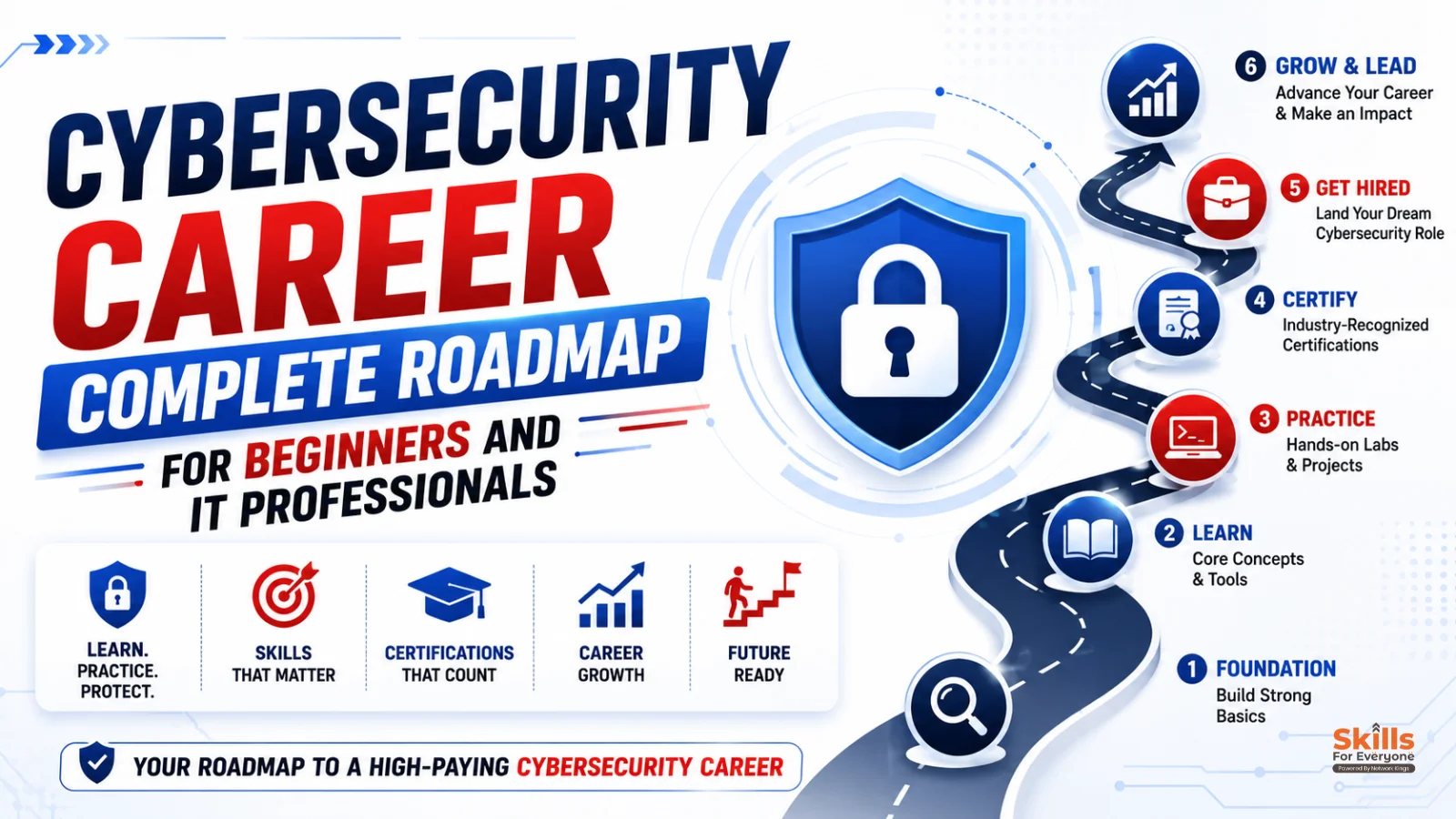
Every day, organizations face thousands of cyber threats ranging from phishing attacks and ransomware to cloud security breaches and insider threats. As businesses continue moving critical systems and data online, protecting digital assets has become a top priority. This shift has created unprecedented demand for cybersecurity professionals across industries.
A cybersecurity career is no longer limited to a small team of security specialists. Today, companies need SOC analysts, SOC engineers, cloud security experts, incident responders, threat hunters, and security architects to defend their environments. Whether you're a student exploring technology careers, an IT professional seeking a new challenge, or a network engineer looking to specialize, cybersecurity offers diverse career paths, excellent earning potential, and long-term growth opportunities.
This guide provides a practical cybersecurity roadmap that explains the skills, certifications, job roles, and learning strategies needed to build a successful career in cybersecurity.
What Is a Cybersecurity Career
A cybersecurity career focuses on protecting systems, networks, applications, and digital assets from cyber threats. Professionals in this field identify vulnerabilities, monitor security events, respond to incidents, and implement security controls to reduce organizational risk.
Cybersecurity is not a single job role. It includes multiple specializations such as:
Network Security
Cloud Security
Identity and Access Management (IAM)
Threat Hunting
Incident Response
Application Security
Governance, Risk, and Compliance
Digital Forensics
This variety allows professionals to choose a path that aligns with their technical interests and career goals.
Why Cybersecurity Is a High-Demand Career in 2026
Organizations face growing challenges from ransomware, phishing attacks, insider threats, and cloud security risks. As businesses migrate critical workloads to cloud platforms and adopt remote work environments, the need for skilled cybersecurity professionals continues to increase.
Several factors contribute to the strong demand:
Increasing cyber threats worldwide
Shortage of qualified cybersecurity professionals
Expanding cloud adoption
Growing regulatory requirements
Increased investment in digital transformation
Greater focus on Zero Trust security models
As a result, cybersecurity jobs are available across industries including finance, healthcare, government, retail, education, and technology.
Cybersecurity Career Roadmap for Beginners
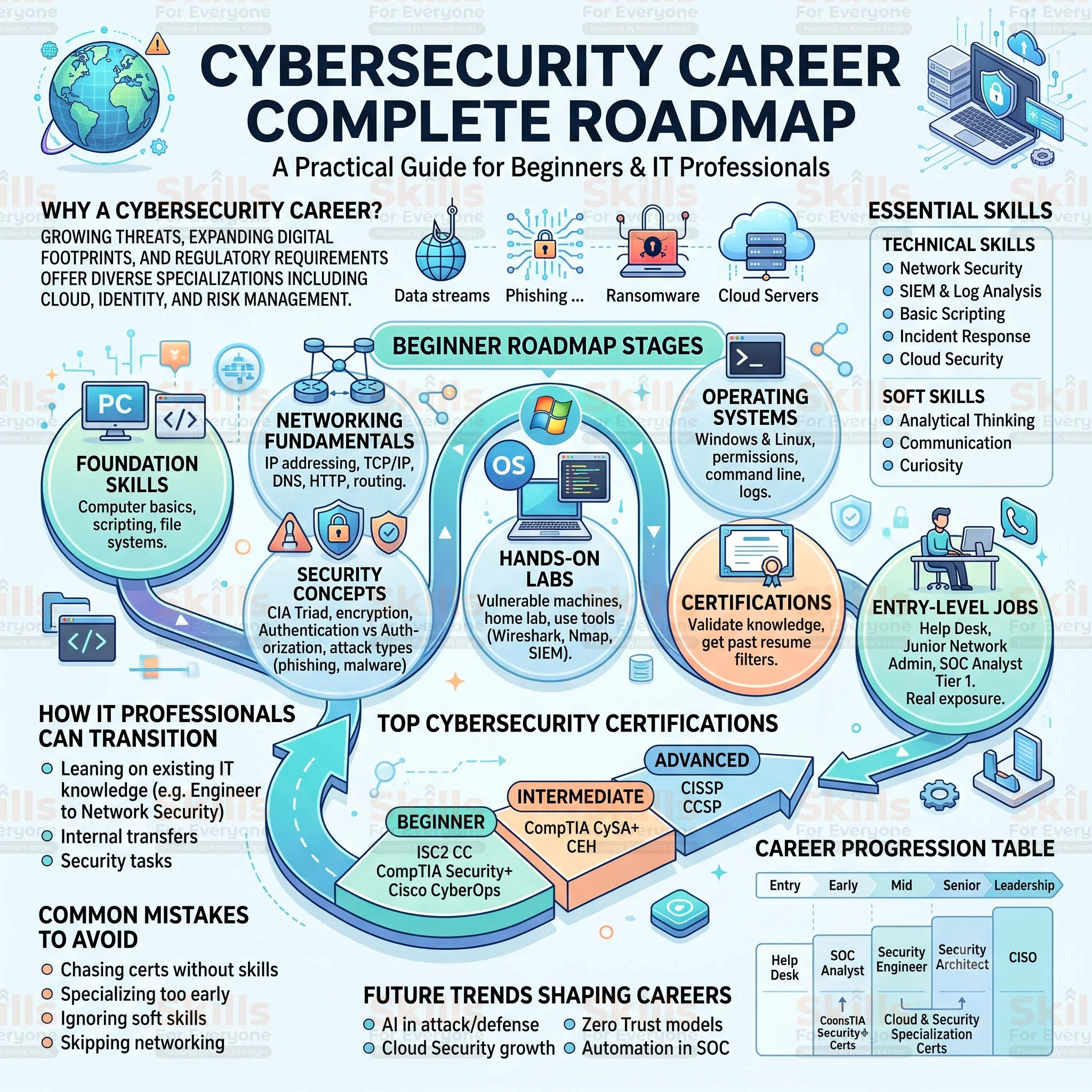
If you're starting from zero, the path can feel overwhelming. Breaking it into stages makes it manageable.
Foundation Skills
Before touching security tools, get comfortable with the basics of how computers and software actually work. Learn a bit of scripting, understand how data moves, and get familiar with common file systems. This groundwork makes everything that follows click faster.
Networking Fundamentals
You genuinely cannot succeed in security without understanding networking. Learn how IP addressing works, how routing and switching function, and how protocols like TCP/IP, DNS, and HTTP behave. Most attacks and most defenses happen at the network layer, so this isn't optional.
Operating Systems
Get hands-on with both Windows and Linux. Learn how permissions work, how processes run, how logs are generated, and how to navigate the command line comfortably. A huge portion of security work happens inside a terminal.
Security Concepts
Once the fundamentals are solid, move into core security concepts. Study the CIA triad, encryption basics, authentication versus authorization, and common attack types like phishing, malware, and social engineering. This is also where you'll start hearing terms like Zero Trust and IAM, which are becoming central to how modern organizations design their defenses.
Hands-On Labs
Reading about security only gets you so far. Set up a home lab, practice with vulnerable machines on platforms built for learning, and get comfortable using tools like Wireshark, Nmap, and a basic SIEM. Employers notice candidates who can talk about what they've actually built and broken.
Certifications
Once you've built a foundation, certifications validate what you know and help you get past resume filters. More on which ones matter in a moment.
Entry-Level Jobs
Your first cybersecurity job probably won't have "security" in the title. Roles like help desk technician, junior network administrator, or SOC Analyst Tier 1 are common entry points. They give you exposure to real systems and real incidents, which is worth more than another certification at this stage.
Essential Skills for a Successful Cybersecurity Career
Technical ability matters, but it's not the whole story. Here's what actually moves the needle.
Understanding of network security and how traffic flows across an environment.
Familiarity with SIEM platforms for log analysis and alert triage.
Basic scripting ability, often Python or PowerShell, to automate repetitive tasks.
Knowledge of incident response procedures and how to contain an active threat.
Awareness of cloud security principles, since most infrastructure now lives at least partly in the cloud.
Strong analytical thinking, since much of the job involves piecing together fragments of evidence.
Clear communication skills, because you'll often need to explain technical risk to non-technical stakeholders.
Curiosity and persistence, since threats evolve constantly and complacency is genuinely dangerous in this field.
Top Cybersecurity Job Roles and Career Paths
Cybersecurity isn't one job, it's a whole ecosystem of specializations.
SOC Analyst roles focus on monitoring alerts, investigating suspicious activity, and escalating real threats. This is where many people start their SOC Analyst career path.
Incident Responders step in when something has already been compromised, working to contain damage and restore normal operations quickly.
Penetration Testers are hired to think like attackers, probing systems for weaknesses before someone with bad intentions does.
Security Engineers design and build the defenses that keep systems protected, from firewalls to endpoint detection tools.
Cloud Security Specialists focus specifically on securing environments like AWS, Azure, and Google Cloud, which has become one of the fastest growing niches.
GRC professionals, short for governance, risk, and compliance, handle the policy and regulatory side of security, making sure organizations meet industry standards.
Threat Hunters proactively search for hidden threats that automated tools might miss, often digging through logs and behavioral patterns to catch what slipped through.
Cybersecurity Certifications Worth Pursuing
Selecting the right certification depends on your experience level and career goals.
Certification | Experience Level | Primary Focus |
ISC2 CC | Beginner | Security Fundamentals |
CompTIA Security+ | Beginner | General Cybersecurity |
Cisco CyberOps Associate | Beginner | SOC Operations |
CompTIA CySA+ | Intermediate | Security Analytics |
CEH | Intermediate | Ethical Hacking |
CISSP | Advanced | Security Management |
CCSP | Advanced | Cloud Security |
Certifications are most valuable when combined with hands-on experience and real-world projects.
Career Progression Table
Career Level | Typical Job Role | Recommended Certifications | Average Skill Level |
Entry Level | Help Desk, Junior SOC Analyst | CompTIA Security Plus, Network Plus | Beginner |
Early Career | SOC Analyst Tier 1 or 2 | CompTIA CySA Plus, CEH | Intermediate |
Mid Career | Incident Responder, Security Engineer | GCIH, OSCP, Cloud Security Certs | Advanced |
Senior Level | Security Architect, Threat Hunter | CISSP, GIAC Specializations | Expert |
Leadership | CISO, Security Director | CISSP, CISM | Expert and Strategic |
How IT Professionals Can Transition into Cybersecurity
If you're already working in IT, you have a head start that beginners don't. Network engineers already understand traffic flow and infrastructure. System administrators already know how permissions, patching, and logging work. Cloud engineers already understand the environments that security teams now spend most of their time protecting.
The smartest move is to lean into that existing knowledge rather than starting over. A network engineer moving into network security, for example, is a much shorter jump than someone starting from scratch. Look for security-adjacent tasks in your current role, volunteer for audits or incident response drills, and start layering security certifications on top of what you already know.
Internal transfers are also worth exploring. Many organizations would rather promote a known, trusted IT employee into a security role than hire an unknown external candidate.
Common Mistakes to Avoid
Chasing every certification without building any hands-on skill is a common trap. Certifications open doors, but they don't replace practical ability during interviews.
Trying to specialize too early is another one. Get a broad foundation first, then narrow down once you know what actually interests you.
Ignoring soft skills is a mistake too. Plenty of technically brilliant candidates get passed over because they struggle to communicate findings clearly.
Skipping networking fundamentals is probably the most common misstep. It catches up with almost everyone eventually, usually in an interview or during a real incident.
Future Trends Shaping Cybersecurity Careers
AI is changing both sides of this equation. Attackers are using it to craft more convincing phishing campaigns, while defenders are using it to spot anomalies faster than any human analyst could alone.
Zero Trust architecture is becoming the default design philosophy rather than an optional upgrade, which means IAM expertise is only going to become more valuable.
Cloud security continues to grow as a specialization on its own, separate from traditional network security, as more organizations run hybrid or fully cloud-native environments.
Automation within SOC environments is also picking up pace, shifting analyst work from repetitive triage toward higher-level investigation and threat hunting.
Conclusion
Building a cybersecurity career takes time, but the path is more accessible than most people assume. Start with strong fundamentals in networking and operating systems, layer in hands-on practice, earn certifications that match your goals, and don't underestimate the value of soft skills along the way.
Whether you're starting from scratch or transitioning from another IT role, the demand for skilled security professionals isn't slowing down anytime soon. The best time to start learning is now, one lab, one certification, and one small win at a time.
Frequently Asked Questions
Is cybersecurity a good career for beginners with no IT background?
Yes, though it takes longer. Starting with foundational IT knowledge before diving into security concepts makes the learning curve much more manageable.
How long does it take to start a cybersecurity career?
Most people land an entry-level role within six months to two years, depending on how consistently they study and build hands-on experience.
Do you need a degree for a cybersecurity career?
Not necessarily. Many professionals enter through certifications and hands-on experience rather than a traditional four-year degree, though a degree can help in some corporate environments.
What is the average cybersecurity salary?
Entry-level roles often start in the range of an average IT salary, while experienced professionals in specialized roles like penetration testing or security architecture can earn significantly more, often well into six figures at senior levels.
Which certification should I get first?
CompTIA Security Plus is generally the most recommended starting point for beginners.
Is a SOC Analyst a good first cybersecurity job?
Yes, it's one of the most common entry points because it exposes you to real alerts, real tools, and real incident patterns early on.
Can network engineers move into cybersecurity easily?
Yes, network engineers often transition smoothly since their existing knowledge overlaps heavily with network security and threat detection.