Cloud Security
Begineer Friendly
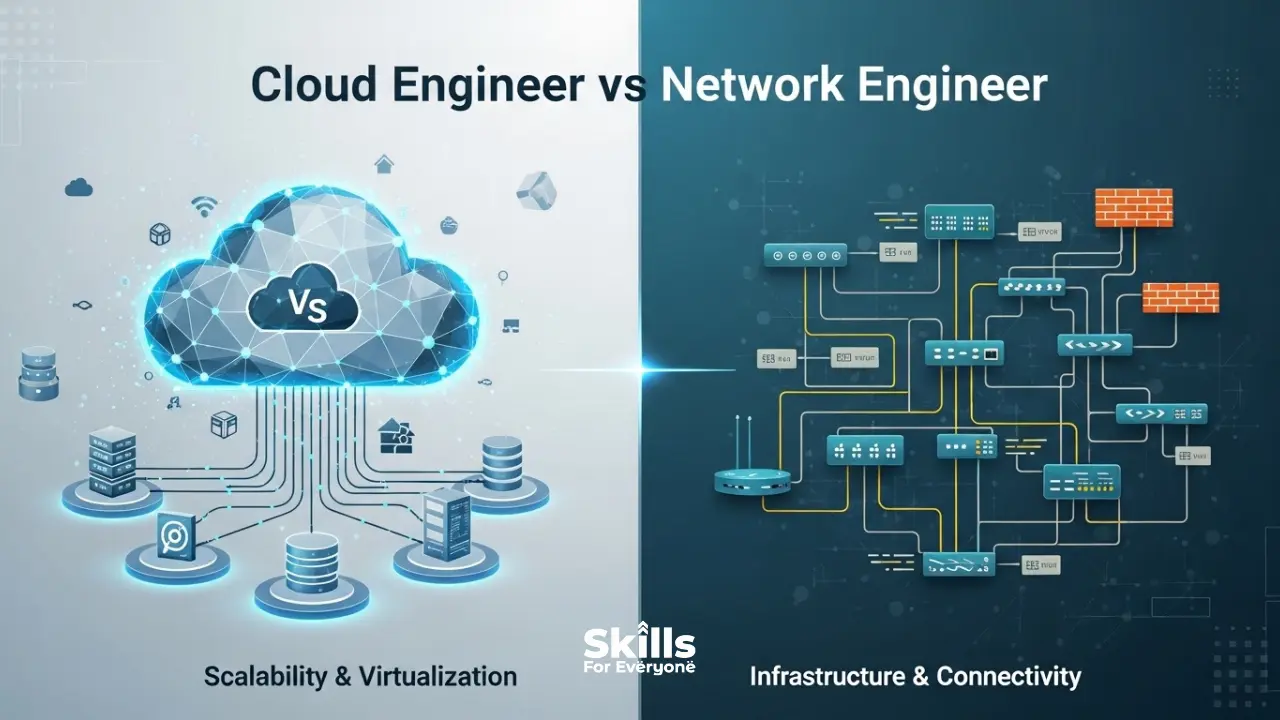
The IT industry is evolving faster than ever, and two roles that are increasingly in the spotlight are Cloud Engineer and Network Engineer. At first glance, they may seem similar — both deal with infrastructure, connectivity, and keeping systems running smoothly. But in practice, these are two distinctly different career paths with different skill sets, responsibilities, tools, and growth trajectories.
Whether you are a fresh IT graduate mapping out your career, a seasoned professional considering a transition, or a hiring manager trying to understand which role your team needs — this guide gives you a clear, honest, and expert-level breakdown of both professions.
Let's cut through the confusion and get to what really matters.
Who is a Cloud Engineer?

A Cloud Engineer is an IT professional responsible for designing, building, and maintaining cloud-based infrastructure and services. They work with platforms such as Amazon Web Services (AWS), Microsoft Azure, and Google Cloud Platform (GCP) to deploy scalable, secure, and cost-efficient systems that support business operations.
Cloud Engineers are often specialists within one of three sub-roles:
Cloud Architect — designs the overall cloud strategy and infrastructure blueprint
Cloud Developer — builds and deploys applications that run on cloud platforms
Cloud Operations Engineer — monitors, manages, and optimizes cloud environments post-deployment
Their work is largely software-defined, meaning they use code, automation scripts, and cloud-native tools rather than physical hardware to build and manage infrastructure.
Who is a Network Engineer?

A Network Engineer is an IT professional responsible for designing, implementing, and maintaining the physical and logical network infrastructure that connects devices, systems, and users within and across organizations. Their domain includes routers, switches, firewalls, VPNs, WANs, LANs, and increasingly, SD-WAN and wireless networks.
Network Engineers are the backbone of enterprise connectivity. Without them, data cannot travel, systems cannot communicate, and businesses cannot function. They typically specialize in areas such as:
Enterprise LAN/WAN design and management
Network security and firewall administration
Wireless network deployment and optimization
VoIP and unified communications infrastructure
Software-Defined Networking (SDN) and SD-WAN
Their work is rooted in a deep understanding of networking protocols — including BGP, OSPF, EIGRP, MPLS, and TCP/IP — and often involves hands-on interaction with physical hardware.
Cloud Engineer vs Network Engineer: Key Differences
Feature | Cloud Engineer | Network Engineer |
Primary Focus | Cloud platforms and virtual infrastructure | Physical and logical network infrastructure |
Work Environment | Largely remote and software-defined | On-site and hybrid environments |
Core Tools | AWS, Azure, GCP, Terraform, Kubernetes | Cisco, Juniper, Palo Alto, Wireshark |
Key Skills | Cloud architecture, DevOps, automation, IaC | Routing, switching, firewalls, SDN |
Certifications | AWS SAA, Azure AZ-104, GCP ACE | CCNA, CCNP, CCIE, CompTIA Network+ |
Avg. US Salary | USD 120,000 – 155,000/year | USD 90,000 – 130,000/year |
Growth Trajectory | Rapidly expanding with cloud adoption | Evolving toward automation and SDN |
Core Skills Comparison
Cloud Engineer Skills
To succeed as a Cloud Engineer, professionals need a strong combination of technical and architectural knowledge:
Proficiency in at least one major cloud platform — AWS, Azure, or GCP
Infrastructure as Code (IaC) using tools like Terraform, CloudFormation, or Ansible
Containerization and orchestration — Docker and Kubernetes
Cloud security best practices — IAM, encryption, compliance frameworks
Scripting and automation — Python, Bash, or PowerShell
Understanding of CI/CD pipelines and DevOps workflows
Cost management and cloud optimization strategies
Network Engineer Skills
A skilled Network Engineer brings deep protocol knowledge and practical hardware experience:
Advanced routing and switching — BGP, OSPF, EIGRP, VLANs, and STP
Firewall configuration and network security policy management
VPN design and implementation — IPsec, SSL VPN, and DMVPN
Wireless networking — WiFi 6, WPA3, and enterprise WLAN design
Network monitoring and troubleshooting — Wireshark, SolarWinds, SNMP
SD-WAN and software-defined infrastructure knowledge
Understanding of QoS for voice and video traffic optimization
Certifications That Define Each Path
Certifications play a major role in validating expertise and boosting earning potential in both fields.
Top Cloud Engineer Certifications:
AWS Certified Solutions Architect (Associate and Professional)
Microsoft Azure Administrator (AZ-104)
Google Cloud Professional Cloud Architect
HashiCorp Terraform Associate
Certified Kubernetes Administrator (CKA)
Top Network Engineer Certifications:
Cisco CCNA — entry-level networking foundation
Cisco CCNP Enterprise — professional-level enterprise networking
Cisco CCIE — expert-level, one of the most prestigious IT credentials globally
Palo Alto PCNSE — network security specialization
CompTIA Network+ — vendor-neutral networking certification
Career Outlook and Salary Comparison
Both roles are in high demand, but for different reasons.
Cloud Engineers are benefiting from a global, accelerating shift to cloud infrastructure. Virtually every organization — from startups to governments — is migrating workloads to the cloud, and skilled Cloud Engineers are in critically short supply. According to industry reports, cloud computing roles are among the fastest-growing in all of tech, with demand expected to grow significantly through 2030.
Network Engineers remain indispensable because physical infrastructure still underpins all cloud connectivity. Additionally, the rise of SD-WAN, network automation, and 5G is creating new demand for Network Engineers who can bridge traditional networking with modern software-defined paradigms.
Salary ranges (United States):
Cloud Engineer: USD 120,000 – USD 155,000/year
Senior Cloud Architect: USD 150,000 – USD 180,000/year
Network Engineer: USD 90,000 – USD 130,000/year
Senior Network Architect: USD 130,000 – USD 160,000/year
Which Career Path Should You Choose?
The right choice depends on your existing skills, interests, and long-term goals.
Choose Cloud Engineering if you:
Enjoy working with software, APIs, and automation tools
Are comfortable writing code or scripting
Want to work in a rapidly growing, high-demand field
Prefer flexible, remote-friendly work environments
Are interested in DevOps, platform engineering, or cloud architecture
Choose Network Engineering if you:
Have a strong foundation in networking protocols and hardware
Enjoy diagnosing and solving connectivity and performance issues
Want to work toward elite certifications like CCIE
Are interested in security, SDN, or enterprise infrastructure
Prefer a deep specialization with clear, long-term career progression
It is also worth noting that the two fields are converging. As cloud adoption grows, Network Engineers are increasingly expected to understand cloud networking, and Cloud Engineers need a solid grasp of networking fundamentals. Professionals who develop expertise in both domains — often called Cloud Network Engineers — are among the most sought-after in the industry today.
Cloud Engineer and Network Engineer are both excellent, future-proof career choices — but they lead in different directions. Cloud Engineering offers rapid growth and high compensation in an environment defined by software and automation. Network Engineering offers deep technical mastery, elite certification pathways, and irreplaceable relevance in enterprise infrastructure.
The best advice is simple: go where your strengths and genuine interests point you. Build real skills, earn recognized certifications, and gain hands-on experience. Whichever path you choose, both roles sit at the heart of how the modern digital world is built and kept running.
FAQs
1. Which is better: Cloud Engineer or Network Engineer?
Both roles are excellent, but the “better” option depends on your interest. Cloud Engineering suits those who enjoy automation, coding, and cloud platforms, while Network Engineering is ideal for those passionate about networking protocols, hardware, and infrastructure.
2. Do Cloud Engineers need networking knowledge?
Yes, networking fundamentals are essential for Cloud Engineers. Understanding concepts like IP addressing, DNS, VPNs, and load balancing is critical for designing secure and scalable cloud architectures.
3. Is Network Engineering still a good career in 2026 and beyond?
Absolutely. Despite cloud growth, Network Engineers remain crucial as they manage the backbone of connectivity. With trends like SD-WAN, 5G, and network automation, the demand continues to evolve and grow.
4. Can a Network Engineer transition into a Cloud Engineer role?
Yes, many professionals successfully transition by learning cloud platforms (AWS, Azure, GCP), automation tools, and DevOps practices. Networking knowledge actually gives a strong advantage in cloud roles.
5. Which role has a higher salary: Cloud Engineer or Network Engineer?
Generally, Cloud Engineers earn higher salaries due to increasing demand and cloud adoption. However, highly experienced Network Engineers with certifications like CCIE can also command top-tier salaries.
6. What certifications should I start with for each career path?
For Cloud Engineering, start with AWS Solutions Architect Associate or Azure AZ-104. For Network Engineering, begin with CCNA and then move to CCNP or CCIE for advanced expertise.
7. Can I learn both Cloud and Networking together?
Yes, and it’s highly recommended. Professionals skilled in both domains (Cloud Networking) are in high demand, as companies need experts who understand both infrastructure and cloud environments.