Networking
Begineer Friendly

Networking careers are shifting faster than at any point in the last two decades. Cloud migration changed how networks are built, and now artificial intelligence is changing how they are managed, monitored, and secured. For professionals wondering where to focus next, developing AI skills for network engineers is quickly becoming one of the smartest career moves available. Engineers who understand both traditional networking and AI-driven tools are positioning themselves for roles that simply did not exist five years ago.
Why AI Matters for Modern Network Engineers
Traditional networking relied on manual configuration, static thresholds, and reactive troubleshooting. That model is breaking down under the weight of modern network complexity. Enterprise networks now span data centers, multiple clouds, remote sites, and thousands of connected devices, generating more telemetry than any human team can review manually.
AI changes the equation by processing that data continuously, spotting anomalies before they become outages, and automating repetitive tasks that used to consume hours of engineering time. Network engineers who bring AI literacy to the table are not being replaced by these tools. They are the ones operating them, tuning them, and making decisions based on their output.
Top AI Skills Every Network Engineer Should Learn
Python Programming for Automation
Python remains the backbone of network automation. It powers most AI libraries and automation frameworks, including tools like Netmiko, NAPALM, and Nornir.
Learning Python lets engineers write scripts that configure devices, pull telemetry, and interact with AI models through APIs. A practical example is a script that pulls interface statistics from hundreds of routers and feeds that data into a model trained to spot abnormal traffic patterns.
Engineers with strong Python skills are consistently favored for automation and DevNet-style roles, which tend to pay more than traditional operations positions.
Machine Learning Fundamentals
Machine learning is the discipline behind pattern recognition in network data. Engineers do not need to become data scientists, but understanding concepts such as supervised learning, anomaly detection, and model training helps them work effectively with AI-powered platforms.
A common application is predictive maintenance, where a model trained on historical failure data flags equipment likely to fail before it does. Understanding how that model works makes an engineer far more effective at deploying and trusting these systems.
Generative AI and AI Assistants
Generative AI tools are increasingly built into network management platforms, ticketing systems, and documentation workflows. Engineers who use these assistants effectively can generate configuration templates, summarize incident reports, and draft documentation in a fraction of the usual time.
For example, an engineer troubleshooting a BGP flapping issue can use an AI assistant to summarize log files and suggest likely root causes, cutting investigation time.
Network Data Analytics
Modern networks produce enormous volumes of data through SNMP, NetFlow, sFlow, and streaming telemetry. Data analytics skills let engineers turn that raw data into actionable insight rather than noise, helping them justify capacity upgrades, catch security issues early, and demonstrate the business value of network investments.
AI-Powered Network Monitoring
AI-powered monitoring platforms use baseline behavior models instead of static thresholds. Rather than alerting only when a metric crosses a fixed number, these systems learn what normal looks like for a specific network and flag genuine deviations, reducing alert fatigue and catching subtle issues, such as a slow memory leak on a switch, before they cause an outage.
Network Automation and Orchestration
Automation and orchestration go beyond scripting individual tasks. Orchestration platforms coordinate multi-step workflows across an entire network, such as provisioning a new branch office in minutes instead of days. AI enhances orchestration by making decisions within those workflows, such as selecting the optimal path for traffic based on current conditions rather than a fixed configuration.
AI for Network Security
AI plays a growing role in threat detection, particularly for identifying patterns that signature-based tools miss. Behavioral analysis models can detect lateral movement, unusual data exfiltration, or command-and-control traffic that would otherwise blend into normal activity. Engineers who understand how these models work are better prepared to respond to incidents and reduce false positives.
Cloud and AI Integration
Most enterprise AI tools run in the cloud and rely on cloud-native data pipelines. Understanding how networking connects to platforms such as AWS, Azure, and Google Cloud is essential for deploying AI tools that monitor hybrid environments effectively.
Prompt Engineering for IT Operations
Prompt engineering is the practice of structuring requests to AI tools so they return accurate, useful output. For network engineers, this might mean writing prompts that generate configuration snippets or extract specific details from lengthy log files. It is a low barrier skill with a high return, since it directly improves the output quality of tools engineers already use daily.
Understanding AI-Driven Networking Platforms
Vendors including Cisco, Juniper, and Arista now embed AI directly into their platforms for predictive analytics and automated root cause analysis. Familiarity with these platforms, even at a conceptual level, helps engineers evaluate vendor claims and choose the right tools.
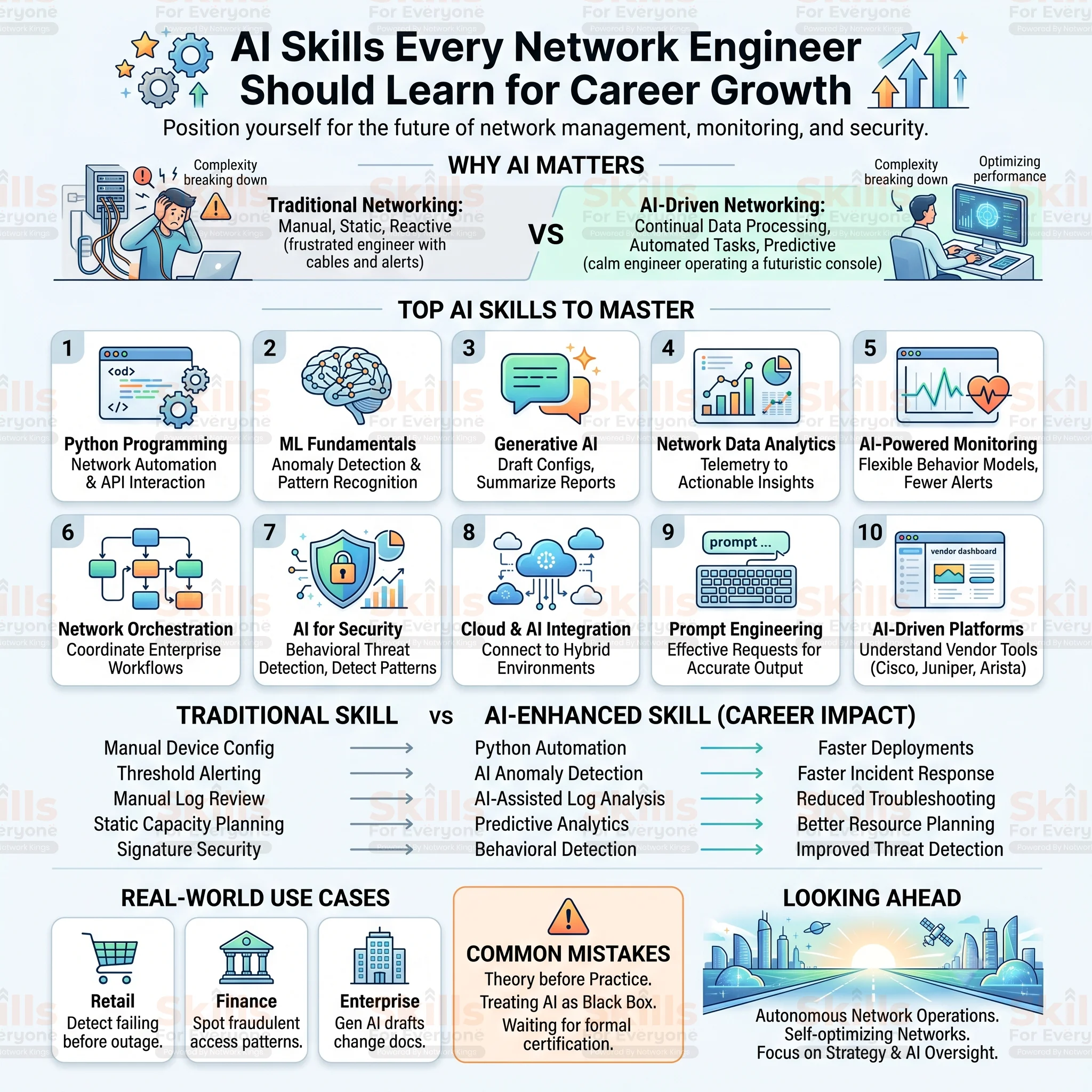
AI Skills vs Traditional Networking Skills
Traditional Skill | AI-Enhanced Skill | Career Impact |
Manual device configuration | Python-based automation | Faster deployments, higher pay for automation roles |
Threshold-based alerting | AI-driven anomaly detection | Fewer false positives, faster incident response |
Manual log review | AI-assisted log analysis | Reduced troubleshooting time |
Static capacity planning | Predictive analytics | Better resource planning and cost control |
Signature-based security tools | Behavioral threat detection | Improved detection of advanced threats |
Real-World Use Cases of AI in Networking
A large retail chain used AI-powered monitoring to detect a failing WAN link at a distribution center days before it caused an outage, based on subtle latency patterns invisible to static thresholds. A financial services company applied machine learning to detect fraudulent access patterns across its branch network, reducing false security alerts significantly. Enterprise IT teams increasingly use generative AI assistants to draft network change documentation, cutting hours of administrative work each week.
Common Mistakes Network Engineers Make When Learning AI
Many engineers try to learn machine learning theory before building practical automation skills, which slows progress. A better approach is to start with Python scripting and simple API integrations, then layer in AI concepts as they become relevant.
Another common mistake is treating AI tools as black boxes and blindly trusting their output. Engineers should validate AI-generated recommendations against their own network knowledge, especially for security and configuration changes.
Finally, some engineers wait for formal certification before experimenting. Hands-on practice with free tools, sandbox environments, and open-source datasets is often more valuable than certification alone.
Future of AI in Networking
Expect AI to move further into autonomous network operations, where systems handle routine remediation without human intervention. Self-optimizing networks that adjust routing and capacity in real time are already emerging in service provider environments. Engineers who understand these systems will move into higher-value roles focused on strategy and AI oversight rather than routine maintenance.
Conclusion
The networking field is not being replaced by AI, but it is being redefined by it. Engineers who invest in AI skills for network engineers today are setting themselves up for the roles that will define the next decade of IT infrastructure. Starting with Python, layering in machine learning fundamentals, and getting comfortable with AI-powered monitoring and security tools is a practical path that pays off quickly. The best time to start building these skills is now, before they become a baseline expectation rather than a differentiator.
FAQs
What AI skills should a network engineer learn first?
Python programming for automation is the best starting point, since it forms the foundation for most AI-powered networking tools and integrations.
Do network engineers need to learn data science to use AI?
No. A working understanding of machine learning concepts is enough for most roles. Deep data science expertise is only necessary for specialized AI engineering positions.
How does AI improve network monitoring?
AI-powered monitoring uses behavioral baselines instead of static thresholds, allowing it to detect subtle anomalies and reduce false alerts compared to traditional monitoring tools.
Can AI replace network engineers?
AI automates repetitive tasks and improves detection accuracy, but it still requires skilled engineers to interpret results, validate decisions, and manage exceptions.
What certifications help with AI and networking careers?
Certifications focused on network automation, such as Cisco DevNet, along with foundational AI or machine learning courses, are useful for building credibility in this area.
Is prompt engineering a useful skill for IT professionals?
Yes. Prompt engineering improves the accuracy and usefulness of AI assistant output, which directly benefits day-to-day tasks like troubleshooting and documentation.
How is AI used in network security?
AI is used to detect behavioral anomalies such as unusual traffic patterns or lateral movement, which helps identify threats that traditional signature-based tools often miss.