Networking
Begineer Friendly

The networking industry continues to evolve as organizations adopt cloud computing, hybrid infrastructure, network automation, and advanced cybersecurity frameworks. Despite these changes, one fact remains consistent: skilled networking professionals are in high demand.
For aspiring and experienced IT professionals alike, earning one of the highest paying networking certifications can significantly improve career opportunities, salary potential, and long-term job security. Certifications validate your expertise, demonstrate commitment to professional growth, and help employers identify qualified candidates in a competitive market.
However, not all certifications deliver the same return on investment. Some require substantial time and financial commitment but can lead to high-paying roles and faster career advancement. This guide explores the networking certifications with the highest ROI and salary potential in 2026 and helps you determine which path aligns best with your career goals.
What Makes a Networking Certification Worth It
Not every certification is created equal, and the difference usually comes down to five factors.
Industry demand matters more than the letters after your name. A certification tied to skills employers are actively hiring for, like cloud networking or zero trust security, will always outperform one tied to a shrinking niche.
Employer recognition is the second piece. Cisco, CompTIA, AWS, and Palo Alto Networks show up in job descriptions constantly, which means hiring managers already know what those credentials represent. Lesser known vendor certifications can be excellent skill builders, but they rarely carry the same weight in a resume screen.
Salary impact is the number most people care about, and the data backs up the hype for the right certifications. A network engineer with a CCNA certification often earns noticeably more than an uncertified peer in the same role, and that gap widens significantly at the CCNP and CCIE level.
Career advancement is where certifications quietly do their best work. They rarely guarantee a promotion on their own, but they open the door to interviews, internal transfers, and specialized roles that would otherwise be out of reach.
Certification costs versus long-term returns is the ROI conversation itself. A CCNA exam costs a few hundred dollars. A CCIE track, including lab attempts and training, can run into five figures. The question is not which certification is cheapest. It is which one pays for itself the fastest and keeps paying for years afterward.
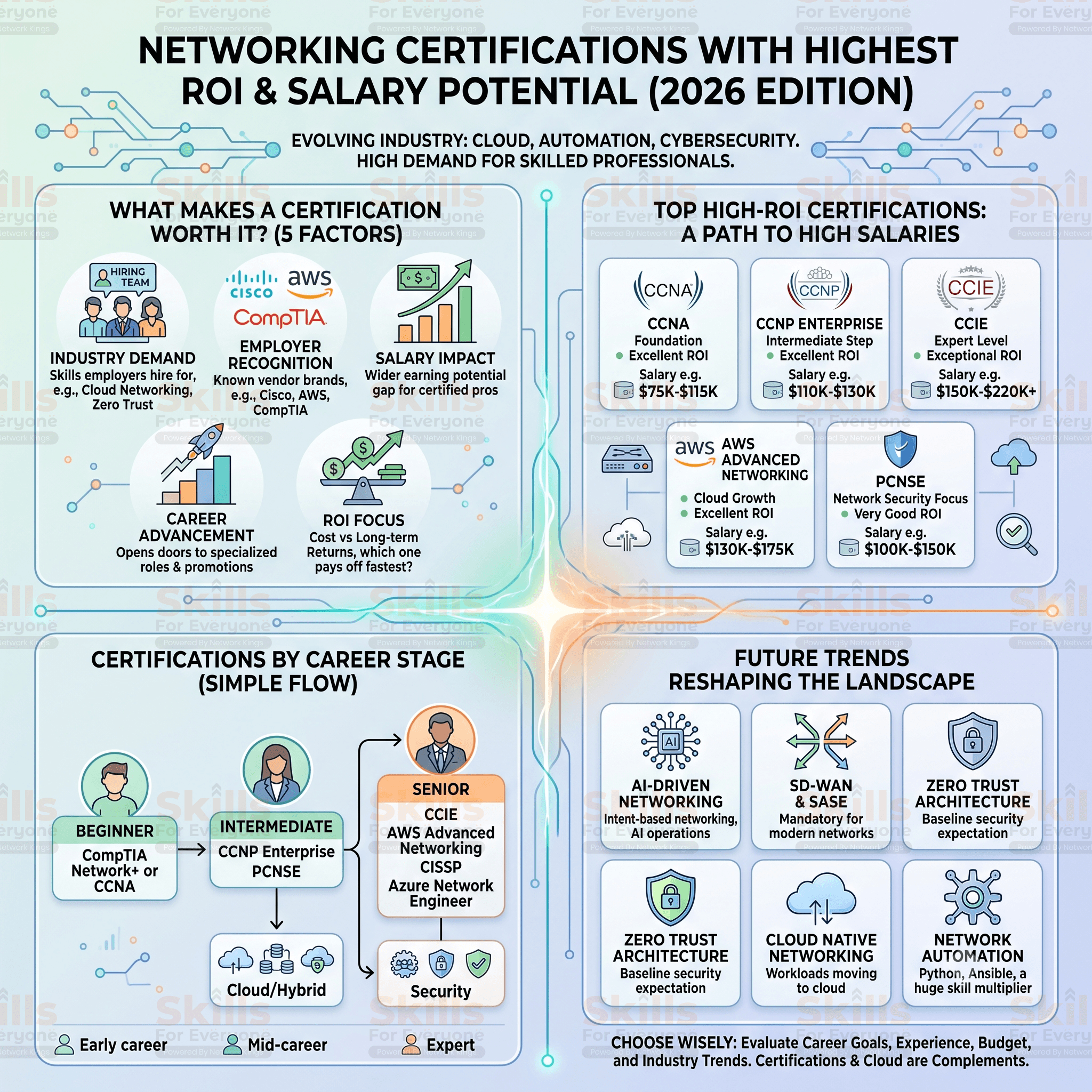
Top Networking Certifications with the Highest ROI and Salary Potential
CCNA (Cisco Certified Network Associate)
CCNA remains the standard entry point into professional networking. It covers IP addressing, routing and switching fundamentals, network access, IP services, security fundamentals, and automation basics.
Recommended experience level is entry to early career, though many self taught candidates pass it with focused study. Typical roles include network technician, junior network administrator, and NOC analyst. Reported average salaries for CCNA holders in the United States generally fall between roughly 75,000 and 115,000 dollars depending on the data source, role, and location, with senior professionals who pair CCNA with experience clearing 140,000 dollars or more.
ROI potential is excellent because the exam cost is low relative to the salary lift it produces. The main limitation is that CCNA alone has a ceiling. It works best as a foundation, not a final destination.
CCNP Enterprise
CCNP Enterprise is the professional level credential that proves you can design, deploy, and troubleshoot complex enterprise networks. It builds on CCNA topics with deeper coverage of advanced routing, wireless, SD-WAN, and automation.
This certification suits professionals with two to five years of hands-on experience. Typical roles include network engineer, senior network administrator, and infrastructure specialist. Average salaries typically land between 110,000 and 130,000 dollars, with security focused tracks often pushing higher.
ROI is strong because the jump from CCNA to CCNP tends to add a meaningful percentage to base pay. The tradeoff is a steeper study curve and a real time investment, usually several months of dedicated preparation.
Cisco Certified Internetwork Expert (CCIE)
CCIE is the most respected credential in traditional networking. It requires passing a demanding written exam followed by an eight hour hands-on lab exam, with pass rates commonly cited around 20 to 30 percent on the first attempt.
This is an expert level certification best suited to engineers with five or more years of experience. Typical roles include principal engineer, network architect, and technical consultant. Salary data varies by source and track, but CCIE holders commonly earn between 150,000 and 220,000 dollars, and CCIE Security specialists in senior roles can clear 250,000 dollars in competitive markets like financial services.
ROI over a career is exceptional given how few professionals hold the credential worldwide. The limitations are real too. The total investment in training, lab attempts, and study time often reaches five figures, and the preparation timeline typically runs twelve to eighteen months.
CompTIA Network+
Network+ is a vendor neutral certification covering networking concepts, infrastructure, network operations, security, and troubleshooting. It works well for people who are not yet committed to a specific vendor ecosystem.
It suits complete beginners and IT support professionals moving into networking. Typical roles include help desk technician, junior systems administrator, and entry level network support. Average salaries tend to fall between 65,000 and 90,000 dollars.
ROI is solid for the price of entry since the exam and study materials cost far less than a Cisco track. The limitation is a lower salary ceiling compared to CCNA and beyond, since Network+ does not lead into a deeper vendor specific career ladder the way Cisco certifications do.
Palo Alto Networks Security Engineer Certifications (PCNSE)
PCNSE validates the ability to design, deploy, and manage Palo Alto Networks security platforms, including next generation firewalls and Panorama management.
This credential fits professionals with a few years of security or network experience. Typical roles include network security engineer, firewall administrator, and security operations specialist. Salary ranges commonly fall between 100,000 and 150,000 dollars, with senior specialists earning more depending on employer and location.
ROI is strong because Palo Alto is one of the most widely deployed next generation firewall platforms in enterprise environments, and demand for specialists consistently outpaces supply. The limitation is that it is vendor specific, so the skills transfer less directly if an employer runs a different security stack.
AWS Advanced Networking Specialty
This certification proves advanced skill in designing and implementing AWS networking architectures, including hybrid connectivity, VPC design, and network security within the AWS ecosystem.
It is best suited to experienced network engineers who are transitioning into cloud infrastructure roles. Typical roles include cloud network engineer, cloud infrastructure architect, and hybrid network specialist. Cloud networking specialists who combine traditional routing knowledge with AWS expertise commonly earn between 130,000 and 175,000 dollars, reflecting the growing premium for hybrid cloud and on premises fluency.
ROI is climbing fast as enterprises move core network infrastructure into the cloud. The limitation is that this certification assumes strong existing networking fundamentals, so it is not a beginner friendly starting point.
Microsoft Azure Network Engineer Associate
This certification validates skills in implementing and managing Azure networking, including hybrid networking, load balancing, and network security within Microsoft's cloud ecosystem.
It fits network professionals moving into Microsoft centric cloud environments. Typical roles include Azure network engineer and cloud network administrator. Reported salaries for Azure focused network roles generally range from about 95,000 to 140,000 dollars depending on experience and region.
ROI is strong for professionals already working in organizations built around Microsoft's cloud stack. The limitation is similar to AWS Advanced Networking. It rewards people who already understand networking fundamentals rather than teaching them from scratch.
Juniper JNCIS and JNCIP
Juniper's professional track certifies skills on Junos based platforms, which are common in service providers and large enterprise environments. JNCIS covers associate to specialist level knowledge, while JNCIP moves into professional level design and troubleshooting.
This path suits engineers working in or targeting service provider and carrier grade networking roles. Typical roles include service provider network engineer and Junos network specialist. Salaries generally track close to Cisco's CCNP equivalent, often in the 100,000 to 140,000 dollar range depending on role and region.
ROI is highest for professionals already in or targeting the service provider space, where Juniper hardware is common. The limitation is a smaller job market compared to Cisco certified roles, since Cisco dominates enterprise networking more broadly.
Fortinet NSE Certifications
Fortinet's Network Security Expert program spans multiple levels, from foundational awareness up through expert level architecture and design. Mid to upper levels like NSE 4 through NSE 7 are the ones employers actively look for.
This track fits security focused network professionals, particularly those working in mid market and enterprise environments where Fortinet firewalls are deployed. Typical roles include network security engineer and firewall specialist. Salaries for NSE certified professionals commonly sit in the 90,000 to 140,000 dollar range depending on level and experience.
ROI is attractive because the certifications are relatively affordable to earn and Fortinet has a large installed base among mid sized enterprises. The limitation, like Palo Alto certifications, is that it is vendor specific.
CISSP for Networking and Security Professionals
CISSP is not a networking certification in the traditional sense, but it carries enormous weight for network professionals who move toward security leadership. It covers security and risk management, asset security, architecture, and more across eight domains.
It requires a minimum of five years of relevant work experience, making it best suited to mid career and senior professionals. Typical roles include security architect, network security manager, and information security officer. CISSP holders frequently earn well above 120,000 dollars, with many senior roles reaching considerably higher depending on industry and responsibility.
ROI is very strong for professionals aiming at leadership or architecture roles that blend networking and security. The limitation is the experience requirement, which rules it out as a starting certification.
Comparison Table
Certification | Difficulty Level | Certification Cost | Average Salary | Industry Demand | ROI Rating | Best For |
CompTIA Network+ | Beginner | Low (roughly 350 dollars) | 65,000 to 90,000 | High | Good | IT support entering networking |
CCNA | Beginner to Intermediate | Low to moderate (roughly 300 to 400 dollars) | 75,000 to 115,000 | Very high | Excellent | Aspiring network engineers |
CCNP Enterprise | Intermediate to Advanced | Moderate (exam fees plus training) | 110,000 to 130,000 | Very high | Excellent | Mid career network engineers |
Juniper JNCIS/JNCIP | Intermediate to Advanced | Moderate | 100,000 to 140,000 | Moderate | Good | Service provider engineers |
Fortinet NSE (4 to 7) | Intermediate to Advanced | Low to moderate | 90,000 to 140,000 | High | Good | Security minded network engineers |
Palo Alto PCNSE | Advanced | Moderate | 100,000 to 150,000 | High | Very good | Firewall and security specialists |
Azure Network Engineer Associate | Advanced | Moderate | 95,000 to 140,000 | High and rising | Very good | Cloud focused network engineers |
AWS Advanced Networking Specialty | Advanced | Moderate | 130,000 to 175,000 | High and rising | Excellent | Hybrid and cloud network architects |
CISSP | Advanced (experience gated) | Moderate to high | 120,000 and up | Very high | Excellent | Security leadership track |
CCIE (any track) | Expert | High (5 figures with training) | 150,000 to 220,000+ | High, limited talent pool | Exceptional | Senior architects and consultants |
Highest Paying Networking Certifications by Career Stage
Beginners should start with CompTIA Network+ or move directly into CCNA if they are confident in their fundamentals. CCNA generally delivers a stronger long term payoff because it opens the door to CCNP and CCIE later.
Intermediate professionals with two to five years of experience get the most value from CCNP Enterprise, CCNP Security, or a Palo Alto PCNSE if they are leaning toward security work. This is the stage where specialization starts paying real dividends.
Senior engineers with strong hands-on experience should evaluate whether CCIE fits their goals. It delivers the highest ceiling in traditional networking, but only makes sense if you plan to stay in architecture, design, or consulting roles for years to come.
Cloud networking professionals should prioritize AWS Advanced Networking Specialty or Azure Network Engineer Associate. These credentials currently show some of the fastest salary growth in the field as enterprises push more infrastructure into hybrid and cloud environments.
Network security professionals benefit most from stacking a security focused Cisco track, a Palo Alto or Fortinet certification, and eventually CISSP once they hit the five year experience mark.
Networking Certifications vs Cloud Certifications
Networking certifications and cloud certifications are not competitors. They are complements. A pure cloud certification like an AWS Solutions Architect credential teaches you how to build in the cloud, but it assumes you already understand the underlying network concepts like routing, subnetting, and firewalls.
Career opportunities expand significantly when you hold both. A network engineer with CCNP plus AWS Advanced Networking Specialty is far more marketable than someone with only one or the other, because they can bridge the on premises and cloud worlds that most enterprises still operate simultaneously.
Salary expectations reflect that blend. Hybrid network engineers who understand both traditional infrastructure and cloud networking commonly out-earn specialists who only know one side, often by 20,000 dollars or more.
Networking fundamentals remain critical in cloud environments because the cloud did not eliminate networking. It just moved it. Virtual private clouds, transit gateways, peering, and hybrid connectivity all rely on the same core concepts you learn in CCNA and CCNP. Engineers who skip the fundamentals and jump straight to cloud tools often hit a ceiling when something breaks at the protocol level.
How to Choose the Right Networking Certification
Start with your career goals. If you want to stay in traditional enterprise networking, the CCNA to CCNP to CCIE ladder is still the clearest path. If you are drawn to cloud infrastructure, prioritize AWS or Azure networking credentials after you have solid fundamentals. If security excites you, look at Palo Alto, Fortinet, or CISSP once you have the experience to qualify.
Consider your current experience honestly. Jumping straight to CCIE or CISSP without a foundation usually backfires. Build fundamentals first, then specialize.
Budget matters too. If you are self-funding your certification path, start with the lower cost credentials that still carry strong ROI, like CCNA or Network+, before committing to an expensive track like CCIE.
Watch industry trends as you plan. Automation, cloud networking, and security are absorbing more of the growth in networking roles, while pure hardware focused roles are growing more slowly. Certifications that touch those growth areas tend to hold their value longer.
Finally, think about long term growth potential rather than just your next job. A certification that sets up a five year career trajectory, like CCNP leading into CCIE or a security specialization, is usually worth more than one that only helps you land the very next role.
Future Trends in Networking Certifications
Several shifts are already reshaping what employers expect from certified professionals.
AI driven networking is pushing certification bodies to add content on intent based networking and AI assisted troubleshooting, since network operations teams increasingly rely on AI tools to detect anomalies before they cause outages.
SD-WAN and SASE knowledge is becoming close to mandatory. Companies are replacing traditional MPLS circuits with software defined alternatives, and certifications that ignore this shift will lose relevance quickly.
Zero trust architecture is now a baseline expectation rather than a specialty. Security certifications that do not address zero trust principles are falling behind ones that do.
Cloud native networking continues to grow as more workloads move away from traditional data centers entirely, which is why AWS and Azure networking credentials are climbing the salary charts so fast.
Network automation is arguably the single biggest skill multiplier right now. Professionals who pair a networking certification with Python and Ansible skills consistently report some of the largest salary jumps in the field, often outpacing the value of the certification alone.
Conclusion
The highest paying networking certifications in 2026 share a common thread. They prove you can solve problems that are expensive for a business to leave unsolved, whether that is a security gap, a fragile enterprise network, or a messy hybrid cloud migration. CCIE still sits at the top of the pay scale for traditional networking, CCNP Enterprise remains one of the strongest mid career investments, and cloud networking certifications like AWS Advanced Networking Specialty are climbing fast as infrastructure keeps moving off premises.
There is no single right answer for everyone. The right certification depends on where you are in your career and where you want to go next. What matters is starting with a credential that matches your current experience, stacking skills deliberately, and treating certification as one part of a broader plan that includes real hands-on practice.
If you are ready to move forward, pick one certification from this guide that matches your current stage, map out a study timeline, and commit to a training program that includes hands-on labs rather than just theory. That combination is what turns a certification into an actual salary increase.
Frequently Asked Questions
Which networking certification pays the highest salary?
CCIE, particularly the Security track, typically pays the highest average salary among networking certifications, with experienced holders commonly earning between 150,000 and 220,000 dollars or more depending on specialization and location.
Is CCNA still worth it in 2026?
Yes. CCNA remains one of the most reliable entry points into networking, with certified professionals generally out earning uncertified peers and gaining access to roles that lead toward CCNP and higher paying specializations.
Which networking certification has the best ROI?
CCNA offers the strongest short term ROI due to its low cost and salary lift, while CCIE offers the strongest long term ROI for professionals committed to a multi year career in expert level networking or architecture roles.
What certification should beginners start with?
Beginners should start with CompTIA Network+ if they want a vendor neutral foundation, or CCNA if they are ready to commit to the Cisco ecosystem, since CCNA opens a longer and generally more lucrative career path.
Are networking certifications worth it for career growth?
Yes. Certifications signal verified skill to employers, often accelerate interview callbacks, and correlate with meaningfully higher salaries at every career stage, especially when paired with real hands-on experience.