Cloud Security
Begineer Friendly
Cloud computing is no longer a futuristic concept — it is the backbone of modern business. In 2026, organizations of every size depend on cloud infrastructure to power operations, store data, run AI workloads, and serve customers globally. But the cloud landscape is evolving faster than ever.
From AI-native architectures to quantum-ready infrastructure, the trends shaping cloud computing in 2026 are not incremental upgrades — they are fundamental shifts in how businesses build, deploy, and scale technology. Whether you are a CTO planning your next infrastructure move or an IT professional keeping pace with the industry, understanding these trends is no longer optional.
This article breaks down the top 15 cloud computing trends in 2026, what they mean for your organization, and how to act on them.
1. AI-Native Cloud Infrastructure
Artificial intelligence has moved from a cloud add-on to a cloud foundation. In 2026, major providers — AWS, Azure, and Google Cloud — have redesigned core services around AI acceleration by default. This means GPU clusters, vector databases, and inference engines are first-class citizens in every cloud environment.
What to do: Evaluate whether your cloud architecture is optimized for AI workloads, not just storage and compute.
2. Sovereign Cloud and Data Residency Compliance
Regulatory frameworks — from the EU's AI Act to emerging Asian data sovereignty laws — have made data residency a top board-level concern. Sovereign cloud solutions, where data is stored and processed exclusively within a country's borders, are now offered by every major provider.
What to do: Audit your data flows and confirm your cloud provider offers a sovereign cloud option in each jurisdiction where you operate.
3. Multi-Cloud as Standard Practice
Over 90% of enterprises now operate across at least two cloud providers. In 2026, multi-cloud is not a strategy — it is the default. Organizations use best-of-breed services: Azure for Microsoft workloads, Google Cloud for AI/ML, and AWS for breadth of services.
Key benefits of multi-cloud:
Avoids vendor lock-in
Optimizes cost by choosing the most efficient provider per workload
Increases resilience and redundancy
Enables geographic flexibility
4. Edge Computing Convergence with Cloud
The line between edge and cloud has blurred significantly. In 2026, cloud providers extend their compute fabric to edge nodes — in factories, hospitals, retail stores, and autonomous vehicles — creating seamless hybrid architectures.
Low-latency processing at the edge, combined with cloud-scale analytics and storage, is now the standard pattern for IoT, real-time AI inference, and connected device management.
5. Serverless and Function-as-a-Service (FaaS) Maturity
Serverless computing has reached enterprise maturity. Organizations are moving entire application tiers to serverless architectures, reducing operational overhead and paying only for what they use. In 2026, serverless extends beyond simple functions to include stateful workflows, AI pipelines, and complex event-driven systems.
What to do: Identify workloads with variable or unpredictable traffic — these are the best candidates for serverless migration.
6. Cloud FinOps: Cost Intelligence at Scale
As cloud bills grow, so does the discipline around managing them. FinOps — the practice of applying financial accountability to cloud spending — is now a dedicated function in most mid-to-large enterprises. AI-driven cost anomaly detection, real-time budget guardrails, and multi-cloud cost attribution tools are transforming how organizations optimize spend.
Quick wins:
Enable cost anomaly alerts on all accounts
Tag every resource with cost center and owner
Use reserved instances and savings plans for predictable workloads
7. Green Cloud and Sustainable Computing
Environmental responsibility is influencing cloud purchasing decisions. In 2026, major cloud providers publish real-time carbon dashboards, and enterprises are held accountable by investors and regulators for their cloud carbon footprint.
Google Cloud, AWS, and Azure all offer carbon-aware scheduling tools that route workloads to regions powered by renewable energy.
What to do: Ask your cloud provider for a Sustainability Report and enable carbon-aware workload scheduling where available.
8. Zero Trust Security in the Cloud
Perimeter-based security is obsolete. The Zero Trust model — "never trust, always verify" — has become the security standard for cloud environments in 2026. Every request, every user, and every device must be continuously authenticated and authorized.
Zero Trust cloud pillars:
Identity verification with MFA and passwordless authentication
Microsegmentation of workloads and networks
Continuous monitoring and behavioral analytics
Least-privilege access enforced by policy
9. Generative AI Platforms as Cloud Services
Every major cloud provider now offers managed Generative AI platforms — from foundation model APIs to full RAG (Retrieval-Augmented Generation) pipelines. In 2026, building a custom AI assistant, document analyzer, or code generation tool no longer requires a dedicated ML team.
These platforms democratize AI development, allowing product and engineering teams to embed intelligence into applications in days, not months.
10. Kubernetes and Platform Engineering Dominance
Kubernetes remains the container orchestration standard, but in 2026 the focus has shifted to Platform Engineering — building internal developer platforms (IDPs) that abstract Kubernetes complexity and let development teams ship faster. Cloud-native platforms like Backstage, Crossplane, and cloud-provider-managed Kubernetes services underpin this movement.
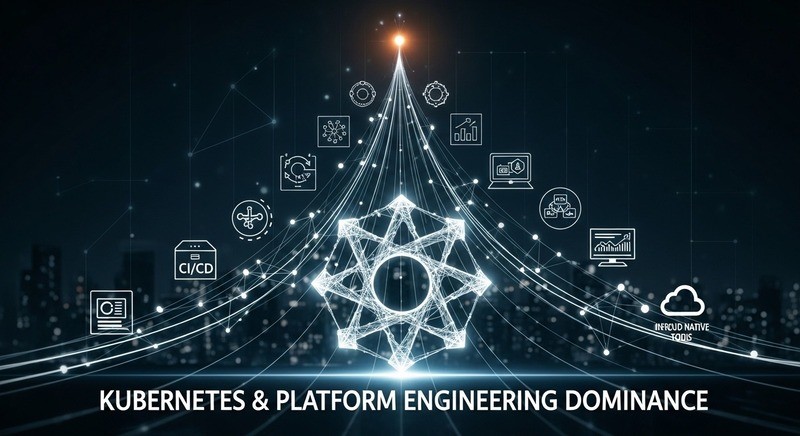
What to do: If your teams are struggling with Kubernetes complexity, invest in an Internal Developer Platform (IDP) to standardize and accelerate deployments.
11. Cloud-Native Databases and Distributed SQL
Relational databases have reinvented themselves for the cloud era. Distributed SQL databases — like CockroachDB, Google Spanner, and Amazon Aurora DSQL (launched in late 2024) — offer the consistency guarantees of traditional SQL with the global scale and resilience of NoSQL.
These systems are the go-to choice for globally distributed applications that cannot tolerate data inconsistency.
12. Confidential Computing
As sensitive workloads migrate to the cloud, Confidential Computing — which protects data while it is being processed using hardware-based Trusted Execution Environments (TEEs) — has moved from research to production.
This is particularly critical for healthcare, financial services, and government sectors that handle regulated or sensitive data in multi-tenant cloud environments.
13. AI-Powered Cloud Operations (AIOps)
Manual cloud operations — monitoring dashboards, alert triage, capacity planning — are being replaced by AI-driven automation. AIOps platforms in 2026 can predict outages, auto-remediate incidents, optimize resource allocation, and reduce alert noise by up to 80%.
Providers like Dynatrace, Datadog, and cloud-native tools from AWS and Azure now offer autonomous operations capabilities.
14. Quantum-Ready Cloud Services
Quantum computing is not yet commercially mainstream, but forward-looking organizations are beginning to invest in quantum-readiness. This means upgrading cryptographic systems to post-quantum standards (NIST PQC algorithms were finalized in 2024) and experimenting with quantum simulation services offered by IBM Quantum, AWS Braket, and Azure Quantum.
What to do: Begin a post-quantum cryptography audit of your existing systems, particularly for data that must remain secure for 10+ years.
15. Cloud Marketplaces as Procurement Channels
Cloud marketplaces — AWS Marketplace, Azure Marketplace, and Google Cloud Marketplace — have evolved into primary enterprise procurement channels. In 2026, SaaS vendors, security tools, and even professional services are purchased and deployed directly through cloud marketplaces, often against existing cloud committed spend.
This simplifies vendor management, reduces procurement cycles, and allows organizations to consolidate billing.
The Road Ahead: What These Trends Mean for Your Organization
The common thread across all 15 trends is this: cloud is no longer just infrastructure — it is the platform on which business strategy is executed.
Organizations that treat cloud as a commodity will fall behind. Those that embrace AI-native architectures, build strong security postures, operate sustainably, and govern their costs intelligently will lead.
Here is a practical starting checklist:
Audit your multi-cloud strategy for redundancy and cost efficiency
Implement Zero Trust security across all cloud workloads
Establish a FinOps practice with real-time cost visibility
Explore Generative AI platforms for your key use cases
Assess your post-quantum cryptography readiness
Measure and reduce your cloud carbon footprint
Evaluate Internal Developer Platforms to accelerate engineering velocity
Final Thoughts
Cloud computing in 2026 is defined by intelligence, security, sustainability, and scale. The trends listed above are not distant forecasts — they are decisions that IT leaders are making right now. The organizations that move deliberately, invest in the right foundations, and align cloud strategy with business outcomes will shape what comes next.
The future of IT is cloud-native. Is your organization ready?
FAQs:
1. What are the key cloud computing trends in 2026?
Key trends include AI-native cloud infrastructure, multi-cloud adoption, edge computing, serverless platforms, Zero Trust security, and sustainable cloud technologies.
2. Why is multi-cloud becoming popular among enterprises?
Multi-cloud allows organizations to avoid vendor lock-in, improve system reliability, and choose the best cloud services for specific workloads.
3. What is AI-native cloud infrastructure?
AI-native cloud infrastructure is designed to support artificial intelligence workloads using GPU acceleration, AI frameworks, and optimized cloud services.
4. How does edge computing improve cloud performance?
Edge computing processes data closer to the source, reducing latency and enabling faster real-time applications.
5. What is FinOps in cloud computing?
FinOps is a practice that helps organizations monitor, control, and optimize cloud spending through financial accountability and cost management tools.
6. Why is Zero Trust important for cloud security?
Zero Trust ensures that every user, device, and request is verified before accessing resources, improving overall cloud security.