Networking
Begineer Friendly

Network security is the practice of protecting computer networks, connected devices, systems, and data from unauthorized access, attacks, misuse, and disruption. It combines technologies, policies, processes, and security controls to protect network infrastructure while allowing legitimate users and applications to communicate safely.
As businesses increasingly depend on cloud services, remote access, wireless networks, and connected devices, effective network security has become an essential part of cybersecurity.
Why Network Security Matters
A network connects users, applications, servers, cloud platforms, and devices. If an attacker gains unauthorized access to one part of that environment, the impact can spread quickly.
Network security helps organizations protect three fundamental security goals: confidentiality, integrity, and availability. Confidentiality ensures that sensitive information is accessible only to authorized users. Integrity helps prevent unauthorized modification of data, while availability keeps systems and services accessible when they are needed.
For example, a company may use firewalls to control network traffic, encryption to protect information in transit, and multi-factor authentication to verify user identities. These controls work together to reduce the likelihood and impact of security incidents.
How Network Security Works
Network security uses multiple layers of protection rather than relying on a single security tool. This layered approach is often called defense in depth.
A typical enterprise network may use security controls at several points, including:
The network perimeter to filter incoming and outgoing traffic
Internal network segments to limit unauthorized movement
Endpoints to detect malicious activity
Applications to control access to sensitive services
Identity systems to authenticate users and devices
Data connections to encrypt information during transmission
Security teams also monitor network activity for unusual behavior. When suspicious traffic or activity is detected, security tools can generate alerts or automatically block certain threats.
Major Types of Network Security
Firewalls
A firewall monitors and controls incoming and outgoing traffic based on defined security rules, acting as a barrier between a trusted internal network and untrusted external networks such as the internet. Modern firewalls inspect traffic more deeply, identifying application-layer threats rather than just filtering by port or IP address.
Intrusion Detection and Prevention Systems
An IDS monitors traffic for suspicious activity and alerts security teams. An IPS goes further by actively blocking the detected threat in real time. Many organizations deploy both, using detection to catch what prevention might miss.
Virtual Private Networks
A VPN encrypts traffic between a device and a network, which matters most for remote employees on home networks or public Wi-Fi. It creates a secure tunnel so data cannot be easily intercepted in transit.
Network Access Control
NAC governs which devices can connect to a network, checking whether a device meets requirements such as updated antivirus software or current patches before granting access.
Endpoint Security
Endpoint security protects individual devices, such as laptops and servers, that connect to the network. Since each device is a potential entry point, endpoint tools scan for malware and can isolate a compromised device before an infection spreads.
Zero Trust Security
Zero trust is a model built on the idea that no user or device should be trusted automatically, even inside the network perimeter. Every access request is verified individually based on identity, device health, and context. This is a newer approach than traditional perimeter-based security, and many organizations are still in the process of adopting it.
Common Network Security Threats
Organizations face a wide range of network security threats. Some target technical vulnerabilities, while others exploit human behavior.
Malware
Malware includes malicious software such as viruses, worms, trojans, and ransomware. Once inside a network, malware can steal information, disrupt systems, or spread between connected devices.
Phishing and Credential Attacks
Phishing attacks attempt to trick users into revealing passwords or other sensitive information. Stolen credentials can provide attackers with legitimate-looking access to network resources.
DDoS Attacks
Distributed denial-of-service attacks attempt to overwhelm a server, application, or network service with large amounts of traffic. The goal is typically to make legitimate services unavailable.
Unauthorized Access
Weak passwords, compromised accounts, misconfigured systems, and unpatched vulnerabilities can give attackers unauthorized access. Once inside, an attacker may attempt to move across the network and access additional resources.
Insider Threats
Security risks can also originate from people who already have legitimate access. An insider threat may involve intentional misuse or accidental exposure of sensitive information.
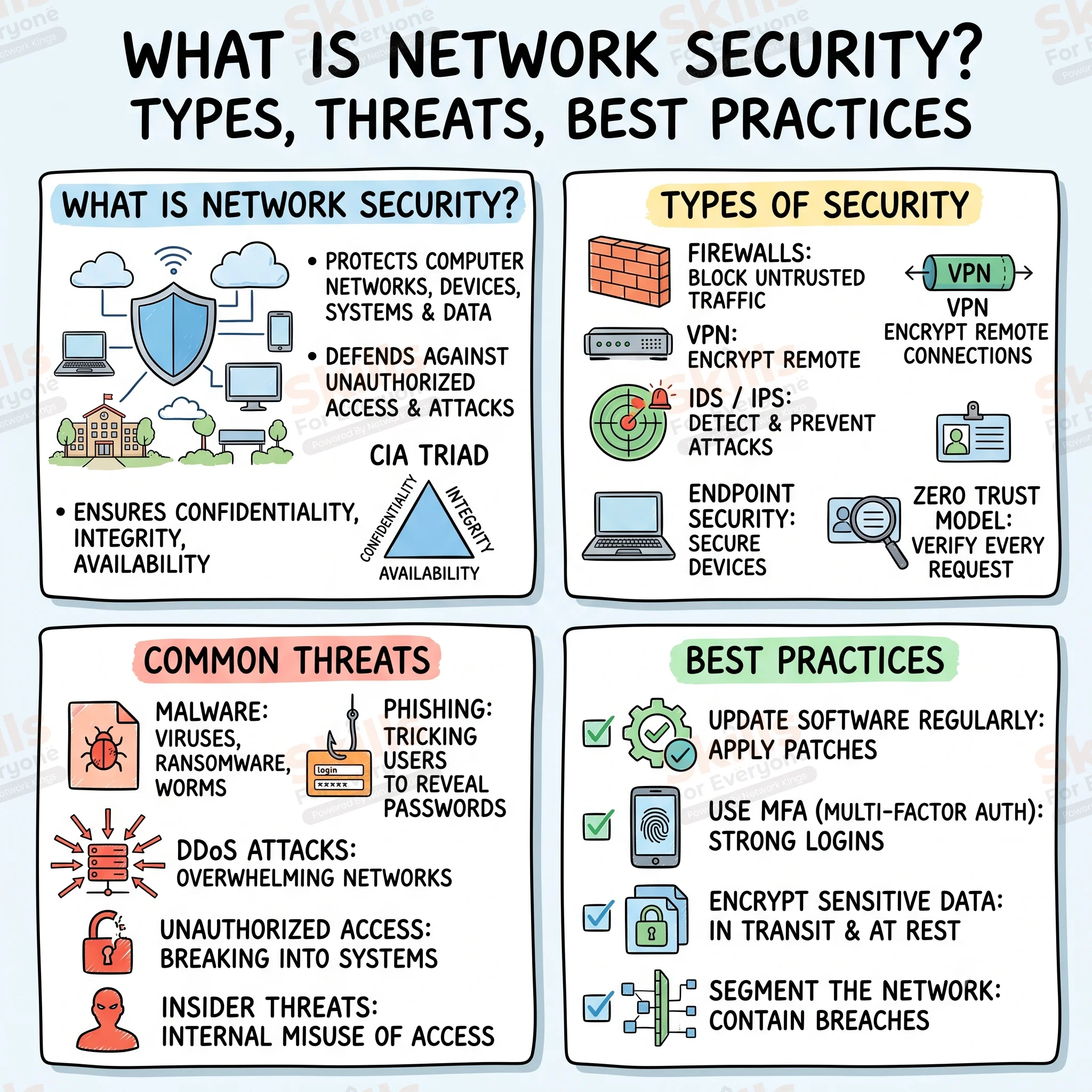
Network Security Best Practices
Strong network security comes from consistent habits as much as from technology.
Keep software and firmware updated to close known vulnerabilities
Use strong, unique authentication, including multi-factor authentication
Segment the network so a breach cannot easily spread
Encrypt sensitive data both in transit and at rest
Apply least privilege, giving users only the access they need
Monitor network activity continuously to catch unusual behavior
Train employees to recognize phishing and social engineering
Maintain tested backups so data can be restored after an incident
Network Security Tools and Technologies Compared
Technology or Control | Purpose | Example Use |
Firewall | Filters traffic entering and leaving the network | Blocking unauthorized inbound connections to a company server |
IDS/IPS | Detects and blocks suspicious network activity | Flagging unusual traffic patterns that suggest an intrusion attempt |
VPN | Encrypts traffic between a device and the network | Securing a remote employee's connection over public Wi-Fi |
NAC | Controls which devices can join the network | Denying network access to an unpatched laptop |
Endpoint protection | Secures individual devices from malware | Detecting and isolating an infected workstation |
Zero trust framework | Verifies every access request individually | Requiring re-authentication before accessing a sensitive database, even from inside the network |
Practical Advice for Improving Network Security
Organizations do not need to implement every control at once. A reasonable starting point is identifying the most valuable assets on the network and working outward from there. Patch management and multi-factor authentication tend to offer a strong return relative to the effort involved, since they close some of the most commonly exploited gaps.
Regular security assessments help too. Reviewing firewall rules, checking who still has access to systems they no longer need, and testing backup restoration are unglamorous tasks that prevent major incidents.
Network security protects the infrastructure that allows modern organizations to communicate, access applications, and exchange information. It combines technologies such as firewalls, VPNs, intrusion prevention, encryption, and network access control with policies and security practices.
Understanding network security types, common threats, and best practices provides a strong foundation for building a more resilient IT environment. As networks become increasingly distributed across cloud platforms, remote locations, and connected devices, organizations need layered security controls and continuous monitoring to manage evolving risks effectively.
FAQs
Why is network security important?
Network security helps protect sensitive data, prevent unauthorized access, reduce cyberattack risks, and maintain the availability of business systems and services.
What are the main types of network security?
Common types include firewalls, VPNs, intrusion detection systems, intrusion prevention systems, network access control, encryption, endpoint security, and network segmentation.
What are common network security threats?
Common threats include malware, phishing, ransomware, DDoS attacks, unauthorized access, credential theft, insider threats, and attacks that exploit unpatched vulnerabilities.
Is a VPN enough to secure a business network on its own?
No. A VPN protects network connections but should be combined with firewalls, MFA, endpoint protection, and monitoring.
How is zero trust different from traditional network security?
Traditional security often trusts internal users, while zero trust continuously verifies users, devices, and access requests.
What is the first step a small business should take to improve network security?
Identify critical systems and data, then implement basic protections such as MFA, updates, backups, and firewall controls.
Why do organizations need both firewalls and endpoint protection?
Firewalls protect network traffic, while endpoint protection secures individual devices. Together, they provide layered defense.