Networking
Begineer Friendly

A Security Operations Center (SOC) is a centralized security function that monitors an organization's IT environment to detect, investigate, and respond to potential cyber threats. It brings together security professionals, processes, and technologies to identify suspicious activity and reduce the impact of security incidents.
A modern SOC can monitor much more than traditional network traffic. Endpoints, servers, identity systems, cloud infrastructure, SaaS applications, firewalls, and network devices can all generate security telemetry that helps analysts understand what is happening across an organization. The goal is not simply to collect alerts, but to determine which events represent genuine threats and respond appropriately.
What Is a SOC
A SOC, or Security Operations Center, manages an organization's day-to-day security monitoring and response activities. It may operate as an internal team, through a managed security service provider, or as a combination of both.
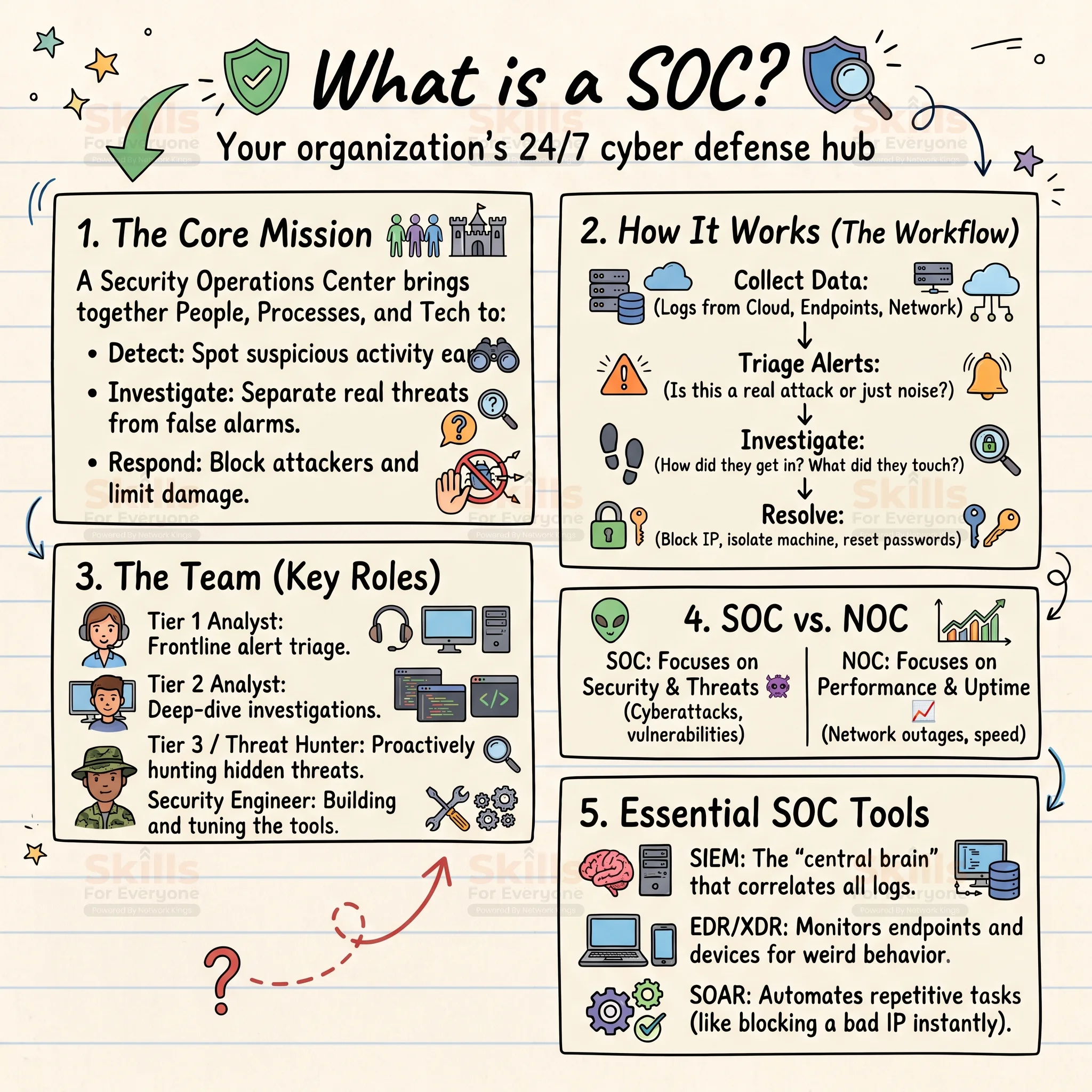
A SOC typically brings together people, processes, and technology. Security analysts investigate alerts, incident responders handle confirmed incidents, security engineers maintain detection and monitoring systems, and threat hunters proactively search for suspicious activity.
The exact structure varies between organizations, but the underlying objective remains the same: detect threats early, investigate them accurately, and limit their potential impact.
What Does a SOC Do
A SOC's job goes well beyond just watching dashboards. Analysts sift through massive volumes of security events generated by firewalls, servers, endpoints, and cloud services, looking for patterns that indicate something is wrong. The core responsibilities usually include:
Continuous security monitoring across networks, endpoints, and cloud environments
Threat detection and alert triage, separating real threats from noise
Incident investigation and response when something suspicious is confirmed
Threat intelligence gathering, tracking known attacker techniques and malicious infrastructure
Vulnerability and exposure monitoring, where applicable
Continuous improvement, refining detection rules based on lessons learned from past incidents
Not every SOC handles all of these in-house. Some outsource threat intelligence or vulnerability management to specialized teams while keeping monitoring and response internal.
How a SOC Works
The daily workflow of a SOC generally follows a predictable pattern, even though the specifics vary by organization.
From Data to Detection
Data collection happens continuously. Logs and telemetry from firewalls, endpoint devices, servers, applications, and cloud platforms feed into a centralized system. That data gets analyzed and correlated, often generating alerts when something matches a known attack pattern or looks statistically unusual. Analysts then triage those alerts, separating genuine threats from false positives, which are alerts that look suspicious but turn out to be harmless.
From Investigation to Resolution
When an alert turns out to be real, the team moves into investigation. This might involve checking which systems were affected, tracing how an attacker got in, and identifying indicators of compromise, such as unusual file hashes or suspicious network connections. From there, the response phase kicks in, which could mean isolating an infected machine, blocking a malicious IP address, resetting compromised credentials, or in more serious cases, activating a full incident response plan involving legal and executive teams.
For example, imagine a SOC analyst sees repeated failed login attempts on a company's VPN from an unfamiliar country, followed by a successful login and immediate access to sensitive file shares. That pattern would trigger an alert, prompt an investigation into whether the account was compromised, and likely lead to disabling the account and forcing a password reset while the team confirms whether any data was accessed.
Key Roles in a SOC
A SOC typically brings together several specialized roles rather than relying on one generalist.
SOC analysts handle the frontline work of monitoring alerts and performing initial investigations. Incident responders step in once a real threat is confirmed, managing containment and recovery. Threat hunters take a more proactive approach, actively searching for hidden threats that automated tools might have missed rather than waiting for alerts to fire. Security engineers build and maintain the tools and infrastructure the rest of the team relies on, including tuning detection rules and integrating new data sources. Overseeing all of this, the SOC manager coordinates staffing, processes, and reporting to leadership.
Technologies Used in a SOC
No SOC runs on manual effort alone. A handful of core technologies make large-scale monitoring possible.
Technology | Purpose |
SIEM (Security Information and Event Management) | Collects and correlates log data across the environment into one centralized view |
SOAR (Security Orchestration, Automation, and Response) | Automates repetitive response tasks, such as blocking a confirmed malicious IP |
EDR (Endpoint Detection and Response) | Monitors individual devices for suspicious behavior |
XDR (Extended Detection and Response) | Expands visibility across endpoints, networks, and cloud in a unified way |
IDS/IPS (Intrusion Detection and Prevention Systems) | Monitors network traffic for suspicious or malicious activity; IPS can also take preventive action. |
Firewalls | Control what traffic is allowed in and out of a network |
Threat intelligence platforms | Feed analysts up-to-date information on active threats and attacker tactics |
SOC Levels and Tiers
Many SOC teams organize analysts into tiers based on experience and responsibility, though the exact structure varies from one organization to another.
Tier | Typical Focus | Common Responsibilities |
Tier 1 | Alert triage | Monitoring dashboards, initial alert review, escalating confirmed threats |
Tier 2 | Investigation | Deeper analysis, correlating events, determining scope and impact |
Tier 3 | Advanced response | Threat hunting, malware analysis, handling complex or high-severity incidents |
SOC Manager | Oversight | Staffing, process improvement, reporting to leadership |
Smaller organizations sometimes combine these tiers into fewer roles, while larger enterprises may add specialized teams for threat intelligence or forensics.
Modern SOC Environments
Today's SOCs increasingly monitor hybrid and cloud-based environments rather than only traditional data centers.
Security teams may need visibility into cloud workloads, SaaS applications, remote users, identity providers, APIs, endpoints, and on-premises infrastructure at the same time. Identity telemetry is particularly important because compromised credentials can provide attackers with access without requiring traditional malware.
This makes centralized visibility and correlation increasingly important. A suspicious login may become much more meaningful when it is correlated with unusual endpoint behavior or activity in a cloud application.
SOC vs NOC
A Security Operations Center and Network Operations Center can both monitor technology environments, but their primary objectives are different.
SOC | NOC |
Focuses on cybersecurity threats | Focuses on availability and performance |
Investigates security incidents | Troubleshoots operational issues |
Monitors suspicious activity | Monitors network and infrastructure health |
Uses security-focused technologies | Uses network and infrastructure monitoring tools |
The teams can still work together. For example, a network issue may initially be investigated by the NOC, while suspicious traffic discovered during the investigation may require SOC involvement.
Benefits and Challenges of a SOC
A well-run SOC gives an organization faster detection and response times, more consistent visibility across its entire environment, and a dedicated team focused specifically on catching threats that would otherwise go unnoticed. It can also support compliance efforts by helping organizations maintain security monitoring, logging, and documented incident response processes where required.
That said, running a SOC isn't without difficulties. Common challenges include:
Alert fatigue, since analysts can be overwhelmed by high volumes of alerts, many of which turn out to be false positives
Staffing gaps, since covering nights, weekends, and holidays is expensive and logistically demanding
Tool sprawl, as many SOCs juggle multiple platforms that don't always integrate smoothly
A persistent industry-wide skills shortage, making it harder to find and retain experienced analysts
Because of these challenges, some organizations choose to outsource SOC functions to a managed security service provider instead of building an in-house team. Outsourcing can reduce staffing burdens and provide 24/7 coverage more affordably, though it may come with less direct control over processes and slower familiarity with an organization's specific environment compared to an in-house team that works with the same systems every day.
SOC Career Opportunities
For people interested in breaking into cybersecurity, a SOC analyst role is a common starting point for people entering cybersecurity. It can provide hands-on exposure to security tools, alert investigation, and incident handling, although employers vary in their experience requirements.
Useful skills for this path include:
Solid understanding of networking fundamentals
Familiarity with operating systems like Windows and Linux
Basic scripting knowledge
Comfort working with SIEM platforms
Relevant certifications, such as CompTIA Security+ or more specialized SOC and incident response credentials
From a Tier 1 analyst role, career paths often branch into threat hunting, incident response, security engineering, or eventually SOC management.
Final Thoughts
A Security Operations Center is less about any single tool and more about the combination of skilled people, well-tuned technology, and consistent processes working together to catch threats early. Understanding how a SOC actually functions, from the roles involved to the tools they rely on, gives IT professionals and aspiring analysts a clearer picture of what a career in this field looks like and why organizations invest in building these teams in the first place.
Frequently Asked Questions
What is a SOC in cybersecurity?
A SOC is a dedicated team and set of tools responsible for continuously monitoring an organization's systems for security threats and responding to incidents when they occur.
What does a SOC analyst do?
A SOC analyst monitors security alerts, investigates suspicious activity, and escalates confirmed threats for deeper investigation or response.
What tools are used in a SOC?
Common tools include SIEM platforms for log correlation, SOAR tools for automation, EDR and XDR for endpoint visibility, IDS and IPS for network monitoring, and firewalls for traffic control.
What is the difference between SOC and NOC?
A SOC focuses on detecting and responding to security threats, while a NOC focuses on network performance and uptime, though the two teams often share information.
What are the different SOC levels?
Many SOCs use a tiered structure, typically Tier 1 for alert triage, Tier 2 for deeper investigation, and Tier 3 for advanced threat hunting and complex incident handling.
Is a SOC responsible for incident response?
Yes, incident response is one of a SOC's core functions, covering everything from containment and remediation to post-incident review.
What skills are needed to work in a SOC?
Useful skills include networking fundamentals, familiarity with operating systems, basic scripting, and hands-on experience with SIEM and other monitoring tools.