Networking
Begineer Friendly

A penetration test is not simply a vulnerability scan with a more technical name. A proper penetration test attempts to understand how weaknesses could be chained together to compromise systems, applications, accounts, data, or physical environments. The scope can range from an internet-facing network to a cloud environment, mobile app, wireless network, or even an organization's employees.
That is why there is no single type of penetration testing that fits every organization. The right approach depends on what needs to be protected, how it is exposed, and what an organization wants to learn from the assessment.
What Is Penetration Testing?
Penetration testing is an authorized security assessment in which testers simulate realistic attack techniques to identify and validate weaknesses in systems, applications, networks, cloud environments, or other assets. Unlike a basic vulnerability scan, a penetration test can show how individual weaknesses might be combined to create a practical attack path and what an attacker could potentially reach.
The scope of a penetration test depends on the organization's technology, risk profile, and security objectives. That is why penetration testing can take several forms, from network and web application testing to cloud, API, mobile, wireless, social engineering, and physical assessments.
What Are the Main Types of Penetration Testing?
The most common types are network, web application, API, cloud, mobile application, wireless, social engineering, and physical penetration testing. Each targets a different part of the attack surface. Separately, black-box, white-box, and gray-box describe how much the tester knows going in, and internal or external describes where the tester starts from. Keeping those three ideas apart makes everything else easier to follow.
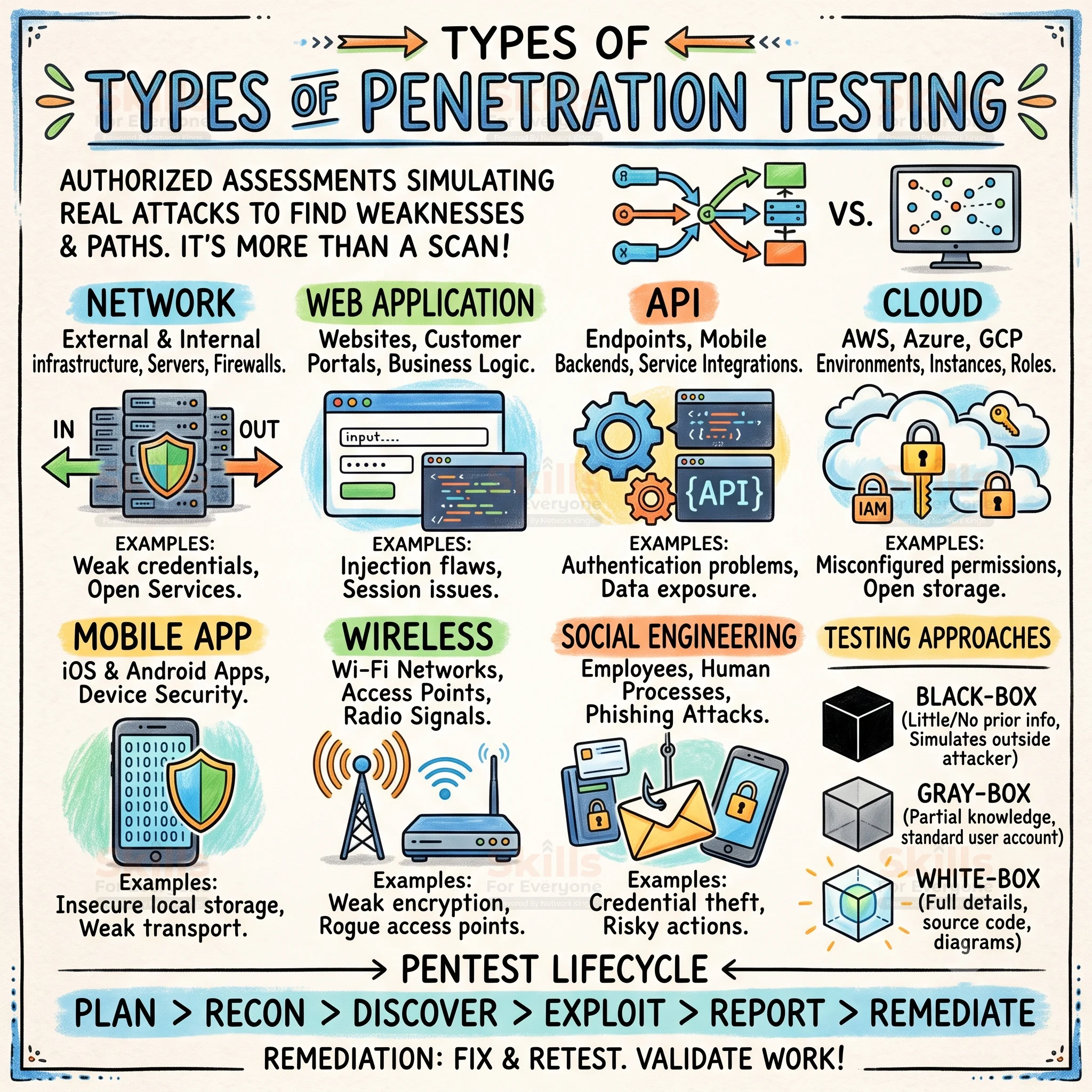
Network Penetration Testing
Network penetration testing examines the infrastructure that connects systems together, including servers, firewalls, routers, VPN gateways, and exposed services. Testers look for open ports running vulnerable services, weak or default credentials, poor segmentation, and misconfigurations that allow movement between systems.
External Testing
An external test starts from the internet with no special access. It answers a simple question: what can an outsider reach and exploit? Targets usually include public IP ranges, mail servers, remote access portals, and DNS.
Internal Testing
An internal test assumes the attacker is already inside, perhaps through a phished employee or a compromised laptop. Testers try to escalate privileges, abuse Active Directory misconfigurations, and reach sensitive systems. This often reveals that a single foothold is far more dangerous than the perimeter suggested.
Web Application Penetration Testing
Web application testing focuses on the application layer rather than the servers underneath. Testers probe login flows, session handling, input validation, access controls, and business logic. They look for problems such as injection flaws, broken authentication, insecure direct object references, and cross-site scripting.
This is a different job from network testing. A perfectly patched server can still host an application that lets one customer view another customer's invoices by changing a number in the URL. Any organization that handles user accounts, payments, or personal data through a web portal usually needs this type of test.
API Penetration Testing
APIs power mobile apps, single-page applications, and integrations between services. API testing checks authentication and authorization on each endpoint, object-level access control, rate limiting, excessive data exposure, and how the API handles unexpected input. Because APIs are often documented and predictable, weaknesses in them can be easy to automate against, so they deserve dedicated attention instead of being treated as an afterthought of web testing.
Cloud Penetration Testing
Cloud penetration testing evaluates environments built on platforms such as AWS, Azure, or Google Cloud. The focus shifts from patching hosts to examining identity and access management, storage permissions, exposed management interfaces, container and Kubernetes configuration, serverless functions, and secrets stored in code or pipelines.
The key difference from traditional infrastructure testing is the shared responsibility model. The provider secures the underlying platform, while the customer is responsible for configuration, identities, and data. Testers must also follow each provider's rules of engagement, so scoping and permissions need care. Misconfigured identity roles and overly open storage are among the most realistic findings here.
Mobile Application Penetration Testing
Mobile testing covers iOS and Android apps along with the backend services they talk to. Testers review how data is stored on the device, how traffic is protected in transit, whether the app resists tampering and reverse engineering, and how authentication works. Banking, healthcare, and retail apps are common candidates, since they often store tokens or personal data directly on the phone.
Wireless Penetration Testing
Wireless testing looks at Wi-Fi networks and related radio technologies. Testers check encryption and authentication settings, look for rogue access points and evil twin setups, and assess whether guest networks are properly isolated from corporate systems. Offices, warehouses, and retail locations with many access points benefit most.
Social Engineering and Physical Testing
Technical controls only go so far when people can be persuaded to bypass them. Social engineering tests use phishing emails, phone pretexting, or messaging to see whether employees disclose credentials or take risky actions.
Physical penetration testing goes a step further by testing whether someone can tailgate into a building, clone a badge, or plug a device into an unattended port. Both types are tightly scoped and require clear written authorization, because they involve real people and real premises.
Penetration Testing Types Compared
Type | Primary target | Typical weaknesses found | Common use case |
Network | Servers, firewalls, internal and external infrastructure | Weak credentials, open services, poor segmentation | Perimeter and internal security validation |
Web application | Websites and portals | Injection, broken access control, session flaws | Customer-facing applications |
API | Endpoints and integrations | Missing authorization, data exposure | Platforms with partner or mobile access |
Cloud | Cloud accounts and services | Over-permissive roles, exposed storage | Cloud migrations and ongoing cloud operations |
Mobile | iOS and Android apps | Insecure local storage, weak transport security | Consumer and financial apps |
Wireless | Wi-Fi and access points | Weak encryption, rogue access points | Offices and retail sites |
Social engineering | Employees | Credential disclosure, risky clicks | Awareness and process validation |
Physical | Buildings and devices | Tailgating, unsecured ports | Data centers and sensitive facilities |
Black-Box, White-Box, and Gray-Box Testing
These terms describe the tester's starting knowledge, not the target. In black-box testing, the tester has little or no information, similar to an outside attacker. White-box testing provides full details such as source code, architecture diagrams, and credentials, which allows deeper coverage in less time. Gray-box sits in between, usually giving the tester a standard user account or partial documentation.
You can combine any approach with any type. A gray-box web application test and a black-box external network test are both perfectly normal engagements.
Penetration Testing vs Vulnerability Assessment
A vulnerability assessment identifies and prioritizes known weaknesses, usually with automated scanning, and it is broad and repeatable. A penetration test goes further by validating which weaknesses can actually be exploited, how they combine, and what the real impact would be. Most mature programs use both, with regular assessments between periodic penetration tests.
How to Choose the Right Type of Penetration Testing
Start with your assets and the risks you worry about most. A company running a customer portal on cloud infrastructure will likely need web, API, and cloud testing. An organization with a large office network and remote workforce may prioritize internal and external network testing plus phishing simulations.
Compliance requirements, recent architecture changes, new product launches, and past incidents should also shape the scope. When unsure, a scoping conversation with a qualified provider can narrow the list.
Methodology, Reporting, and Remediation
Most engagements follow a similar flow of planning and scoping, reconnaissance, vulnerability discovery, exploitation, post-exploitation analysis, and reporting. Many testers align their work with published guidance such as the OWASP Web Security Testing Guide or the Penetration Testing Execution Standard, though the right reference depends on the target.
The report is where the value lands. A good one explains each finding, shows evidence, rates the risk, and gives practical fix guidance. After remediation, a retest confirms the fixes actually worked.
Conclusion
Penetration testing is not one service but a set of focused tests, each built to examine a specific part of your environment. The strongest results come from matching the test type to your real attack surface, choosing an approach that fits your goals, and treating the final report as the start of remediation work. Testing will not guarantee security, but done well, it shows you where attackers would actually get in.
Here are 8 FAQs that fit the article naturally and target useful long-tail search intent without sounding keyword-stuffed.
Frequently Asked Questions (FAQs)
What are the main types of penetration testing?
The main types include network, web application, cloud, API, mobile application, wireless, social engineering, and physical penetration testing. The right type depends on the systems, applications, infrastructure, and attack surfaces an organization wants to assess.
What is the difference between network and web application penetration testing?
Network penetration testing focuses on infrastructure such as servers, firewalls, VPNs, network services, and segmentation. Web application penetration testing focuses on the application's functionality and security controls, including authentication, authorization, session management, input handling, and business logic.
What does cloud penetration testing test?
Cloud penetration testing evaluates approved cloud resources and configurations for security weaknesses. Depending on the scope, this can include identity and access management, storage permissions, network controls, workloads, exposed services, credentials, and cloud APIs.
What is the difference between black-box and white-box penetration testing?
Black-box testing gives the tester limited information about the target and more closely resembles an external attack. White-box testing provides extensive information about the environment or application, allowing for deeper assessment. Gray-box testing sits between these two approaches.
Is API penetration testing different from web application penetration testing?
Yes. API penetration testing focuses specifically on application programming interfaces and how they handle authentication, authorization, requests, data, and access controls. It can be performed alongside web application testing because modern web and mobile applications often depend heavily on APIs.
What is the difference between vulnerability assessment and penetration testing?
A vulnerability assessment primarily identifies and prioritizes potential security weaknesses across an environment. A penetration test goes further by attempting to validate whether weaknesses can be exploited and by examining how they may contribute to realistic attack paths and business impact.
How do I know which type of penetration testing my organization needs?
Start by identifying your most important assets and exposed attack surfaces. A public-facing application may require web and API testing, while an organization with extensive infrastructure may need external and internal network testing. Cloud workloads, mobile applications, wireless networks, and physical facilities may require additional assessments.
How often should penetration testing be performed?
There is no single schedule that applies to every organization. Testing is commonly considered after significant changes to applications or infrastructure and as part of a broader security testing program. The appropriate frequency depends on factors such as risk, regulatory requirements, technology changes, and the organization's exposure.