Networking
Begineer Friendly

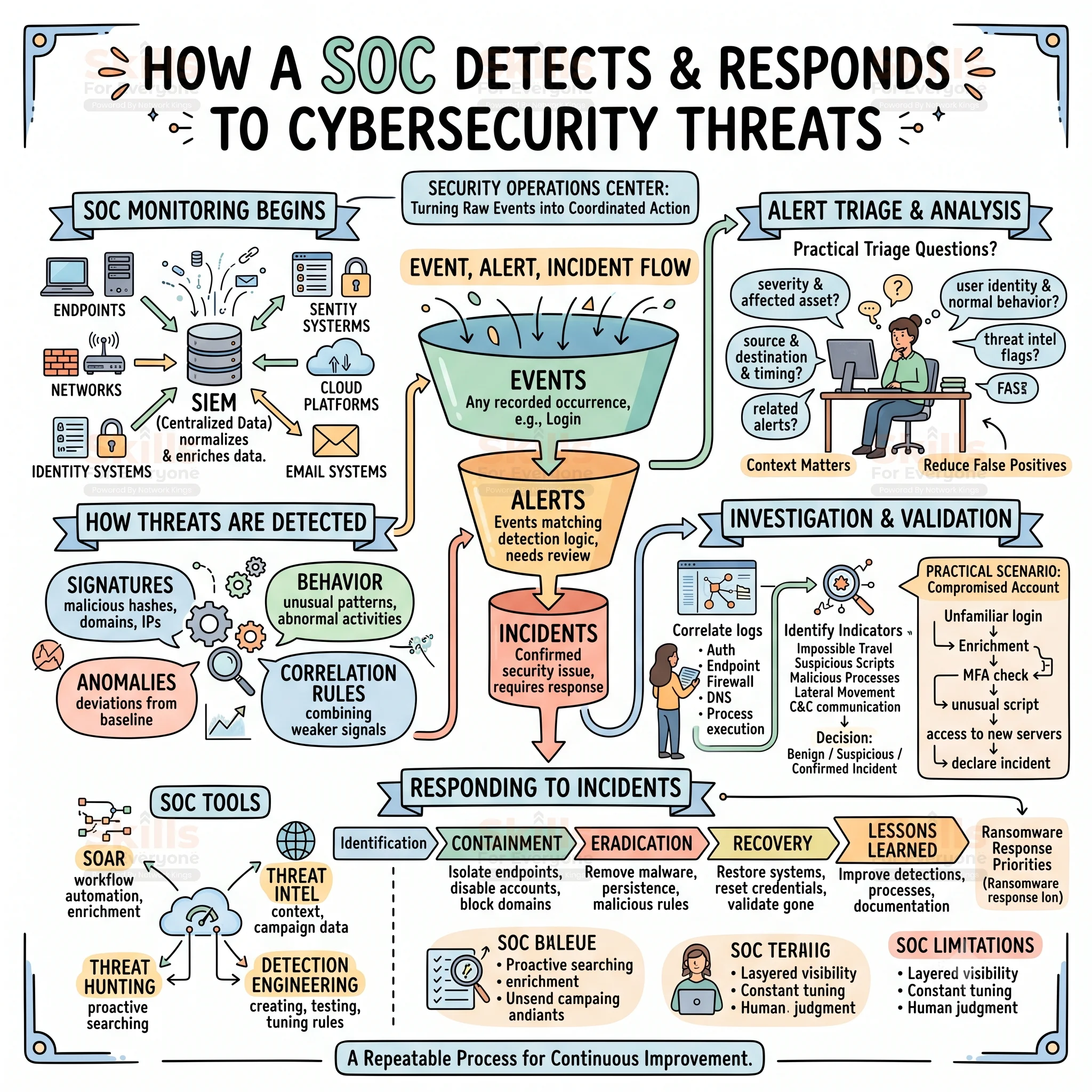
A Security Operations Center detects threats by collecting telemetry from endpoints, networks, identity systems, and cloud platforms, running it through detection logic, and sending suspicious activity to analysts who triage, investigate, and respond. The result is a repeatable workflow that turns raw events into confirmed incidents and coordinated action.
A SOC is not just a team watching a dashboard. It combines people, processes, security technologies, threat intelligence, detection rules, and incident response procedures. Tools generate alerts, but analysts decide what those alerts mean, how far an intrusion has spread, and what to do about it.
The typical flow runs from security telemetry to detection, alert generation, triage, investigation, validation, containment, eradication, recovery, and lessons learned. The sections below follow that path.
Where SOC Monitoring Begins
Everything starts with visibility. A SOC collects data from endpoints, servers, firewalls, identity providers, cloud platforms, applications, network devices, and email security systems. Each source shows a different slice of activity. Authentication logs reveal who signed in, endpoint telemetry shows which processes ran, and DNS and firewall records show where systems communicated.
That data usually flows into a SIEM, which normalizes different log formats into a common structure, enriches events with context such as asset owner or geolocation, and correlates them using rules. The SIEM centralizes and connects data. It does not investigate or respond on its own.
How a SOC Detects Threats
Detection relies on several approaches working together:
Signature and indicator matching, such as known malicious hashes, domains, or IP addresses (Indicators of Compromise)
Behavioral detection, which looks for patterns like unusual process chains or abnormal login activity (Indicators of Attack)
Anomaly detection, which flags deviations from a baseline
Correlation rules, which combine weaker signals into a stronger one
Network tools add another layer. Firewalls enforce policy and log connections, while IDS and IPS inspect traffic for known malicious patterns, with IPS able to block it. EDR records endpoint activity in detail, and XDR extends that correlation across additional sources such as email, identity, and cloud.
Event, Alert, and Incident
These terms are not interchangeable. An event is any recorded occurrence, such as a login. An alert is an event or set of events that matched detection logic and needs review. An incident is a confirmed security issue that requires response. Most alerts never become incidents.
Alert Triage and Reducing False Positives
When an alert fires, the analyst first decides how seriously to treat it. Practical triage questions include:
What is the severity, and which asset is affected?
Which user identity is involved, and is that behavior normal for them?
What are the source and destination, and does the timing make sense?
Do threat intelligence sources flag any indicators?
Are there related alerts on the same host or account?
Context separates real threats from noise. A PowerShell command might be routine for an administrator running approved automation and suspicious for an accountant's laptop at 3 a.m. False positives occur when rules are too broad, baselines are incomplete, or legitimate tools behave like attack techniques. SOCs reduce them by tuning thresholds, adding allowlists with documented justification, and enriching alerts with asset and identity data. Left unaddressed, noisy rules cause alert fatigue, which is how real incidents get missed.
How Analysts Investigate and Validate
Investigation means building a timeline. An analyst might correlate authentication logs, endpoint telemetry, firewall events, DNS activity, and process execution to see whether isolated oddities form an attack pattern.
Useful indicators include unusual authentication, impossible travel, suspicious PowerShell activity, malicious process execution, privilege escalation, lateral movement, command-and-control communication, and abnormal data transfers. No single one proves compromise. Several together, in a plausible sequence, usually do.
Validation ends with a decision: benign, suspicious and needs monitoring, or confirmed incident.
A Practical Scenario
Consider a SIEM alert for a finance user signing in from an unfamiliar country.
The alert arrives and is enriched with identity data showing the user normally works from one region and has no travel record.
The analyst checks the identity provider and finds a recent MFA prompt approved minutes before the login.
EDR data shows a new script launching from the user's workstation and querying internal file shares.
Correlation shows authentication attempts from that account against two servers it has never accessed.
The analyst concludes the account is likely compromised and declares an incident.
Containment begins. The account is disabled, sessions are revoked, and the endpoint is isolated through EDR.
The team reviews the two servers for further activity and checks for persistence.
Afterward, the incident is documented and a new detection is built for MFA approval followed by unusual internal access.
Responding to Confirmed Incidents
Incident response generally covers identification, containment, eradication, recovery, and post-incident analysis. The exact path depends on severity and organizational policy. Not every incident follows the same steps or needs the same urgency.
Containment limits damage. Common actions include isolating an endpoint, disabling a compromised account, and blocking malicious domains or IPs. Eradication removes the cause, such as malware, persistence mechanisms, or malicious access rules. Recovery restores systems from trusted sources, resets credentials, and validates that the threat is gone.
Ransomware response illustrates the stakes. Analysts prioritize isolating affected hosts, protecting backups, identifying the initial access path, and confirming scope before restoring anything. Rushing recovery without eradication risks reinfection.
SOC Tools and How They Work Together
SOAR automates repetitive workflows such as enrichment, ticket creation, and user notification. Automated response is appropriate for low-risk, well-understood actions. Higher-impact steps, like disabling executive accounts or isolating production servers, usually need analyst approval.
SOC Stage | What Happens | Common Technologies | Analyst Responsibility |
Detection | Suspicious activity generates an alert | SIEM, EDR, IDS/IPS | Validate the detection |
Triage | Alert is prioritized and enriched | SIEM, threat intelligence | Determine severity |
Investigation | Related activity is analyzed | SIEM, EDR, XDR | Establish scope and cause |
Containment | Threat is restricted | EDR, firewall, IAM, SOAR | Approve or execute response |
Recovery | Systems return to normal | Backup, endpoint, IAM tools | Validate recovery |
Lessons learned | Detections and processes improve | SIEM, SOAR, documentation | Update controls |
Threat Hunting, Intelligence, and Detection Engineering
Threat intelligence adds context to indicators, such as whether an IP has been tied to known campaigns. Threat hunting is different from incident response. Hunters proactively search for activity that evaded alerts, based on hypotheses, while responders act on confirmed incidents.
MITRE ATT&CK is a knowledge framework describing adversary tactics and techniques. It does not detect anything itself, but teams use it to map detections and find coverage gaps. Detection engineering turns that understanding into rules: creating them, testing against realistic activity, tuning for noise, and maintaining them as environments change.
Limitations Worth Acknowledging
No SOC detects everything. Attackers can evade individual controls, and telemetry gaps leave blind spots. Effective operations depend on layered visibility, continuous tuning, threat intelligence, and human judgment that tools cannot replace.
Conclusion
A SOC detects and responds to cybersecurity threats through a continuous process of collecting telemetry, detecting suspicious behavior, triaging alerts, investigating evidence, validating incidents, and coordinating response. SIEM, EDR, XDR, SOAR, network controls, and threat intelligence each contribute different capabilities.
The strongest SOC operations treat every incident as an opportunity to improve detection engineering and response processes. The result is not simply faster alert handling, but a security operation that becomes better at identifying meaningful behavior and responding to it over time.
Frequently Asked Questions
1. How do analysts prioritize alerts when many arrive at once?
They weigh severity, asset criticality, user privilege, and whether multiple alerts point to the same host or account. A medium alert on a domain controller often outranks a high alert on an isolated test machine.
2. What causes most false positives?
Overly broad rules, missing baselines, and legitimate administrative tools that resemble attacker behavior. Enrichment with asset, identity, and change-management data helps analysts separate them.
3. How does SIEM correlation differ from a single detection rule?
A single rule matches one condition. Correlation links multiple events across sources and time, such as a failed-login burst followed by a success and then unusual process execution.
4. What should be automated with SOAR, and what should not?
Enrichment, ticketing, and notifications are strong candidates. Actions with business impact, like disabling privileged accounts, typically warrant human approval.
5. How is threat hunting different from alert triage?
Triage responds to alerts that already fired. Hunting is hypothesis-driven and looks for behavior that detections missed.
6. What is the practical difference between EDR and XDR?
EDR focuses on endpoint telemetry and response. XDR correlates data from additional domains such as email, identity, network, and cloud, though capabilities vary by vendor.
7. How do teams use MITRE ATT&CK in practice?
They map existing detections to techniques, identify uncovered areas, prioritize new rules, and structure threat hunts and incident reports.
8. How is incident severity determined?
Factors include business impact, data sensitivity, number of affected systems, confirmed attacker access, and whether the activity is ongoing. Organizations define their own severity tiers.