Cyber Security
Begineer Friendly
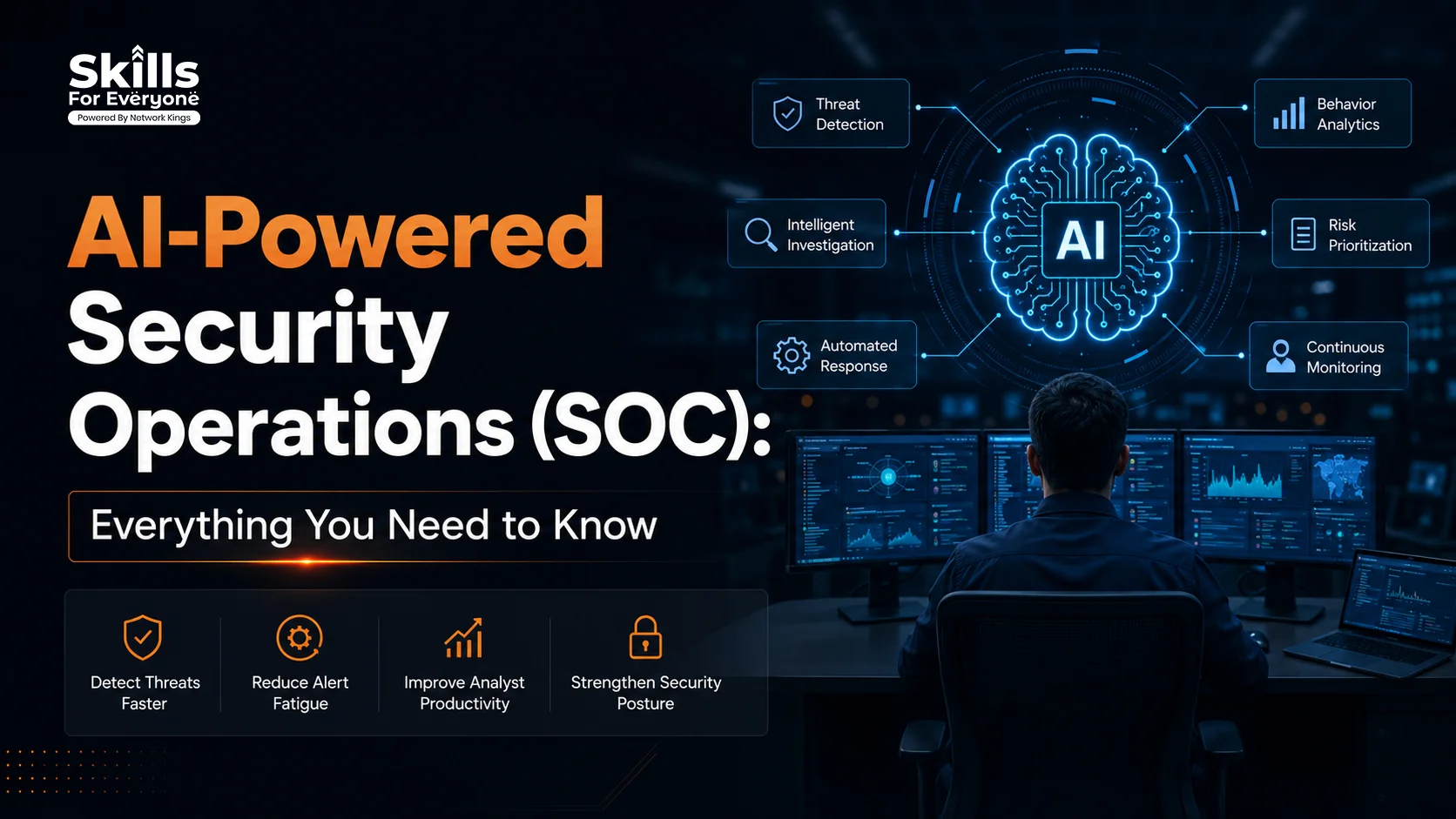
Cybersecurity teams today face a challenge that continues to grow every year. Organizations generate millions of security events daily, while cybercriminals use increasingly sophisticated tactics to bypass traditional defenses. As a result, security teams often struggle with alert fatigue, slow investigations, and limited resources. This is where AI-Powered Security Operations is changing the game.
By combining artificial intelligence, machine learning, security analytics, and automation, modern Security Operations Centers (SOCs) can detect threats faster, prioritize incidents more accurately, and respond to attacks with greater efficiency. Organizations across industries are now adopting AI-driven cybersecurity operations to improve visibility, reduce risk, and strengthen overall security posture.
What Is an AI-Powered Security Operations Center
An AI-powered Security Operations Center is a SOC that uses artificial intelligence and machine learning to enhance the way security teams detect, investigate, and respond to threats. Instead of relying solely on static rules and manual review, an AI SOC continuously learns from data patterns across the network to spot anomalies that traditional tools might miss.
In simple terms, it's a security team supported by software that never gets tired, never loses focus during a night shift, and can process millions of events per second. The AI doesn't replace analysts. It filters the noise so analysts can spend their time on real investigations instead of chasing false positives.
How AI Transforms Security Operations
AI touches nearly every stage of the security workflow. Here's where it makes the biggest difference.
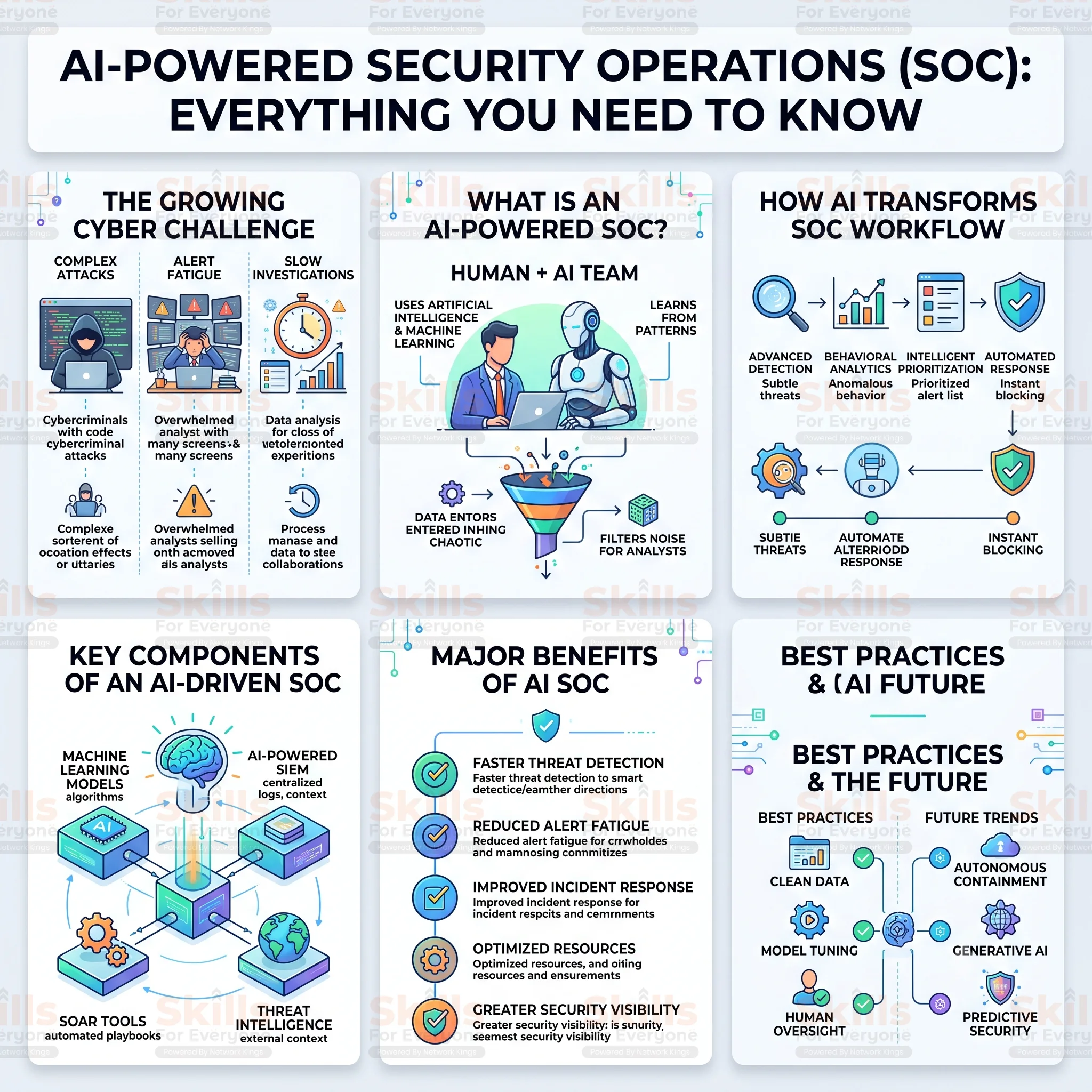
Threat detection gets a major upgrade because machine learning models can identify subtle patterns across huge volumes of log and network data, catching threats that rule-based systems would never flag.
Behavioral analytics allows the system to build a baseline of normal user and device activity, then flag deviations such as an employee account suddenly accessing systems it never touches, or a server sending data to an unfamiliar location.
Incident prioritization becomes smarter too. Instead of treating every alert equally, AI models score incidents based on risk and context, so analysts see the most dangerous issues first.
Automated investigations cut down the manual work of pulling logs, correlating events, and building a timeline. AI can assemble much of that picture automatically, saving hours per incident.
Response automation closes the loop by triggering predefined actions, like isolating a device or blocking an IP address, within seconds of detection rather than waiting for a human to act.
Key Components of an AI-Driven SOC
A modern AI SOC typically brings together several core technologies.
SIEM (Security Information and Event Management) platforms collect and centralize log data from across the organization, and increasingly use AI to enrich that data with context.
SOAR (Security Orchestration, Automation, and Response) tools handle the playbooks that automate repetitive response actions.
Threat intelligence feeds provide external context about known malicious actors, domains, and attack patterns, which AI models use to sharpen detection accuracy.
Machine learning models sit at the core, trained to recognize both known attack signatures and previously unseen anomalies.
Security analytics platforms pull everything together into dashboards that give analysts a clear, prioritized view of what's happening across the environment.
Together, these pieces form the backbone of Security Operations Center automation, letting teams operate with far less manual overhead.
Traditional SOC vs AI-Powered SOC
The differences between the two models are significant, especially at scale.
Factor | Traditional SOC | AI-Powered SOC |
Threat detection speed | Minutes to hours | Seconds to minutes |
Alert management | Manual triage, high volume | Automated scoring and filtering |
Analyst workload | High, prone to burnout | Reduced, focused on real threats |
Incident response | Manual, slower | Partially or fully automated |
Scalability | Limited by headcount | Scales with data volume |
Accuracy | Dependent on rules and analyst skill | Improves with learning over time |
Operational efficiency | Reactive | Proactive and predictive |
Major Benefits of AI-Powered Security Operations
Organizations implementing AI in cybersecurity experience several significant advantages.
Faster Threat Detection
AI can analyze vast amounts of security data in seconds, helping teams identify threats before they escalate into major incidents.
Reduced Alert Fatigue
By filtering false positives and prioritizing meaningful alerts, AI allows analysts to focus on genuine security concerns.
Improved Incident Response
Automated workflows accelerate response times and minimize the impact of attacks.
Better Resource Utilization
Security teams can spend less time on repetitive tasks and more time on strategic security initiatives.
Enhanced Security Visibility
AI provides deeper insights into network activity, user behavior, and potential vulnerabilities across the organization.
The benefits of AI in a Security Operations Center include faster threat detection, reduced alert fatigue, improved incident response, stronger security visibility, lower operational costs, and better analyst productivity..
Common Use Cases and Real-World Applications
AI in cybersecurity shows up in a wide range of practical scenarios. Financial institutions use it to detect fraudulent transactions in real time by spotting behavioral anomalies. Healthcare organizations rely on it to protect patient data against ransomware, often the most targeted industry for this kind of attack. Managed SOC services providers use AI to monitor dozens of clients simultaneously without needing a proportional increase in staff.
Enterprises also use AI for insider threat detection, catching unusual data access patterns from employees before sensitive information walks out the door. Cloud-heavy organizations lean on AI SOC tools to monitor sprawling, dynamic environments where traditional perimeter based monitoring falls short.
Challenges and Considerations When Implementing AI in SOC
AI isn't a plug and play fix. Data quality is one of the biggest hurdles, since machine learning models are only as good as the data they're trained on. Poor or incomplete logging leads to blind spots no matter how advanced the AI is.
False positives and false negatives remain a challenge too, particularly in the early stages of deployment before models are properly tuned to an organization's environment. There's also a skills gap. Teams need analysts who understand both cybersecurity and how to work alongside AI tools, which isn't always an easy hire.
Cost and integration complexity matter as well. Rolling out an AI-powered SIEM and AI-enhanced SOAR tools often requires significant investment and careful planning to integrate with existing infrastructure.
Best Practices for Building an Effective AI-Powered SOC
Start with clean, comprehensive data collection, since AI models need quality inputs to produce quality outputs. Combine automation with human oversight rather than fully removing analysts from the loop, especially for high-stakes decisions like isolating critical systems.
Invest in continuous model tuning, since threat landscapes evolve constantly and a model trained six months ago may already be outdated. Choose tools that integrate well with your existing SIEM and SOAR stack instead of creating more silos. Finally, train your team not just on how to use AI tools, but on how to interpret and validate their outputs.
Future of AI in Security Operations
The next phase of AI in cybersecurity is moving toward autonomous response, where systems can contain and remediate certain threats without waiting for human approval. Generative AI is also starting to play a role, helping analysts summarize incidents, draft reports, and even simulate attack scenarios for training purposes.
We'll likely see tighter integration between AI SOC platforms and threat intelligence sharing networks, creating a more collective defense model across industries. As machine learning models mature, expect fewer false positives and more precise, context aware detection across every layer of the security stack.
Conclusion
AI-Powered Security Operations are no longer a futuristic concept. They're becoming the standard for organizations that need to keep pace with modern threats without burning out their security teams. From faster threat detection to smarter incident prioritization and automated response, AI is reshaping what a SOC can accomplish.
Organizations that invest in the right mix of technology, data quality, and human expertise will be best positioned to defend against tomorrow's threats. The shift toward AI-powered Security Operations isn't about replacing analysts. It's about giving them the tools to do their jobs faster, smarter, and with far less noise getting in the way.
FAQs
What is an AI-powered SOC?
An AI-powered SOC is a Security Operations Center that uses machine learning and automation to detect, investigate, and respond to cyber threats faster and more accurately than manual processes alone.
How does AI improve security operations?
AI improves security operations by analyzing large volumes of data to detect anomalies, prioritizing alerts based on risk, and automating repetitive investigation and response tasks.
What are the benefits of AI in a Security Operations Center?
Key benefits include faster threat detection, reduced analyst workload, lower operational costs, improved accuracy over time, and better scalability as data volume grows.
Is AI going to replace SOC analysts?
No. AI is designed to support analysts by handling repetitive tasks and filtering noise, allowing human experts to focus on complex investigations and strategic decisions.
What is the difference between SIEM and SOAR in an AI SOC?
SIEM collects and centralizes security data for analysis, while SOAR automates the response actions and workflows once a threat has been identified. AI enhances both by adding context and automation.
How much does an AI-powered SOC cost to implement?
Costs vary widely depending on company size, existing infrastructure, and whether an organization builds in-house or uses managed SOC services, but most organizations see cost savings over time through reduced manual workload.
Can small businesses benefit from AI in cybersecurity?
Yes. Many managed SOC service providers now offer AI-driven monitoring as a service, making advanced threat detection accessible to smaller organizations without a large in-house team.