Networking
Begineer Friendly
The TCP/IP model forms the backbone of modern internet communication, yet many professionals struggle to understand its layered architecture. Whether you're a network administrator, cybersecurity specialist, or IT professional preparing for 2026's evolving digital landscape, mastering TCP/IP protocols is non-negotiable.
In this comprehensive guide, we'll break down the TCP/IP model's four layers into digestible concepts, explore critical protocols you need to know, and explain why understanding these fundamentals matters more than ever in 2026—especially as cyber threats become more sophisticated and cloud infrastructure becomes standard.
What Is the TCP/IP Model?
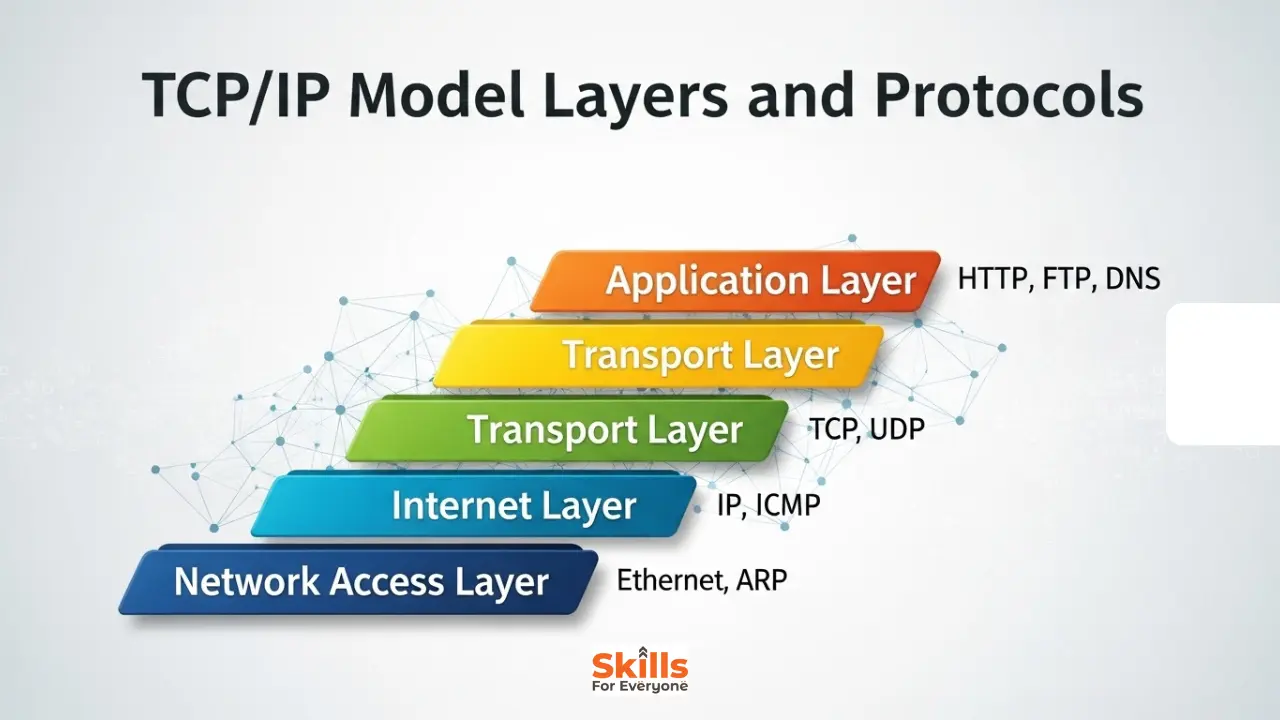
The TCP/IP model is a four-layered framework that describes how data is transmitted across networks. Unlike the seven-layered OSI model, the TCP/IP model combines layers to create a practical, streamlined approach that dominates real-world networking.
Why it matters in 2026: With hybrid cloud environments, IoT expansion, and increased remote work, understanding how data moves through these layers helps you troubleshoot issues faster, secure networks more effectively, and design resilient infrastructure.
The Four Layers of the TCP/IP Model
Layer 1: Application Layer (Layer 4)
The Application Layer is where users interact with network services. It handles end-user applications and services that communicate across the internet.
Key protocols in this layer:
HTTP/HTTPS – Foundation of web browsing; HTTPS dominates due to encryption requirements
SMTP/POP3/IMAP – Email transmission and retrieval protocols
DNS – Converts domain names into IP addresses; critical for internet navigation
FTP/SFTP – File transfer protocols; SFTP preferred for secure transfers
SSH – Secure remote access and command execution
TLS/SSL – Encryption protocols protecting sensitive data transmission
2026 relevance: As cyber attacks target application-level vulnerabilities, professionals must understand how these protocols work. Zero-trust security models demand granular control at the application layer.
Layer 2: Transport Layer (Layer 3)
This layer manages end-to-end communication and ensures reliable or fast data delivery. Two primary protocols dominate this layer.
Critical transport protocols:
TCP (Transmission Control Protocol) – Connection-oriented, reliable delivery; used for HTTP, HTTPS, email, and SSH. Ensures every packet arrives correctly.
UDP (User Datagram Protocol) – Connectionless, fast delivery; used for video streaming, online gaming, and DNS queries. Prioritizes speed over reliability.
Choosing between TCP and UDP:
Feature | TCP | UDP |
Connection Type | Connection-oriented | Connectionless |
Reliability | Guaranteed delivery | No guarantee |
Speed | Slower but reliable | Faster |
Use Cases | Web, email, file transfer | Video, VoIP, gaming |
2026 relevance: Real-time applications and 5G technology demand understanding when to use UDP. Network engineers must optimize transport layer performance for low-latency requirements in AI and IoT applications.
Layer 3: Internet Layer (Layer 2)
The Internet Layer handles logical addressing and routing, determining how data packets navigate across networks.
Primary protocols:
IP (Internet Protocol) – Defines how packets are formatted and addressed. IPv4 still dominates, but IPv6 adoption accelerates for expanded address space.
ICMP (Internet Control Message Protocol) – Diagnostic tool for network troubleshooting; powers the "ping" utility.
IGMP (Internet Group Management Protocol) – Manages multicast group memberships.
ARP (Address Resolution Protocol) – Maps IP addresses to MAC addresses on local networks.
2026 perspective: IPv6 transition continues as organizations exhaust IPv4 addresses. Understanding both protocols is essential. Additionally, DDoS attacks often exploit ICMP, making protocol-level security critical.
Layer 4: Link Layer (Layer 1)
The Link Layer handles physical transmission, managing how data frames travel across network hardware and cables.
Essential protocols and technologies:
Ethernet – Standard wired network technology; remains the backbone of data centers
WiFi (802.11) – Wireless connectivity; 802.11be (WiFi 7) emerging in 2026
PPP (Point-to-Point Protocol) – Legacy dial-up and broadband connections
MAC (Media Access Control) – Physical device addressing on local networks
Hardware involved:
Network interface cards (NICs)
Switches and routers
Cables (twisted pair, fiber optic)
2026 considerations: As edge computing expands, Link Layer optimization becomes critical. 5G integration and WiFi 7 adoption require understanding physical layer capabilities and limitations.
How These Layers Work Together: A Practical Example
When you browse a website, here's what happens across TCP/IP layers:
Application Layer – Your browser sends an HTTPS request
Transport Layer – TCP establishes a connection and ensures reliable delivery
Internet Layer – IP routes your request through multiple networks using routers
Link Layer – Your network interface card transmits data via Ethernet or WiFi
Each layer adds its own header information (called encapsulation), creating a complete packet that travels to its destination, where the process reverses.
Why Understanding TCP/IP Matters in 2026
Security implications: Hackers exploit protocol vulnerabilities at every layer. Understanding how TCP/IP works helps you recognize and prevent attacks.
Cloud migration: Cloud architects must understand TCP/IP to design efficient, scalable infrastructures across hybrid environments.
IoT and edge computing: Billions of IoT devices require optimized TCP/IP implementations. Choosing between TCP and UDP impacts performance in connected devices.
Network troubleshooting: When networks fail, knowledge of TCP/IP layers enables faster diagnosis and resolution.
Actionable Takeaways
✓ Master the fundamentals: Understand how the four layers interact and encapsulate data.
✓ Know your protocols: TCP, UDP, HTTP, HTTPS, DNS, and IP are non-negotiable knowledge.
✓ Practice with tools: Use Wireshark, tcpdump, and ping to observe TCP/IP in action.
✓ Stay security-conscious: Apply protocol-level security at each layer.
✓ Plan for IPv6: Begin transitioning to IPv6 if you haven't already.
✓ Optimize for your use case: Choose appropriate protocols based on reliability versus speed requirements.
The TCP/IP model isn't just theoretical networking knowledge—it's the practical foundation of modern digital communication. Whether you're securing networks against evolving threats, designing cloud infrastructure, or troubleshooting connectivity issues, understanding these four layers and their protocols is essential.
As we move deeper into 2026, organizations relying on complex cloud environments, IoT ecosystems, and real-time applications need professionals who can think across all TCP/IP layers. Invest time in mastering these concepts, practice with network analysis tools, and stay informed about protocol evolution. Your network's performance, security, and scalability depend on it.