Networking
Begineer Friendly
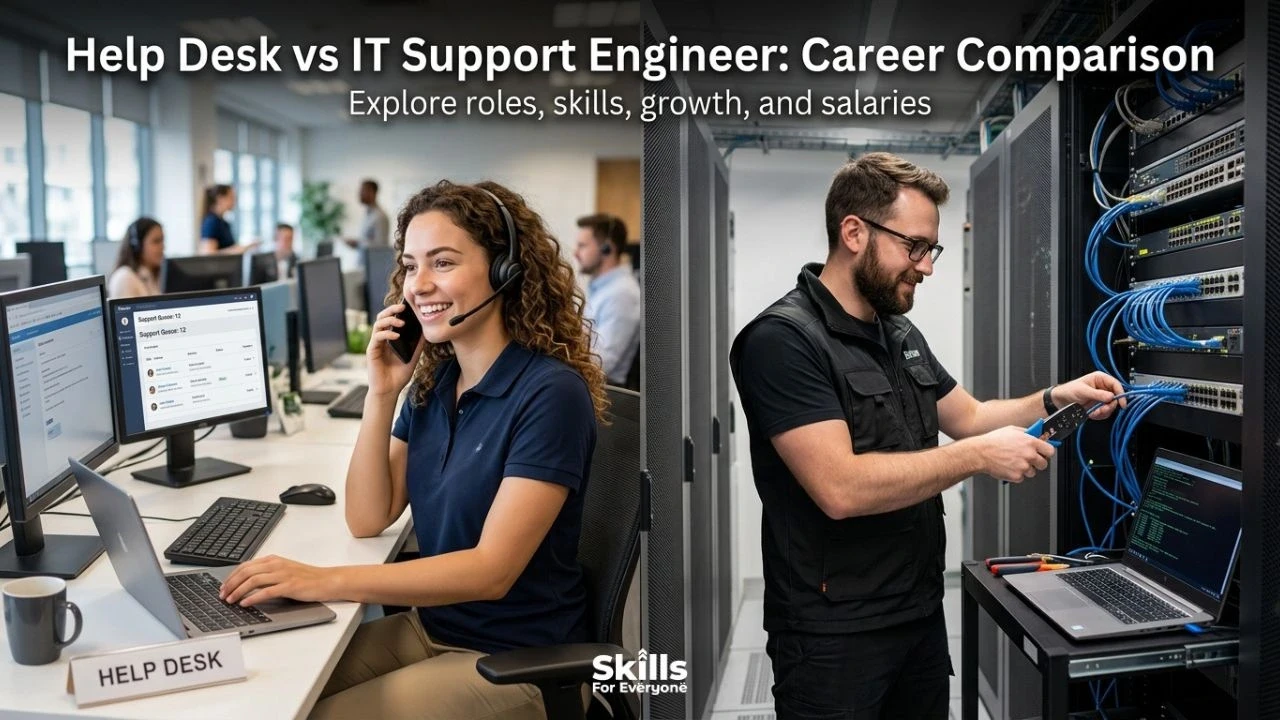
If you're thinking about breaking into IT support roles, you've probably noticed these two positions get thrown around interchangeably—but they're actually quite different animals. Whether you're just starting your tech career or considering a transition, understanding the distinctions between a help desk technician and an IT support engineer can save you years of wandering down the wrong path. Let's break it down honestly.
Understanding the Help Desk Role
What Help Desk Technicians Actually Do
Help desk technicians are typically the first line of defense for end-user support. When someone's computer won't turn on or they can't remember their password, the help desk is who gets the call or ticket.
Here's what a typical day looks like:
Troubleshooting user issues – Software glitches, connectivity problems, printer disasters, you name it
Password resets and account management – More common than you'd think
Hardware diagnostics – Identifying whether a problem is software or hardware-related
Creating documentation – Recording issues and solutions for future reference
Escalating complex problems – Knowing when to pass things up the chain
The role is fundamentally reactive. Someone has a problem, and you solve it—usually on a call or via remote access.
Help Desk: Skills You'll Need
Technical skills:
Operating systems (Windows, macOS, Linux basics)
Basic networking concepts
Remote support software proficiency
Ticketing systems management
Hardware troubleshooting
Soft skills (honestly, these matter more):
Patience – and then some more patience
Clear communication – explaining technical stuff to non-technical people
Problem-solving ability
Time management
Customer service mindset
Most help desk positions don't require heavy coding knowledge. If you can Google effectively and think logically, you're already ahead of many candidates.
The IT Support Engineer Path
What IT Support Engineers Do Differently
IT support engineers sit one or two levels above help desk technicians. They handle more complex, specialized issues and often work on infrastructure, networks, and systems rather than individual user problems.
Their typical responsibilities include:
Network management and troubleshooting – Managing switches, routers, and connectivity
Server and system administration – Maintaining infrastructure that entire organizations depend on
Security implementation – Setting up and managing security protocols
Proactive maintenance – Preventing problems before they happen
Supporting other IT staff – Often helping help desk technicians with escalations
System upgrades and deployments – Rolling out new software or hardware across networks
The work is more proactive and strategic. You're not just fixing user issues; you're building and maintaining the systems that enable those users to work.
IT Support Engineer: Required Expertise
Technical skills:
Network administration and protocols (TCP/IP, DNS, DHCP)
Server operating systems and management
Active Directory and user management
Virtualization platforms (VMware, Hyper-V)
Basic scripting or automation (PowerShell, Bash)
Cloud services (AWS, Azure, or Google Cloud)
Security fundamentals
Database basics
Soft skills:
Independent problem-solving
Project management capability
Communication skills (working with both technical and non-technical stakeholders)
Attention to detail
Continuous learning mindset
Head-to-Head Comparison
Factor | Help Desk Technician | IT Support Engineer |
Entry Level | Yes, ideal for beginners | Usually requires 2-3+ years experience |
Primary Focus | End-user support | Infrastructure and systems |
Technical Depth | Broad, shallow knowledge | Deeper, specialized knowledge |
Salary Range | $30,000–$45,000 annually* | $50,000–$75,000+ annually* |
Certification Path | CompTIA A+, Microsoft fundamentals | CompTIA Network+, Security+, Azure/AWS certs |
Work Environment | Fast-paced, high-volume tickets | Project-driven, strategic focus |
Phone Time | Significant | Minimal |
Remote Options | Common | Often available |
Career Growth | Strong pathway to senior roles | Natural progression to specialist/architect roles |
Salaries vary significantly based on location, company size, and specific industry. Tech hubs command 20-40% premiums over national averages.
Certifications That Actually Move Your Career Forward
For Help Desk Professionals
CompTIA A+ – The gold standard entry certification. Covers both hardware and software troubleshooting comprehensively. Most employers expect this or equivalent knowledge.
Microsoft Certified: Windows Server Fundamentals – Adds credibility if you're supporting Microsoft environments.
Cisco CCENT (Certified Entry Networking Technician) – Optional but valuable for networking-focused roles.
For IT Support Engineers
CompTIA Network+ – Essential for anyone managing networks. Covers routing, switching, and network troubleshooting deeply.
CompTIA Security+ – Increasingly mandatory in corporate environments. Demonstrates security fundamentals employers want.
Microsoft Azure Administrator or AWS Solutions Architect Associate – Cloud certifications are becoming as important as traditional infrastructure certs.
Cisco CCNA – The professional-level networking certification. Significant jump in credibility and earning potential.
Exam Preparation Tips
The most successful candidates don't just memorize answers:
Use hands-on labs – Don't just watch videos; build actual test environments
Practice exams matter – Take them under real test conditions multiple times
Join study groups – Teaching others solidifies your understanding
Space your studying – Cramming doesn't work for IT certifications
Focus on the why, not the what – Understanding concepts beats memorizing facts every time
Which Path Is Right for You?
Start with Help Desk If You:
Are completely new to IT support
Want to earn while you learn
Prefer working directly with people
Like variety in daily tasks
Don't have prior IT experience or certifications
Help desk truly is the most accessible entry point. You'll get real experience, build skills, and figure out which IT specialization interests you most.
Go for IT Support Engineer If You:
Have 2+ years of IT support experience (either help desk or self-study)
Enjoy working with systems and infrastructure
Prefer solving complex problems over handling high-volume tickets
Are willing to invest in certifications
Want higher earning potential
IT support engineering offers better long-term earning and advancement opportunities, but requires more technical foundation and commitment to continued learning.
Your Career Growth Timeline
Help Desk → IT Support Engineer typically takes 2-4 years:
Start as help desk technician (0-1 year to establish fundamentals)
Get CompTIA A+ certified (6-12 months part-time study)
Pursue specialization interests (networking, security, servers, cloud)
Earn relevant specialist certifications
Apply for IT support engineer or senior technician roles
The key is being intentional. Don't stay in the help desk longer than necessary if you want to advance. Use it as a learning platform.
Final Thoughts
The choice between help desk and IT support engineering isn't really about which is "better"—it's about where you are in your career and where you want to go. Help desk is the logical starting point for most people. It teaches you how IT actually works, separates those who love troubleshooting from those who don't, and provides the foundation every IT professional needs.
If the help desk feels like the right entry point, go for it. Get certified, learn relentlessly, and start planning your next move within your first year. If you already have IT experience or the foundation to jump straight to engineer roles, pursue that path with strategic certifications backing you up.
Either way, the IT support field is growing, compensation is solid, and remote opportunities are abundant. The real move is picking your path and committing to continuous learning. Your future self will thank you for it.
Frequently Asked Questions
Q: Can I skip help desk and go straight to IT support engineer?
A: Unlikely. Most employers want to see at least 2-3 years of IT support experience. Some managed service providers (MSPs) might hire help desk experience + strong certifications, but it's rare. Use a help desk to build genuine troubleshooting skills.
Q: Which certification should I get first?
A: CompTIA A+ if you're in the help desk, Network+ if you're targeting IT engineer roles. A+ teaches fundamentals you'll use constantly. Network+ opens doors to network-focused positions with better pay.
Q: Is help desk experience required for IT support engineering?
A: Not technically required, but it's incredibly valuable. If you build a homelab, get certified, and demonstrate infrastructure knowledge without help desk experience, some employers will consider you. It's just harder.
Q: What's the realistic salary progression?
A: Help desk → $35-40K starting → IT support engineer → $55-65K → Senior engineer/specialist → $75K+. Location and industry matter enormously. New York or California pays 30-50% more than rural areas.
Q: How long should I stay in the help desk before moving up?
A: Minimum 1-2 years to gain solid experience, but ideally 2-3 years. You'll move faster if you're also getting certified and learning new skills on your own time. Managers notice people who invest in their development.