Networking
Begineer Friendly
Network teams and security operations centers are drowning in alerts, misconfigurations, and threats that move faster than any human team can track manually. That is exactly why the search for the best AI tools for network automation, cloud security, and threat detection has become one of the top priorities for IT leaders in 2026. Cloud environments are more distributed, attack surfaces are wider, and skilled security talent remains scarce. Artificial intelligence has stepped in to close that gap, correlating signals across networks, endpoints, and cloud workloads in seconds rather than hours. In this guide, you will get a practical breakdown of the leading platforms, what they actually do well, and how to pick the right one for your environment.
What Makes AI Essential for Modern Network and Security Operations
Traditional rule-based monitoring cannot keep pace with dynamic cloud infrastructure, encrypted traffic, and polymorphic malware. AI models trained on massive telemetry datasets can spot subtle anomalies, such as a service account suddenly authenticating from an unusual region, long before a human analyst would notice the pattern. This shift from reactive to predictive operations is the core reason AI network automation tools and AI cybersecurity tools have moved from experimental pilots to production-critical infrastructure.
Key Benefits of AI in Network Automation and Cloud Security
Organizations adopting AI-powered security platforms typically see several concrete advantages.
Faster mean time to detect and respond, since machine learning threat detection models flag anomalies in near real time instead of waiting for scheduled log reviews.
Reduced alert fatigue, because AI security analytics can cluster related alerts into a single incident instead of flooding analysts with duplicate notifications.
Improved network uptime, as AI for network management can predict hardware failures or congestion before they cause outages.
Lower operational costs, since automation handles repetitive triage work that would otherwise require additional headcount.
Stronger cloud security automation, allowing teams to enforce consistent policies across multi-cloud environments without manual intervention.
Top AI Tools for Network Automation, Cloud Security, and Threat Detection
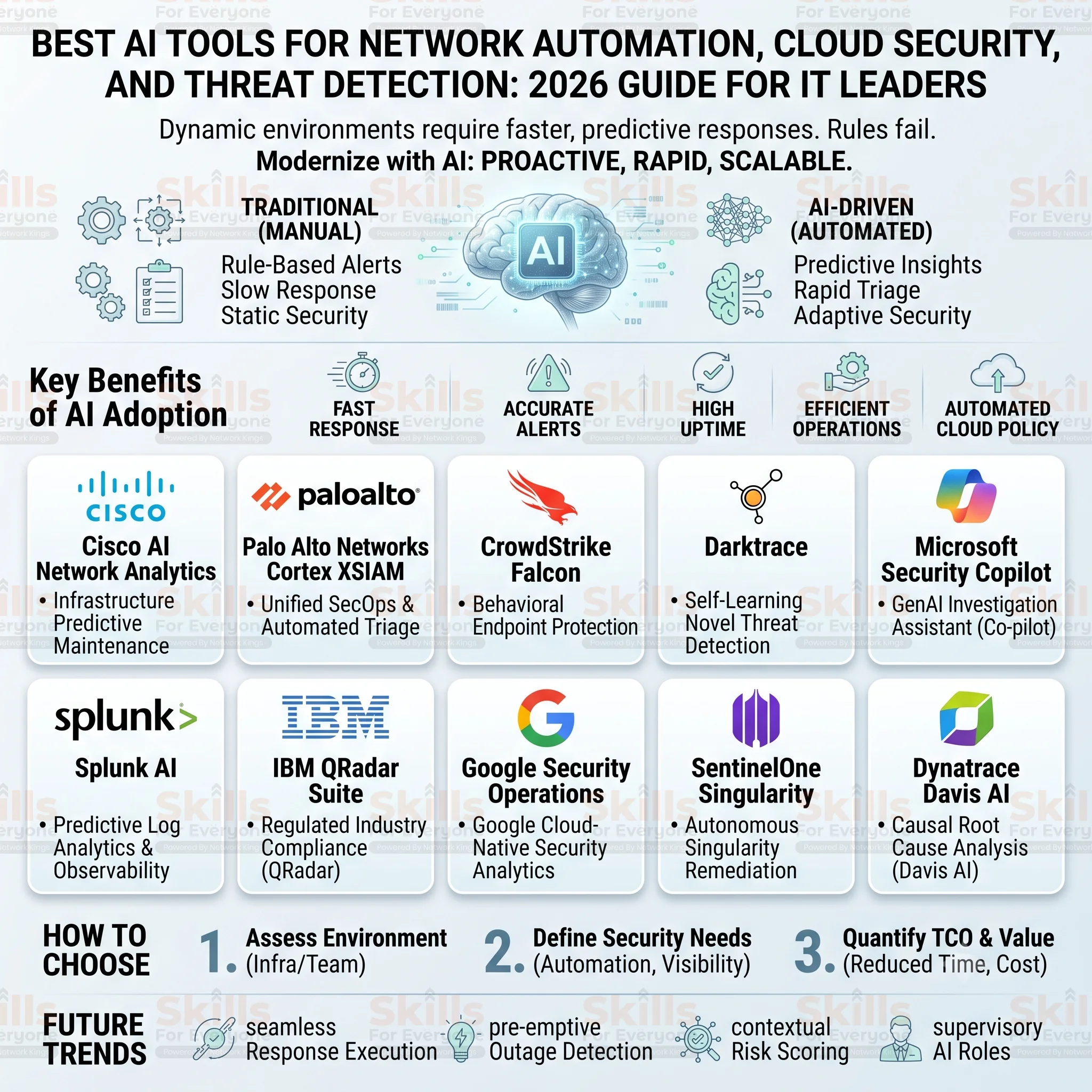
Cisco AI Network Analytics
Overview. Built into Cisco DNA Center and Catalyst Center, this tool applies machine learning to network telemetry for proactive issue resolution.
Key Features. Anomaly detection, predictive insights, automated root cause analysis, and baseline comparisons across similar networks.
Best Use Cases. Large enterprise campus and branch networks needing predictive maintenance.
Pros. Deep integration with Cisco hardware, strong peer benchmarking data.
Limitations. Most value is realized within Cisco-heavy environments.
Ideal Users. Network engineers managing Cisco infrastructure at scale.
Palo Alto Networks Cortex XSIAM
Overview. An AI-driven security operations platform that unifies SIEM, SOAR, and endpoint protection into one data lake.
Key Features. Automated incident scoring, threat intelligence correlation, and playbook-driven remediation.
Best Use Cases. Enterprises seeking to consolidate fragmented security tools.
Pros. Reduces tool sprawl and speeds investigation timelines.
Limitations. Migration from legacy SIEMs can require significant planning.
Ideal Users. SOC teams and DevSecOps engineers at mid-to-large enterprises.
CrowdStrike Falcon
Overview. A cloud-native endpoint and workload protection platform powered by the Charlotte AI assistant.
Key Features. Behavioral detection, threat hunting, natural language incident summarization.
Best Use Cases. Endpoint and cloud workload protection across hybrid environments.
Pros. Lightweight agent, strong threat intelligence pedigree.
Limitations. Advanced modules add cost as environments scale.
Ideal Users. Security analysts needing fast endpoint visibility.
Darktrace
Overview. Uses unsupervised machine learning to build a self-learning model of normal behavior across the network.
Key Features. Autonomous response, self-learning baselines, coverage across email, cloud, and OT environments.
Best Use Cases. Detecting novel or insider threats without relying on known signatures.
Pros. Effective against zero-day and unknown attack patterns.
Limitations. Tuning is required to minimize false positives early on.
Ideal Users. Security teams wanting behavior-based rather than signature-based detection.
Microsoft Security Copilot
Overview. A generative AI assistant integrated with Microsoft Defender, Sentinel, and Entra to accelerate investigation and response.
Key Features. Natural language querying, automated incident summaries, guided remediation steps.
Best Use Cases. Organizations already embedded in the Microsoft security ecosystem.
Pros. Speeds up analyst workflows with plain language prompts.
Limitations. Best value requires Microsoft security stack adoption.
Ideal Users. IT administrators and analysts inside Microsoft-centric environments.
Splunk AI
Overview. Adds machine learning and generative AI capabilities to the Splunk platform for security and observability data.
Key Features. Predictive analytics, natural language search, automated anomaly detection.
Best Use Cases. Organizations with large, complex log environments.
Pros. Highly flexible across security and IT operations use cases.
Limitations. Licensing and data ingestion costs can grow quickly.
Ideal Users. Enterprises with mature data-driven security operations.
IBM QRadar Suite
Overview. A unified SIEM and SOAR platform infused with IBM watsonx AI for faster case management.
Key Features. Federated search, automated case creation, risk-based alert prioritization.
Best Use Cases. Regulated industries needing thorough audit trails.
Pros. Strong compliance and reporting capabilities.
Limitations. Interface complexity can require dedicated training.
Ideal Users. Enterprise decision makers in finance, healthcare, and government.
Google Security Operations
Overview. A cloud-native security analytics platform built on Google's data infrastructure with integrated threat intelligence.
Key Features. Petabyte-scale log retention, automated detection rules, Gemini-powered investigation assistance.
Best Use Cases. Organizations running heavily on Google Cloud.
Pros. Fast search across massive datasets at predictable cost.
Limitations. Best suited to teams already invested in Google Cloud tooling.
Ideal Users. Cloud engineers and SOC teams operating in GCP environments.
SentinelOne Singularity
Overview. An autonomous endpoint, cloud, and identity protection platform built around its Purple AI analyst.
Key Features. Autonomous remediation, real-time rollback, natural language threat hunting.
Best Use Cases. Organizations wanting automated remediation without heavy analyst involvement.
Pros. Strong automated response reduces manual workload.
Limitations. Full value depends on adopting the broader Singularity suite.
Ideal Users. Lean security teams needing autonomous protection.
Dynatrace Davis AI
Overview. A causal and predictive AI engine embedded in the Dynatrace observability platform.
Key Features. Automatic root cause analysis, anomaly detection, and performance forecasting.
Best Use Cases. Cloud and application performance monitoring tied to security context.
Pros. Precise causal analysis rather than correlation guesswork.
Limitations. Primary strength is observability rather than full-spectrum threat detection.
Ideal Users. Cloud engineers focused on application reliability and security overlap.
Comparison Table
Tool | Primary Function | AI Capabilities | Best For | Deployment Type |
Cisco AI Network Analytics | Network monitoring | Predictive analytics, anomaly detection | Enterprise campus networks | On-premises and hybrid |
Palo Alto Cortex XSIAM | SecOps platform | Automated triage, correlation | Enterprise SOC consolidation | Cloud |
CrowdStrike Falcon | Endpoint protection | Behavioral AI, natural language summaries | Endpoint and workload security | Cloud |
Darktrace | Threat detection | Self-learning behavioral models | Novel and insider threats | Cloud and on-premises |
Microsoft Security Copilot | Security assistant | Generative AI investigation | Microsoft-centric organizations | Cloud |
Splunk AI | Data analytics | Predictive and generative analytics | Large log environments | Cloud and on-premises |
IBM QRadar Suite | SIEM and SOAR | Risk-based prioritization | Regulated industries | Cloud and on-premises |
Google Security Operations | Security analytics | Large-scale detection, Gemini assistance | GCP-centric teams | Cloud |
SentinelOne Singularity | Endpoint and identity protection | Autonomous remediation | Lean security teams | Cloud |
Dynatrace Davis AI | Observability | Causal root cause analysis | Cloud performance and reliability | Cloud |
How to Choose the Right AI Security and Automation Tool
Start with your existing infrastructure. A Cisco-heavy network will benefit more from Cisco AI Network Analytics, while a Microsoft-centric organization gets more value from Security Copilot. Next, consider your team's size and skill level. Smaller teams often benefit most from platforms with strong automated remediation, such as SentinelOne, since they reduce the manual workload. Larger enterprises with dedicated SOC staff may prefer highly configurable platforms like Splunk or QRadar. Finally, weigh total cost of ownership against measurable outcomes such as reduced detection time, fewer false positives, and improved uptime.
Future of AI in Network Automation and Threat Detection
Expect tighter integration between generative AI assistants and automated response actions, meaning tools will not just recommend a fix but execute it under governed guardrails. Predictive network automation will increasingly prevent outages before they happen rather than simply flagging them. Threat intelligence will become more contextual, correlating identity, cloud, and network signals into a single risk score. Security operations automation will continue shifting analysts from manual investigation toward supervising AI-driven workflows.
Conclusion
The best AI tools for network automation, cloud security, and threat detection are not one-size-fits-all solutions. The right choice depends on your existing infrastructure, team size, and risk tolerance. Organizations should start by identifying their biggest operational bottleneck, whether that is alert fatigue, slow incident response, or network downtime, and then match that gap to a platform built to solve it. As AI capabilities mature, the organizations that adopt these tools thoughtfully today will be far better positioned to handle the threats and complexity of tomorrow.
FAQs
What is the best AI tool for network automation?
There is no single best tool for every organization. Cisco AI Network Analytics is strong for Cisco-based networks, while Dynatrace Davis AI suits teams prioritizing cloud performance and reliability alongside security.
How does AI improve cloud security?
AI improves cloud security by continuously analyzing behavior patterns across workloads and identities, flagging deviations that indicate misconfigurations, compromised credentials, or emerging threats faster than manual review.
Can AI detect cyber threats in real time?
Yes. Platforms like Darktrace, CrowdStrike Falcon, and SentinelOne Singularity analyze telemetry continuously and can flag or automatically contain suspicious activity within seconds of detection.
Which AI cybersecurity platform is best for enterprises?
Enterprises with complex, multi-cloud environments often benefit from Palo Alto Cortex XSIAM or IBM QRadar Suite due to their scalability and compliance features.
Is AI replacing security analysts?
No. AI handles repetitive triage and correlation work, but human analysts remain essential for judgment calls, complex investigations, and strategic decision making.