Networking
Begineer Friendly

Enterprise networks have grown far beyond what humans can manage manually. Between hybrid cloud environments, thousands of endpoints, and an ever-expanding attack surface, network teams are drowning in alerts, tickets, and manual configuration changes. This is exactly why AI for network automation has moved from an experimental concept to a business necessity.
Traditional network management relies on static rules, manual troubleshooting, and reactive fixes that simply cannot keep pace with modern infrastructure demands. AI changes that equation entirely. Instead of waiting for something to break, AI-driven systems predict issues, adjust configurations in real time, and resolve problems before end users ever notice. As enterprises push deeper into digital transformation, understanding how AI for network automation works, and why it matters, has become essential reading for every IT leader.
What Is AI for Network Automation
AI for network automation refers to the use of machine learning, analytics, and intelligent decision-making to manage, monitor, and optimize network infrastructure with minimal human intervention. Rather than following fixed scripts, AI systems learn from historical network telemetry and adapt their behavior based on real conditions.
This goes beyond basic scripting or traditional automation tools. AI-powered platforms can interpret patterns across thousands of data points, flag anomalies that humans would likely miss, and take corrective action automatically. The result is a network that behaves less like a collection of static devices and more like a living system that continuously tunes itself.
Why Traditional Network Management Is No Longer Enough
Manual network operations were built for a simpler era of on-premises data centers and predictable traffic patterns. Today's enterprise networks span multiple clouds, remote offices, IoT devices, and SaaS applications, all generating constant streams of telemetry.
Legacy tools rely heavily on static thresholds and manual correlation, which means engineers often spend more time chasing false alarms than solving real problems. Configuration changes made by hand introduce human error, and troubleshooting complex, multi-vendor environments can take hours or even days. Enterprises simply cannot scale headcount fast enough to match the complexity of modern infrastructure, which is why intelligent automation has become the logical next step.
How AI Improves Enterprise Networking
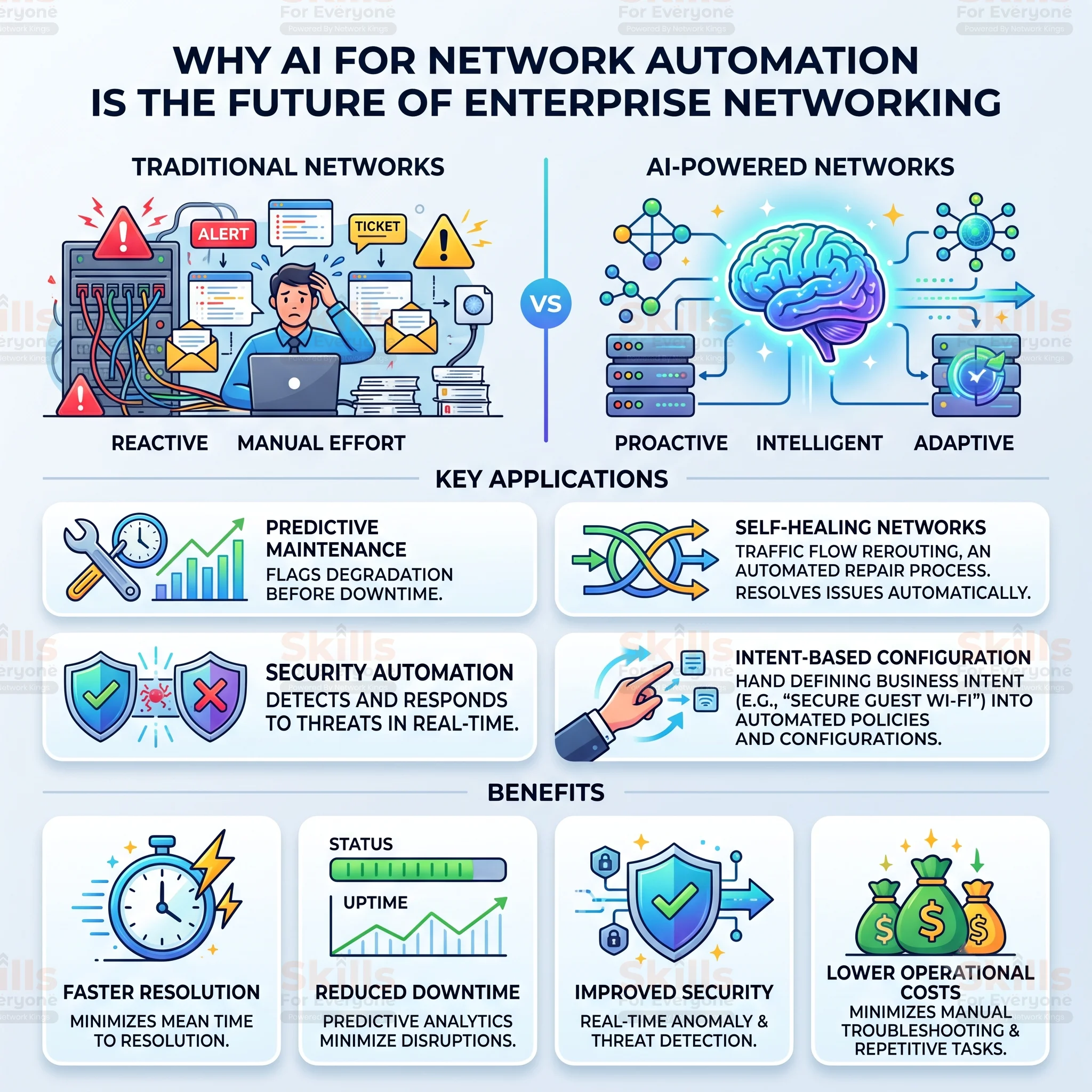
AI strengthens nearly every layer of network operations. Intelligent monitoring continuously analyzes traffic and device health, catching subtle deviations long before they escalate into outages. Predictive maintenance uses historical failure data to flag hardware or link degradation before it causes downtime.
Automated troubleshooting correlates symptoms across the network stack to pinpoint root causes in seconds rather than hours. Self-healing networks take this further, automatically rerouting traffic or restarting failed services without waiting for a human to intervene. AI also supports smarter capacity planning by forecasting bandwidth needs based on usage trends, while continuously optimizing performance through dynamic traffic engineering.
Security automation is another major win. AI models detect unusual behavior, such as lateral movement or data exfiltration attempts, far faster than manual log review. On the configuration side, AI validates changes against intent before deployment, dramatically reducing outages caused by misconfigurations.
Core Technologies Behind AI Network Automation
Several technologies work together to make AI-driven networking possible. Machine learning models analyze telemetry to detect patterns, forecast congestion, and predict failures before they affect users. AIOps platforms consolidate data from multiple monitoring tools, reducing alert fatigue and accelerating root cause analysis.
Intent-Based Networking (IBN) enables administrators to define business intent instead of configuring individual devices manually, while Software Defined Networking (SDN) provides the programmable infrastructure that allows automated policy enforcement.
Leading enterprise networking platforms have already incorporated these capabilities. Examples include Cisco Catalyst Center for intent-based automation, Cisco ThousandEyes for end-to-end network visibility, Juniper Mist AI for AI-driven campus networking, Arista CloudVision for network orchestration, HPE Aruba Central for AI-powered wireless management, VMware NSX for software-defined networking, SolarWinds Observability for infrastructure monitoring, and Fortinet AIOps for intelligent security operations. Together, these platforms demonstrate how AI is moving from theory into everyday enterprise networking operations.
Benefits of AI for Enterprise Networks
Faster incident detection and resolution through continuous, intelligent monitoring
Reduced downtime thanks to predictive maintenance and self-healing capabilities
Lower operational costs by minimizing manual troubleshooting and repetitive tasks
Improved security posture through real-time anomaly and threat detection
Greater consistency in configuration management across large, multi-vendor environments
Better capacity planning driven by accurate, data-backed forecasting
Increased agility to support cloud migration and hybrid infrastructure growth
Real-World Enterprise Use Cases
Banks use AI-driven network automation to maintain the uptime required for real-time transactions while detecting fraud-related network anomalies. Healthcare organizations rely on it to keep clinical systems and connected medical devices online, where downtime can directly affect patient care.
Manufacturers apply AI to manage industrial IoT networks across factory floors, ensuring production lines stay connected. Telecom providers use it to manage massive, distributed infrastructure and deliver reliable 5G services. Cloud providers depend on AI automation to operate hyperscale data centers efficiently, while retailers use it to keep point-of-sale systems and e-commerce platforms running during peak demand. Universities and school districts increasingly adopt AI networking tools to secure and manage sprawling campus networks with lean IT teams.
AI vs Traditional Network Management
Feature | Traditional Network Management | AI-Powered Network Management |
Monitoring | Manual threshold-based monitoring | Continuous AI-driven analytics |
Configuration | Manual device configuration | Automated intent-based configuration |
Troubleshooting | Reactive and time-consuming | Predictive root cause analysis |
Incident Response | Human intervention required | Automated remediation and self-healing |
Scalability | Limited by available staff | Scales efficiently across hybrid environments |
Security | Rule-based detection | AI-powered anomaly detection and behavioral analytics |
Capacity Planning | Historical estimates | Predictive forecasting using machine learning |
Operational Cost | Higher due to manual processes | Lower through intelligent automation |
Human Effort | Focus on repetitive operational tasks | Focus on architecture, optimization, and innovation |
Challenges and Best Practices
AI network automation is powerful, but it is not a plug-and-play solution. Data quality matters enormously, since poor or incomplete telemetry leads to inaccurate predictions. Many organizations also face a skills gap, requiring network teams to build familiarity with data science concepts alongside traditional networking expertise.
Security and privacy need careful attention, particularly when AI systems have access to sensitive traffic data. Integration with legacy systems can be complex, and the upfront cost of AI platforms may seem steep before ROI becomes clear. Strong governance frameworks are essential too, ensuring AI-driven changes are auditable and reversible. Enterprises that succeed typically start with a narrow use case, validate results, and expand automation gradually rather than attempting a full overhaul at once.
Future Trends
Looking ahead, autonomous networks that require minimal human oversight are becoming a realistic goal rather than a distant vision. AI agents will increasingly handle routine operational tasks independently, while generative AI assists engineers with troubleshooting, documentation, and configuration generation through natural language.
Digital twins of network infrastructure will allow teams to simulate changes safely before deployment. Predictive networking will shift further from reactive alerts to proactive prevention, and zero-touch operations will reduce manual intervention across provisioning and maintenance. As enterprises expand across multiple cloud providers, multi-cloud automation will become a core requirement rather than an optional feature.
Key Benefits
Reduces mean time to resolution for network incidents
Minimizes unplanned downtime and its associated business costs
Frees network engineers to focus on strategic initiatives instead of firefighting
Strengthens security through faster anomaly detection
Supports scalable growth without proportional increases in headcount
Conclusion
AI for network automation is no longer a futuristic concept reserved for tech giants. It is becoming a practical necessity for any enterprise managing complex, hybrid infrastructure. From predictive maintenance and self-healing networks to intelligent security automation, AI is redefining what efficient network operations look like.
Enterprises that embrace AI-driven automation today will be better positioned to handle growing complexity, reduce downtime, and free their teams for higher-value work. If your organization is still relying on manual, reactive network management, now is the time to explore how AI-powered network automation can transform your infrastructure for the years ahead.
FAQs
What is AI for network automation?
It is the use of machine learning and intelligent analytics to monitor, manage, and optimize enterprise networks with reduced manual intervention.
How does AI improve enterprise networking?
AI improves networking through predictive maintenance, automated troubleshooting, real-time anomaly detection, and self-healing capabilities that reduce downtime.
Is AI replacing network engineers?
No. AI handles repetitive and data-heavy tasks, allowing engineers to focus on strategy, architecture, and complex problem-solving rather than routine maintenance.
What are the best AI network automation tools?
Leading enterprise platforms combine AIOps, Intent-Based Networking, and SDN capabilities, often integrated with major vendors such as Cisco, Juniper, and Arista.
What is the future of AI in networking?
The future includes autonomous networks, AI agents, generative AI assistance, and predictive systems that prevent issues before they affect users.
What is the difference between SDN and AI networking?
SDN provides the programmable infrastructure that makes automation possible, while AI adds the intelligence layer that analyzes data and makes autonomous decisions.
Is AI network automation secure?
When implemented with proper governance, AI actually strengthens security by detecting threats faster than manual monitoring, though data privacy and access controls must be carefully managed.