Networking
Begineer Friendly
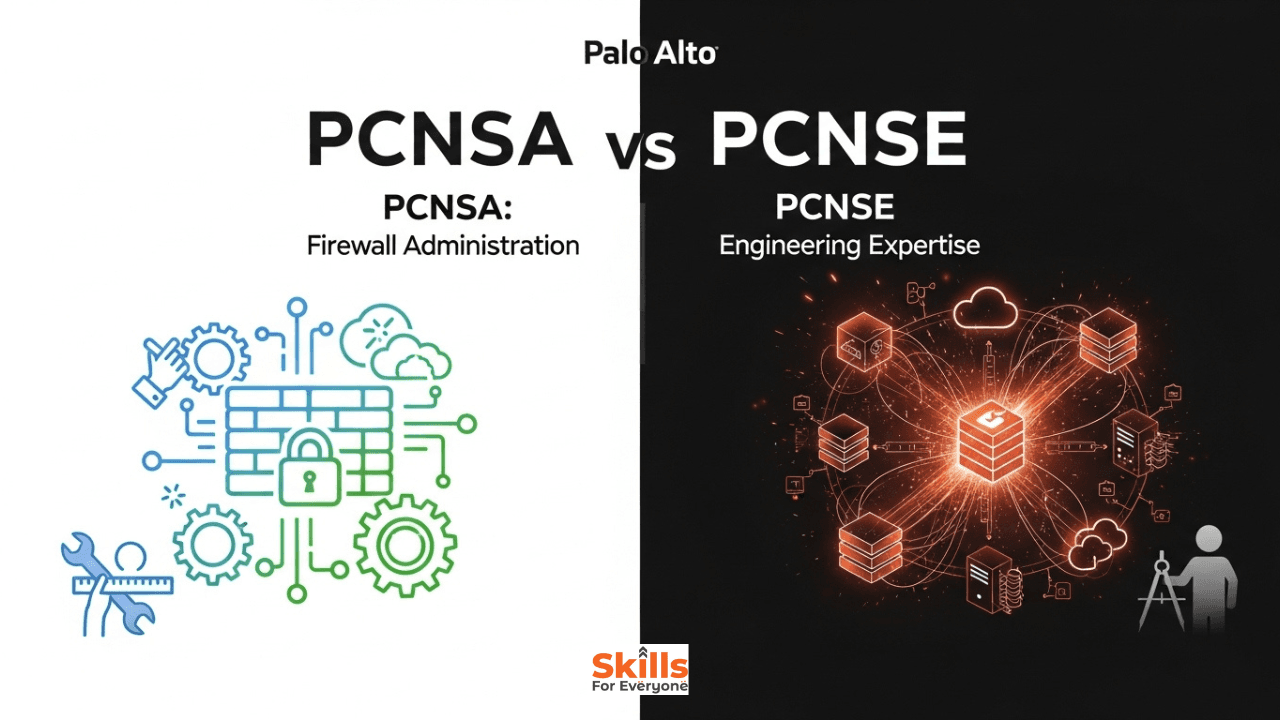
When professionals enter the Palo Alto Networks certification ecosystem, they quickly encounter a fork in the road: the PCNSA and the PCNSE. On the surface, both credentials validate skills in Palo Alto Networks technology. But beneath that surface lies a fundamental difference — one that separates those who run firewalls from those who build and fix them.
Understanding the distinction between firewall administration and network security engineering is not just an academic exercise. It directly shapes which certification you should pursue, how long it will take to prepare, and what kind of career opportunities will open up as a result.
This article draws a clear line between the two credentials, examines the depth of knowledge each demands, and gives you a practical roadmap for deciding which path aligns with your professional goals.
The Core Distinction: Administration vs Engineering
Before diving into exam specifics, it's worth understanding what separates these two disciplines in practice.
Firewall administration is operational work. An administrator configures security policies, manages user access, monitors traffic logs, applies software updates, and responds to alerts. The focus is on keeping systems stable, compliant, and correctly configured within an already-established architecture.
Network security engineering is architectural and diagnostic work. An engineer designs the firewall infrastructure itself — determining how devices interconnect, how traffic flows across complex multi-site environments, how redundancy is achieved, and how performance is tuned under load. When something breaks in an unexpected way, the engineer diagnoses it from first principles.
The PCNSA is built around the administrator's world. The PCNSE is built around the engineer's.
PCNSA Deep Dive: The Firewall Administrator's Credential
The Palo Alto Networks Certified Network Security Administrator (PCNSA) validates your ability to manage and operate Palo Alto Networks next-generation firewalls competently and independently.
What the PCNSA Covers:
PAN-OS fundamentals — understanding the operating system's core architecture
Security policy configuration — building and managing rules that control traffic flow
App-ID and User-ID — leveraging Palo Alto's application awareness and user-based controls
NAT policies — configuring network address translation for various deployment scenarios
Basic threat prevention — enabling antivirus, anti-spyware, and URL filtering profiles
VPN configuration — setting up GlobalProtect and site-to-site IPSec tunnels
Log monitoring and reporting — reading traffic, threat, and system logs effectively
Who It's Designed For:
The PCNSA is the right credential if your daily work involves logging into a firewall management console, pushing policy changes, investigating security alerts, and keeping the environment humming. It's ideal for network administrators, junior security analysts, and IT generalists who manage Palo Alto gear as part of a broader role.
Typical preparation time: 4–8 weeks for candidates with existing networking fundamentals and 6–12 months of hands-on Palo Alto experience.
PCNSE Deep Dive: The Network Security Engineer's Credential
The Palo Alto Networks Certified Network Security Engineer (PCNSE) is the flagship certification in the Palo Alto ecosystem. It goes far beyond operational competency, testing whether you can design, deploy, and troubleshoot complex Palo Alto Networks environments at enterprise scale.
What the PCNSE Covers:
Panorama management — centralizing policy management across dozens or hundreds of firewalls using device groups, templates, and template stacks
High availability (HA) — designing and troubleshooting active/passive and active/active HA pairs
Advanced routing — integrating Palo Alto firewalls into BGP, OSPF, and PBF environments
SSL/TLS decryption — configuring forward-proxy and inbound inspection with certificate management
SD-WAN architecture — deploying software-defined WAN features across distributed branch environments
Advanced troubleshooting — using CLI commands, packet captures, and system diagnostics to resolve complex issues
Security profile optimization — tuning threat prevention, WildFire, and DNS security for performance and efficacy
Who It's Designed For:
The PCNSE is the right credential if your work involves designing security architectures, deploying greenfield environments, integrating firewalls into complex routing topologies, or troubleshooting issues that stump less experienced colleagues. It's essential for senior network security engineers, solutions architects, MSSP engineers, and Palo Alto professional services consultants.
Typical preparation time: 3–6 months for candidates with strong prior experience and PCNSA-level knowledge as a baseline.
Comparing the Exam Experience
Both exams are delivered through Pearson VUE and cost approximately $175 USD. However, the nature of the questions differs significantly.
Attribute | PCNSA | PCNSE |
Question Count | ~75 | ~80 |
Time Limit | 80 minutes | 80 minutes |
Question Depth | Operational and conceptual | Architectural and diagnostic |
Scenario Complexity | Single-device, straightforward | Multi-device, multi-site |
Troubleshooting Weight | Light | Heavy |
CLI Knowledge Required | Basic | Extensive |
PCNSA questions tend to test whether you know what to configure. PCNSE questions tend to test whether you know why something isn't working — often in a multi-constraint scenario where the right answer requires eliminating plausible-but-wrong options.
Practical Preparation Tips for Each Certification
To Pass the PCNSA:
Work through Palo Alto Networks' EDU-110 course (Firewall Essentials) as your foundation
Spend time in a hands-on lab environment — either physical hardware, a VM-Series in a home lab, or Palo Alto's cloud-based training labs
Focus heavily on policy configuration scenarios and understanding App-ID logic
Review the official exam blueprint and ensure you can explain every listed objective
To Pass the PCNSE:
Complete the PCNSA first — skipping it increases failure risk significantly
Study Panorama administration in depth, as it carries heavy exam weight
Practice packet captures and CLI diagnostics on live or simulated environments
Work through HA failover scenarios until the logic is second nature
Review Palo Alto's Technical Documentation portal for configuration guides on advanced features
Use practice exams critically — not to memorize answers, but to identify knowledge gaps
Which Path Should You Choose?
The honest answer depends on two things: your current experience level and your target role.
Choose the PCNSA if:
You manage firewalls but don't design them
You have under 2 years of Palo Alto hands-on experience
You want a credible, achievable near-term certification goal
You're building toward the PCNSE over the next 1–2 years
Choose the PCNSE if:
You're responsible for network security architecture decisions
You regularly work with Panorama across multiple sites
You want to move into consulting, MSSP engineering, or senior security roles
Your organization — or a target employer — explicitly requires it
One important note: The PCNSA and PCNSE are not redundant. Earning the PCNSA first and then the PCNSE gives you structured, progressive mastery — and demonstrates to employers that your growth was methodical and verified at every stage.
Final Thoughts: Administration and Engineering Are Both Essential
Firewall administration and network security engineering are not competing disciplines — they're complementary ones. Every secure enterprise needs skilled administrators who keep day-to-day operations tight, and engineers who ensure the underlying architecture is sound and scalable.
The PCNSA and PCNSE reflect that reality. Together, they represent the full spectrum of Palo Alto Networks expertise — from the policy console to the architecture whiteboard.
Whichever credential you pursue, the investment pays dividends. The SkillsForEveryone, Network KIngs platform continues to dominate enterprise security deployments globally, and certified professionals who can prove their skills remain among the most sought-after in the industry.
Know your current level. Know your target role. Then certify accordingly.